
About
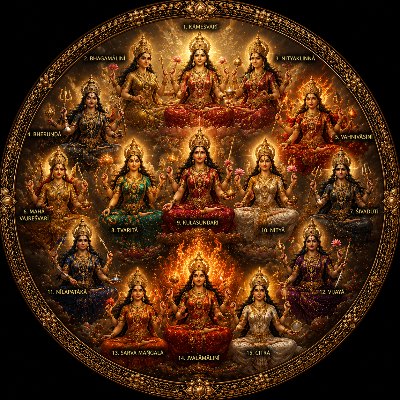
The Fifteen Nitya Devis — Eternal Lunar Goddesses of the Sri Vidya Tradition
Nitya Devis · Nityas · Shodasha Nityas (inclusive of Lalita) · Tithidevatas · Kalas of the Moon · Nityashodashika
The fifteen Nitya Devis are the eternal lunar goddesses of the Sri Vidya tradition within Shaktism, each governing one of the fifteen visible tithis — the lunar days of the waxing fortnight — of the Hindu sacred calendar. They are understood as the fifteen rays or kalas of the waxing moon, emanating from and returning to the supreme consciousness of Lalita Tripura Sundari, who constitutes the invisible sixteenth kala — the unchanging essence behind all lunar phases. Together with Lalita as the sixteenth, the complete group is called the Shodasha Nityas — the sixteen eternals. Each Nitya possesses her own yantra, mantra, vidya, distinct iconography, group of attendant Shaktis, and specific cosmic functions encoded in the Tantric literature. They are the principal deities of the Nityashodashikarnava — also called the Vamakeshvara Tantra — the most important primary Tantric text of the Sri Vidya tradition for the Nitya system. They are also attested in the Tantraraja Tantra, the Dakshinamurti Samhita, the Jnanarnava Tantra, the Parashurama Kalpasutra, and the Lalitopakhyana of the Brahmanda Purana, in which they perform the decisive collective military act of destroying Vishanga's night-attacking army during the war against Bhandasura.
✦ The Name and Concept
The word Nitya is Sanskrit for eternal, permanent, always existing, or that which never ceases. As applied to these fifteen goddesses, the name carries a specific theological meaning: they are the eternal aspects of the supreme goddess Lalita, not separate beings created at a particular moment but permanent modifications of her own consciousness. The Nityashodashikarnava explains that Lalita is the moon in its fullness and that the fifteen Nityas are the fifteen lunar days of the waxing fortnight — each day's appearance of the moon being a distinct but inseparable expression of the same lunar light. As the moon grows from the first sliver of the Pratipat to the full radiance of the Purnima, the Nityas emerge from Lalita one by one; as the moon wanes from Purnima back to the new moon darkness, they return to her one by one. The cycle of their departure and return constitutes the rhythm of the lunar fortnight, which is simultaneously the rhythm of the practitioner's own consciousness as it moves between the poles of manifestation and absorption.
A second dimension of the name Nitya encodes the tradition that these fifteen goddesses represent not only the fifteen lunar days but also the fifteen vowels of the Sanskrit alphabet, the fifteen Shaktis of the Panchadashi mantra — the fifteen-syllable mantra of Lalita — and the fifteen principal kalas of the moon recognised in Tantric cosmology. The complete circle of Nityas also corresponds to the 21,600 breaths a human being takes in a full day and night — encoding the Nityas as the rhythm of life itself, the pulse of consciousness manifesting in each breath across the passage of each day.
✦ The Fifteen Nitya Devis: Names and Tithi Correspondences
The fifteen Nitya Devis govern the fifteen tithis of the waxing fortnight in their primary enumeration, departing from Lalita as the moon waxes and returning to her as it wanes. Their names and tithi correspondences, as given in the Nityashodashikarnava and confirmed across the Tantraraja, Dakshinamurti Samhita, and tantra.press compilation, are as follows:
- 1. Kameshvari — governs the Pratipat (first tithi). She who is the mistress of desire. First among the Nityas, she embodies the most concentrated and primary form of the feminine creative principle as it begins to emerge from the fullness of Lalita at the first waxing of the moon. Her mantra is derived from the first syllable of the Panchadashi.
- 2. Bhagamalini — governs the Dvitiya (second tithi). She who wears a garland of auspicious creative energies. Golden or yellow in complexion. She embodies the proliferating aspect of creative desire as it expands into the second phase of manifestation.
- 3. Nityaklinna — governs the Tritiya (third tithi). She who is ever moist or ever liquid — the eternally fluid one. She embodies the Klinna Shakti, the power of liquefaction and dissolution of boundaries that allows consciousness to flow without impediment.
- 4. Bherunda — governs the Chaturthi (fourth tithi). She of the terrible or formidable form — Bherunda meaning frightening or fearsome. She embodies the fierce protective dimension of the Nitya cycle at its fourth phase.
- 5. Vahnivasini — governs the Panchami (fifth tithi). She who dwells in fire. A Nitya of the fire element, she was one of the two fire-associated Nityas — alongside Jwalamalini — who illuminated the darkness during the night attack by Vishanga's forces in the war against Bhandasura, making concealed demons visible.
- 6. Mahavajreshvari — governs the Shashthi (sixth tithi). The great sovereign of the vajra — the thunderbolt or the diamond. She embodies the indestructible and penetrating dimension of consciousness that cuts through all obstacles as the diamond cuts through all substances.
- 7. Shivaduti — governs the Saptami (seventh tithi). She whose messenger is Shiva, or she who uses Shiva as her emissary — a name encoding the relationship between Shakti and Shiva in the Sri Vidya framework, in which the masculine principle serves the supreme feminine. Some texts render this as Shiva-duti, the one who is Shiva's messenger herself.
- 8. Tvarita — governs the Ashtami (eighth tithi). The swift one, the fleet one. She embodies the quality of instantaneous action, the lightning speed of divine grace or divine wrath, and the rapid movement of consciousness between states. Her mantra is said to be the most quickly effective of all the Nitya mantras.
- 9. Kulasundari — governs the Navami (ninth tithi). The beauty of the Kula, or the beautiful one of the clan or lineage. Kula in the Tantric tradition refers specifically to the stream of Kaula practice — the Left-Hand Tantric path — making Kulasundari the presiding Nitya of the Kaula dimension of Sri Vidya.
- 10. Nitya — governs the Dashami (tenth tithi). The Eternal One — she who bears the name of the entire category as her own personal name, making her the most direct expression of the eternal quality that all fifteen goddesses share. She is the tenth of the fifteen and governs the tenth tithi of each lunar fortnight.
- 11. Nilapataka — governs the Ekadashi (eleventh tithi). She of the blue banner or blue flag. Nila means blue and pataka means banner or flag. She governs the eleventh tithi, one of the most auspicious tithis of the Hindu calendar, particularly sacred to Vishnu in the mainstream tradition.
- 12. Vijaya — governs the Dvadashi (twelfth tithi). The victorious one. Victory in the Tantric context encompasses not only external conquest but the inner victory of consciousness over its own limitations — liberation understood as the supreme triumph.
- 13. Sarvamangala — governs the Trayodashi (thirteenth tithi). She who is all-auspicious, the one in whom all auspiciousness resides. She embodies the fully beneficent dimension of the Nitya cycle at its thirteenth phase, when the moon is nearly but not yet full.
- 14. Jvalamalini — governs the Chaturdashi (fourteenth tithi). She who wears a garland of flames. The fire-goddess profiled separately in this series as the builder of the hundred-yojana fire wall and the illuminator of Vishanga's night forces. Her governance of the penultimate tithi places her at the threshold of the full moon.
- 15. Chitra — governs the Purnima (fifteenth tithi — the full moon). The variegated one, the many-coloured one, or she who is amazing and wonderful. As the Nitya of the full moon, Chitra governs the moment of Lalita's fullest manifestation in the lunar cycle — the complete expression of all fifteen kalas simultaneously present in the moonlight. After Chitra, the moon wanes and the Nityas return one by one to Lalita.
✦ The Waxing and Waning Cycle
The Nityashodashikarnava describes the cosmic movement of the Nityas through the lunar cycle in precise terms. During the waxing fortnight — the Shukla Paksha — Lalita releases the Nityas one by one beginning with Kameshvari on the Pratipat; each day one more Nitya emerges, adding one more kala of lunar light, until on the Purnima all fifteen are present in the full moon's radiance. During the waning fortnight — the Krishna Paksha — the Nityas return to Lalita one by one, Chitra first, then Sarvamangala, then Vijaya, until on the Amavasya — the new moon — all fifteen have returned and Lalita alone remains as the invisible sixteenth kala, the potential from which the next waxing cycle will begin. The Pratipat of the next Shukla Paksha then sees Kameshvari emerge again, and the cycle continues without interruption.
Each Nitya governs both the daytime portion and the nighttime portion of her tithi through two aspects: the Prakashamsa — the luminous aspect, ruling the day — and the Vimarshamsa — the reflective aspect, ruling the night. This dual governance encodes the Tantric philosophical principle that every moment of time contains both the active (Prakasha) and reflective (Vimarsha) dimensions of consciousness, corresponding to the Shiva and Shakti principles respectively. Each Nitya thus embodies a complete unit of consciousness-time rather than merely a temporal interval.
✦ Role in the Lalitopakhyana: The Night Battle
The Lalitopakhyana of the Brahmanda Purana records the collective military action of the Nitya Devis in the war against Bhandasura's forces. When Vishanga organised a treacherous night attack on the Shakti Sena's rear flank, attacking simultaneously with Kutilaksha from the front, the divine army was thrown into darkness and confusion. The presiding deities of the tithis — the Tithidevatas — requested Lalita's permission for Vahnivasini (the fifth Nitya) and Jwalamalini (the fourteenth Nitya) to illuminate the battlefield with their inherent fire-radiance. Lalita gave permission; both fire-goddesses blazed, dispelling the darkness and making Vishanga's concealed forces visible.
With the battlefield illuminated, all sixteen Nitya Devis — the fifteen Nityas in their inclusive count with Lalita — attacked Vishanga's army together. All the commanders of Vishanga's night-attacking force were killed. Vishanga himself, wounded across his entire body, fled in shame. Kutilaksha also retreated. Lalita's response is encoded in the Lalita Sahasranama (Name 72): Nityaparakrama-topa-nirikshana-samutsuka — seeing the valour of the Nitya Devatas, Lalita was extremely pleased. This name is the primary scriptural commemoration of the Nityas' collective military act and confirms their identity as warriors of the divine army as well as eternal lunar goddesses.
✦ The Sri Chakra and the Nitya System
Within the Sri Chakra — the primary yantra of Lalita Tripura Sundari — the Nityas are worshipped in the outermost regions of the Bhupura, the first enclosure. Their mantras are drawn from the syllables of the Panchadashi, the fifteen-syllable mantra of Lalita, establishing a direct correspondence between the structure of the mantra, the structure of the yantra, and the structure of lunar time. The Nityashodashikarnava specifies that each Nitya's individual vidya is extracted from the Panchadashi, making the fifteen Nityas the personalised forms of each syllable of the supreme mantra.
The sixteenth kala — called Sadakhya — which corresponds to Lalita as the full moon's invisible sixteenth ray, is identified with the Sri Chakra itself. The fifteen visible kalas are the Nityas; the sixteenth invisible kala is Lalita, the Sri Chakra. The tithichakra — the wheel of time — is thus within the Sri Chakra, not external to it: the entire movement of time through its lunar phases is contained within the structure of the supreme yantra.
✦ Individual Structure: Yantra, Mantra, Shaktis
Each of the fifteen Nitya Devis possesses a complete and independent worship system. Each has a distinct yantra — a geometric diagram through which she is invoked and meditated upon. Each has a distinct vidya — a mantra or set of mantras encoding her specific energy. Each has a group of attendant Shaktis — subsidiary goddesses who constitute her court and serve specific functions within her domain. Each has a distinct iconographic description specifying her complexion, the number of arms, the weapons and implements she holds, the gesture of her hands, her ornaments, her mount, and the specific qualities of light and colour she radiates. The Tantraraja Tantra provides the magical rites — mantras and yantras — associated with each Nitya for specific purposes. The Dakshinamurti Samhita provides alternate versions of the mantras and yantras. The Jnanarnava Tantra and the Parashurama Kalpasutra provide further ritual applications.
Jwalamalini has been profiled separately in this series and her governance of solar, lunar, and fire kalas documented there. She is the only Nitya whose individual profile appears in this series prior to this collective profile, and her individual profile contains the most detailed Tantric information available for any single Nitya from the sources consulted. The remaining fourteen Nityas warrant individual profiles as stated at the outset of this series; this collective profile provides the foundational framework within which each individual profile will situate itself.
✦ Theological Significance
The Nitya system represents one of the most sophisticated integrations of cosmology, liturgical practice, and metaphysical philosophy in the entire Hindu Tantric tradition. By identifying the fifteen goddesses with the fifteen lunar days, the fifteen vowels of Sanskrit, the fifteen syllables of the supreme mantra, and the fifteen kalas of the moon, the Nityashodashikarnava constructs a total correspondence between the structure of sacred sound, sacred time, sacred geometry, and the human body — all understood as expressions of the same supreme consciousness in different registers. The practitioner who masters the Nitya system progressively — beginning with the worship of individual Nityas through their tithis and building toward the full understanding of their collective identity as Lalita's own kalas — is understood to be moving from the periphery of the Sri Chakra toward its centre, from the gross expression of consciousness toward the subtlest, in a journey that mirrors the moon's own return from visible phases to the invisible sixteenth kala at the new moon.
✦ References
Primary Sources
- Nityashodashikarnava (Vamakeshvara Tantra) — The principal primary Tantric text of the Sri Vidya tradition for the Nitya system; provides the complete list of fifteen Nityas with their names, tithi correspondences, individual vidyas derived from the Panchadashi, yantras, iconographic descriptions, and attendant Shaktis. The foundational source for all Nitya worship.
- Tantraraja Tantra — Provides the magical rites, mantras, and yantras associated with each of the fifteen Nityas for specific ritual purposes; the source for Jwalamalini's governance of solar, lunar, and fire kalas.
- Dakshinamurti Samhita — Provides alternate versions of the Nitya mantras and yantras; a secondary primary Tantric source for the Nitya system.
- Jnanarnava Tantra — A further primary Tantric source providing ritual applications for Nitya worship.
- Parashurama Kalpasutra — Establishes the Nitya Devis within the Sri Vidya initiatory tradition and specifies their place within the ritual system of Lalita's worship.
- Brahmanda Purana, Lalitopakhyana, sections 280–286 — The primary Puranic source for the Nitya Devis' collective military action: the illumination by Vahnivasini and Jwalamalini, and the attack of all sixteen Nityas on Vishanga's night-attacking forces.
- Lalita Sahasranama, Name 72: Nityaparakrama-topa-nirikshana-samutsuka — The primary scriptural commemoration of the Nityas' collective valour in battle, encoded within the thousand names of Lalita.
Modern and Secondary Reference Works
- Tantra.press — The Fifteen Nityas in the Crescent Moon (en.tantra.press/the-fifteen-nityas-in-the-crescent-moon) — A compendium drawn from the Tantraraja, Dakshinamurti Samhita, Jnanarnava Tantra, and Kalpasutra; provides the complete ordered list of fifteen Nityas from Kameshvari to Chitra; confirms the 21,600-breaths cosmological correspondence; confirms the waxing departure and waning return cycle; and identifies the sixteenth kala Sadakhya as the Sri Chakra itself.
- Tantra.press — Yantras of the Nityas or the 15 Phases of the Waxing Moon (en.tantra.press/yantras-of-the-nityas-or-the-15-phases-of-the-waxing-moon) — Confirms the dual-aspect governance of each tithi through Prakashamsa (day) and Vimarshamsa (night) for each of the fifteen Nityas.
- Omshivashakti.wordpress.com — Lalitopakhyana, sections 280–286 — Confirms the war narrative of the Nityas including the Tithidevatas' request, the two fire-goddesses' illumination, and the collective assault of sixteen Nityas on Vishanga's army.
- Nivniks.wordpress.com — Sri Lalitopakhyana Part 9 — Provides the most detailed narrative account of the night attack and the Nitya Devis' collective response.
- Srilalithatripurasundari.wordpress.com — Commentary on Name 72: Nityaparakrama-topa-nirikshana-samutsuka — Confirms Lalita's pleasure at the Nityas' valour and provides the specific name-by-name analysis of the Lalita Sahasranama encoding of the Nityas' war act.
- Wikipedia — Bhagamalini article (en.wikipedia.org/wiki/Bhagamalini) — Confirms Bhagamalini as one of the sixteen Nitya goddesses venerated in the Sri Vidya tradition of Shakta Tantrism; provides the Wisdomlib cross-reference confirming her Nitya affiliation.
- Shivashakti.com — The Fifteen Nityas — Provides additional detail on individual Nitya mantras and the cross-reference between Vahnivasini and Jwalamalini in the fire-element context of the war illumination episode.
- Arunraj.org — Nitya Devi — Confirms the complete list with Lalita as the sixteenth, the lunar-tithi correspondence, and the waxing-waning departure-return cycle.