
About
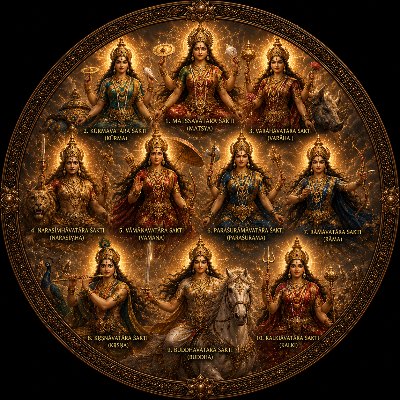
The Dashavatara Shaktis — The Ten Avatar-Powers Manifested by Lalita Tripura Sundari in the War Against Bhandasura
Dashavatara Shaktis · Dasha Avatar Murtis · Avatar Astras of Lalita · Pratyastra Murtis · Shakti-Avatara forms
The Dashavatara Shaktis are the ten Shakti-forms of Vishnu's principal avatars that were manifested by Lalita Tripura Sundari during the final phase of her war against Bhandasura in the Lalitopakhyana of the Brahmanda Purana. They were not independent cosmic beings but divine counter-weapons — pratyastras — each generated by Lalita in direct response to a corresponding weapon or astra discharged by Bhandasura during the climactic personal duel between the supreme goddess and the asura emperor. Each of Bhandasura's weapons invoked the demonic power of a specific mythological adversary — beings who had been defeated by the Dashavatara in previous cosmic cycles — and each of Lalita's counter-astras took the form of the corresponding avatar who had originally defeated that adversary, now manifested as a living Shakti-form fighting under the Goddess's command. Following their respective victories over the demons they were summoned to counter, the ten avatar-murtis were commanded by Lalita to reside in Sri Vaikunta and to re-enact their heroic deeds in every cosmic cycle. The entire sequence is recorded in the Kamakoti Mandali's primary text compilation from the Lalitopakhyana and is encoded in the Lalita Sahasranama.
✦ The Names and Concept
The Dashavatara — from dasha, ten, and avatara, descent or incarnation — are the ten primary avatars of Vishnu through which the cosmic preserver descends into the manifest world to restore dharmic order at moments of cosmic crisis. In the standard enumeration followed in the Lalitopakhyana's counter-astra list, they are Matsya (the fish), Kurma (the tortoise), Varaha (the boar), Narasimha (the man-lion), Vamana (the dwarf), Parashurama (Rama with the axe), Rama (the prince of Ayodhya), Balarama (Haladhara, the plough-bearer), Krishna (Vasudeva, with the forms Sankarshana, Pradyumna, and Aniruddha also represented), and Kalki (the future avatar of the horse age).
In the Lalitopakhyana's Shakta theological framework, these avatars are not understood as manifestations independent of the supreme Goddess but as expressions of her own power that she had previously delegated to Vishnu for use in cosmic restoration. When Bhandasura deployed weapons that invoked the demonic adversaries these avatars had originally overcome, Lalita manifested the corresponding avatar-Shakti directly from her own being — demonstrating that all avatar-power resides originally in the Goddess and that the avatars' historical victories were ultimately expressions of her supreme creative and protective power.
✦ The Occasion: The Maha-Asurastra and the Crisis
The Dashavatara Shaktis were manifested during the direct personal combat between Lalita and Bhandasura on the final day of the war. By this point Bhandasura had lost his brothers Vishukra and Vishanga, all thirty of his sons, Dhumini's ten sons, and his full demonic army. He faced Lalita alone. The combat between them took the form of an extended duel of astras — magical weapons of cosmic power — in which each side launched increasingly formidable weapons and the other neutralised them with corresponding counter-astras.
The Lalitopakhyana records a sequence of twenty-three astra-pratyastra exchanges in this duel, each with a named weapon on Bhandasura's side and a named counter-weapon on Lalita's side. Ten of these exchanges produced the Dashavatara Shaktis. Bhandasura's strategy was to deploy weapons named after and invoking the power of beings who had previously been defeated by the Dashavatara — on the principle that the power which had overcome those beings could now be turned against the Goddess. Lalita's counter-strategy was to manifest the very avatars those weapons invoked, demonstrating that their power resided in her and could be called forth directly from her own being.
✦ The Ten Avatar Shaktis: The Astra Sequence
The Kamakoti Mandali's primary text compilation from the Lalitopakhyana gives the complete astra-pratyastra list in order. The ten exchanges producing the Dashavatara Shaktis are as follows, drawn from that list with their sequential numbers in the full twenty-three exchange sequence:
- Bhandasura's Maha-Asurastra (Exchange 10) — A weapon that summoned thousands of asuras, including the great demons Madhu, Kaitabha, Mahishasura, Sumbha, Nisumbha, and Raktabija, from previous cosmic cycles. The Shakti Sena was placed in great peril, her soldiers crying out for intervention. Lalita's counter-weapon was the Mula-Durgastra — from which the goddess Durga manifested in her lion-mounted form, destroying the resurrected demons including Mahishasura. The first of the Dashavatara Shaktis, properly speaking, began in the exchanges that followed.
- Bhandasura's Arnavasra (Exchange 13) — A weapon invoking the primordial waters. Lalita's counter was the Adi-Kurma-Astra — the Shakti-form of the Kurma (tortoise) avatar who had borne the churning mountain on his back at the churning of the cosmic ocean.
- Bhandasura's Hiranyaksha-Astra (Exchange 14) — A weapon invoking the demon Hiranyaksha, who had dragged the earth into the primordial ocean. Lalita's counter was the Maha-Varaha-Astra — the Shakti-form of the Varaha (boar) avatar who had retrieved the earth from the cosmic depths.
- Bhandasura's Hiranyakashipu-Astra (Exchange 15) — A weapon invoking Hiranyakashipu, the indestructible demon-king who could not be slain by god, man, animal, by day or by night, indoors or outdoors, on earth or in space. Lalita's counter was the Ugra-Narasimha-Astra — the Shakti-form of Narasimha, the man-lion, who had emerged from a pillar at twilight to kill Hiranyakashipu in a form that fulfilled none of the demon's protections.
- Bhandasura's Balindra-Astra (Exchange 16) — A weapon invoking the power of Bali, the demon-king who had claimed dominion over the three worlds. Lalita's counter was the Vamana-Astra — the Shakti-form of Vamana, the dwarf avatar, who had reclaimed the three worlds from Bali in three steps.
- Bhandasura's Haihaya-Astra (Exchange 17) — A weapon invoking the Haihaya dynasty, the thousand-armed demon-king Kartavirya Arjuna and his kshatriya armies who had terrorised the world. Lalita's counter was the Bhargava-Astra — the Shakti-form of Parashurama, the axe-wielding brahmin-warrior avatar, who had exterminated the warrior class twenty-one times in revenge for the slaughter of his father.
- Bhandasura's Ravana-Astra (Exchange 18) — A weapon invoking Ravana, the ten-headed demon-king of Lanka, and from it emerged Ravana, Kumbhakarna, and Indrajit. The Scribd source confirms a detail unique to this exchange: Lalita roared the syllable hum, and from her left index fingernail emerged Lakshmana — the brother of Rama — who engaged and slew Indrajit, followed by Rama himself with his bow who destroyed Ravana and his forces. Lalita's counter was the Kodanda-Rama-Astra — the Shakti-form of Rama with his bow Kodanda.
- Bhandasura's Dvivida-Astra (Exchange 19) — A weapon invoking the demon Dvivida, the powerful ape-demon who had fought against Krishna and Balarama. Lalita's counter was the Haladhara-Astra — the Shakti-form of Balarama, who bears the plough and the pestle as his principal weapons.
- Bhandasura's Raja-Asura-Astra (Exchange 20) — A weapon invoking a class of royal demons who had conquered the three worlds. Lalita's counter was the Vasudeva-Astra, the Sankarshana-Astra, the Pradyumna-Astra, and the Aniruddha-Astra — the four Shakti-forms corresponding to the four vyuha manifestations of Krishna-Vishnu, reflecting the Pancharatra Vaishnava theological framework in which Vasudeva, Sankarshana, Pradyumna, and Aniruddha are four primary forms of the supreme deity.
- Bhandasura's Kaly-Astra (Exchange 21) — A weapon invoking the destructive forces of the Kali age. Lalita's counter was the Kalki-Astra — the Shakti-form of Kalki, the future avatar who will appear at the end of the Kali Yuga riding a white horse with a sword of pure light to restore dharmic order. The manifestation of the Kalki Shakti within the war is theologically remarkable: Kalki is described as the avatar who has not yet appeared in the conventional temporal sequence, yet here the Goddess manifests his power directly, demonstrating that all of time's restoring powers reside within her and can be deployed at will regardless of the temporal sequence in which they would otherwise appear.
✦ The Broader Duel: Other Notable Exchanges
The full twenty-three exchange sequence of the Lalitopakhyana duel extends beyond the ten Dashavatara counter-astras to include responses to weapons of darkness (the Andhatamisra-Astra neutralised by the Mahataranya-Astra — the great sun-weapon), heresy (the Pakhandha-Astra neutralised by the Gayatri-Astra), blindness, fear, disease, and death. The Maha-Moha-Astra — the weapon of great delusion — was neutralised by the Shambhava-Astra. The Narayana-Astra destroyed Bhandasura's armies. The Pashupata-Astra destroyed his forty remaining commanders. Finally, after all these, the Mahakameshvara-Astra vaporised Bhandasura himself and erased Shunyaka from existence.
✦ The Final Command: Eternal Re-enactment
Following all their victories over the demons assigned to them, the ten avatar-murtis stood before Lalita. The Lalitopakhyana records that she commanded them to reside in Sri Vaikunta — the supreme realm of Vishnu — and to re-enact their heroic deeds in every cosmic cycle. This command encodes a profound theological statement: the Dashavatara as they are known in the Vaishnava tradition — the ten sequential appearances of Vishnu across cosmic time — are, in the Shakta reading of the Lalitopakhyana, eternal re-enactments commissioned by the supreme Goddess, recurring at her instruction rather than spontaneously by Vishnu's own initiative. Every Dashavatara that occurs in every cycle of cosmic time is, in this framework, a continuation of what was first performed under Lalita's direct command during the war against Bhandasura.
✦ The Lalita Sahasranama Encoding
The Lalita Sahasranama encodes the Dashavatara episode across several names in the section describing the war. The name Dasamudra-samudbhuta-dasa-avatara-sevita — she who is attended by the ten avatars who arose from the ten oceans — directly commemorates the manifestation of the ten avatar-Shaktis. The names covering the specific weapons used in the Bhandasura duel — including Mahavajreshvari-devi-kaya-sannibha (connected to the Vajreshvari weapon) and others in the Sahasranama's war-narrative section — collectively encode the entire astra-pratyastra sequence. The Kamakoti Mandali's primary text list is the most complete single reference for this encoding, cross-referencing each name with its corresponding astra-pratyastra pair.
✦ Theological Significance
The Dashavatara Shaktis episode is one of the most theologically ambitious passages in the Lalitopakhyana, and its significance within the Shakta tradition is considerable. By having Lalita manifest the ten avatars of Vishnu directly from her own being as counter-weapons, the text makes a precise doctrinal assertion: the Goddess is the source of all avatar-power. Vishnu descends in avatar-forms because the supreme Shakti sends those forms forth from herself. The avatars are not independent cosmic interventions but specific deployments of the Goddess's own restorative power through the form of the cosmic preserver. The Lalitopakhyana's list makes this explicit: each avatar emerges specifically in response to Bhandasura's astra, from Lalita's command or person, and completes its task under her authority.
The inclusion of Kalki — the future avatar — in this sequence is particularly significant. In the conventional Vaishnava understanding, Kalki has not yet appeared. In the Lalitopakhyana's account, Lalita manifested the Kalki Shakti in the war against Bhandasura and then commanded Kalki to re-enact his deeds in every future cycle — making Kalki's expected future appearance not a first occurrence but a recurring re-enactment of what was first accomplished at Lalita's direct command. This inversion of the temporal sequence of the Dashavatara — from a progression through time to a set of eternal performances commissioned before time's own cycles began — is the theological centrepiece of the Dashavatara Shaktis episode.
✦ References
Primary Sources
- Brahmanda Purana, Lalitopakhyana (Lalita Mahatmya), Chapter 29: Slaying of Bhandasura — The primary source for the complete astra-pratyastra exchange sequence including all ten Dashavatara counter-astras; narrates Lalita's direct personal duel with Bhandasura and the manifestation of each avatar-Shakti from her own being as each astra was deployed against her.
- Lalita Sahasranama (within the Lalitopakhyana) — Encodes the Dashavatara Shaktis episode in several names of the war-narrative section; the name encoding their collective manifestation from the ten oceans confirms the episode's canonical status within the Sahasranama's structure.
Modern and Secondary Reference Works
- Kamakoti Mandali — A List from Lalitopakhyana (kamakotimandali.com) — The most authoritative secondary source for the complete astra-pratyastra list drawn directly from the primary Lalitopakhyana text; provides all twenty-three exchanges in Sanskrit transliteration with both the astra name and the pratyastra name; confirms the ten Dashavatara counter-astras as items 13–21 in the sequence and identifies the Maha-Durgastra (Exchange 10) as the counter to the Maha-Asurastra.
- Scribd — Insights on LalitOpakhyana and Devi; Glimpses of LalitOpakhyana Through Lalitha Sahasranama (scribd.com) — Confirms the narrative sequence: the Maha-Asurastra causing the Shakti Sena's peril, Lalita's laughter producing Durga, the subsequent Dashavatara counter-astras, the unique detail of the left index fingernail producing Lakshmana in the Ravana-Astra exchange, and the final command to the ten avatar-murtis to reside in Vaikunta and re-enact their deeds every yuga.
- Wikipedia — Bhandasura article (en.wikipedia.org/wiki/Bhandasura) — Confirms from the Wisdomlib Chapter 29 citation that Narasimha and Kalki came to the aid of Lalita during the duel; confirms the Maha-Asurastra episode and Durga's manifestation from Lalita's laughter; attests the Wisdomlib primary text source for Chapter 29.
- Wisdomlib — Lalitopakhyana, Chapter 29: Slaying of Bhandasura (wisdomlib.org/hinduism/book/lalitopakhyana-lalita-mahatmya/d/doc362967.html) — The English translation of the primary text chapter providing the most accessible full account of the duel and the avatar-Shakti manifestations.
- Wikipedia — Dashavatara article (en.wikipedia.org/wiki/Dashavatara) — Provides the standard list and sequence of the ten avatars of Vishnu against which the Lalitopakhyana's counter-astra sequence is mapped; confirms the standard enumeration including Balarama as the ninth in traditions that omit Krishna independently.
- Srilalithatripurasundari.wordpress.com — Lalitopakhyana Synopsis, Chapter 29 section — Provides the narrative of the final duel including the astra sequences, the Dashavatara manifestations, and the post-victory command to the avatar-murtis to reside in Vaikunta.