
About
Trayyaruna — King of Ayodhya and Father of Trishanku
Trayyaruna · Trayaruni · Traiyaruna · Trayyarunaka
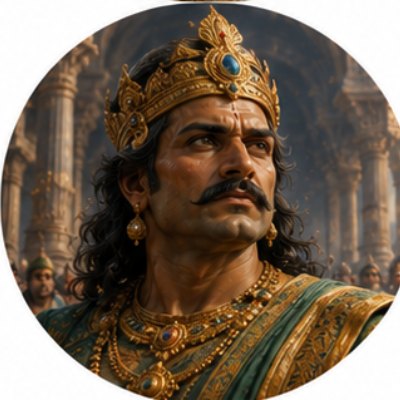
Trayyaruna was a king of the Ikshvaku dynasty of Ayodhya, belonging to the Solar lineage, the Suryavamsha, and is placed in the Treta Yuga by the genealogical traditions of the Puranas. He is the son of King Tridhanvan and the father of Satyavrata, the prince who would later become the notorious and celebrated Trishanku. As a direct ancestor of Rama — the seventh avatar of Vishnu and the hero of the Valmiki Ramayana — Trayyaruna occupies a generational position of some importance within the Solar dynastic lineage, though the primary texts devote far less narrative attention to him than to his son. He is principally remembered for a single defining act: the banishment of his own heir following a grave breach of dharmic and social order. His name appears in the dynastic genealogies of the Brahma Purana, the Vishnu Purana, the Bhagavata Purana, the Harivamsa, and the Valmiki Ramayana, though the narrative content associated with him personally is sparse and confined primarily to the Brahma Purana and the background sections of the Trishanku episode in the Ramayana.
✦ The Name
The name Trayyaruna is of Sanskrit formation. It appears in manuscript traditions under variant spellings — Traiyaruna, Trayaruni, and Trayyarunaka — reflecting scribal variation across different Puranic recensions rather than distinct epithets. The core element aruna carries the sense of reddish or tawny light, the colour associated with the dawn and with the sun in its rising aspect; it is the same root used for Aruna, the charioteer of the sun-god Surya in Puranic tradition. The prefixing element tray or trayi relates to the number three or to the three Vedas collectively. The compound name does not carry a single transparent meaning in the tradition, and no extended etymological gloss is provided by the primary Puranic sources. Its variant form Trayaruni, which follows a patronymic suffix pattern, appears occasionally in genealogical lists as though it were a metronymic or patronymic rather than a personal name, though the primary texts treat it as the king's own name.
✦ Lineage
- Dynasty: Ikshvaku dynasty, Suryavamsha (Solar lineage), ruling from Ayodhya
- Father: King Tridhanvan, a king of Ayodhya in the Solar line, recorded in the Puranic vamshanuchritas as the immediate predecessor of Trayyaruna on the throne
- Son: Prince Satyavrata, later known as Trishanku — the king who was cursed to the form of a Chandala and who, through the intervention of the sage Vishvamitra, was elevated to a specially created heaven suspended between earth and the realm of the gods, where he remains inverted for eternity
- Grandson: King Harishchandra, celebrated throughout the Puranic and epic traditions as the supreme exemplar of truth-keeping under extreme suffering; he inherited the throne of Ayodhya after Trishanku's ascent and suspension
- Royal preceptor: Sage Vasishtha, son of the creator Brahma and one of the seven great sages of the tradition, who served as the hereditary family priest and spiritual guide of the Ikshvaku dynasty
✦ The Banishment of Satyavrata
The single narrative episode most firmly associated with Trayyaruna in the primary sources is his decision to banish his son and heir, the prince Satyavrata. The act that precipitated this banishment was the prince's forcible abduction of a Brahmin's newly wed bride — a transgression that violated the most fundamental norms of social and ritual order. The Brahma Purana records that Trayyaruna, in response to this act, expelled Satyavrata from the kingdom and stripped him of his status as heir, acting on the principle that the rule of dharma must be upheld even at personal cost. The Valmiki Ramayana, in its Bala Kanda account of Trishanku's history, corroborates this event, recording that Satyavrata was banished by his father and compelled to live in the company of outcastes.
During the period of Satyavrata's exile, which coincided with a severe twelve-year famine, the exiled prince placed himself in the service of the family of the sage Vishvamitra — a former king named Kaushika who had undertaken extraordinary austerities to transform himself into a Brahmarishi, one of the highest categories of sage. Satyavrata sustained Vishvamitra's wife and children through this period. Trayyaruna died during or after this famine; the Valmiki Ramayana records that following the end of the famine, and following the death of Trayyaruna, the sage Vasishtha himself installed Satyavrata on the throne of Ayodhya — conferring on him the kingship his father had revoked and the name Trishanku as a permanent mark of his three transgressions.
The claim present in certain secondary accounts that Trayyaruna formally abdicated his throne following the banishment and retired to the forest to practice austerities until his death cannot be confirmed from the primary Puranic or epic texts consulted. The primary sources record his death as occurring during the period of Satyavrata's exile but do not provide details of the circumstances, and the profile accordingly does not extend beyond what the texts establish.
✦ Textual Variants and Inconsistencies
The genealogical lists of the Solar dynasty across the major Puranas are broadly consistent in placing Trayyaruna as the son of Tridhanvan and the father of Satyavrata-Trishanku. The Vishnu Purana, the Bhagavata Purana, the Brahma Purana, and the Harivamsa all attest this three-generation sequence, and there is no substantive contradiction across these texts on the question of Trayyaruna's parentage or his son's identity.
The Valmiki Ramayana, Bala Kanda, does not narrate Trayyaruna's life independently but refers to his banishment of Satyavrata as background to the Trishanku episode. This account is consistent with the Brahma Purana's treatment in its essential facts — the abduction, the banishment, the subsequent installation of Satyavrata as king after the father's death — though the Ramayana does not go into detail about Trayyaruna's own character or reign.
The Brahma Purana provides the most focused textual attention to Trayyaruna within its dynastic genealogy sections, recording the expulsion of Satyavrata and framing Trayyaruna's action as an exercise of strict dharmic judgment. The characterisation of him as deeply pious and closely guided by Vasishtha is consistent across secondary sources drawing on the Puranic tradition, though this characterisation is embedded in the genealogical and background sections of those texts rather than in independent narrative episodes devoted to him.
A Sanskrit passage from the Brahma Purana, cited in some secondary sources, records that Satyavrata was Trayyaruna's son and that the father cast him off in accordance with the root of dharma. This passage is consistent with the account in the Valmiki Ramayana and other Puranas. The supplied Sanskrit passage attributed to this source has been noted in preparing this profile, but as its precise verse attribution requires confirmation against a critical edition, it is cited as contextual corroboration rather than treated as a verbatim primary excerpt.
✦ Connection to the Wider Genealogy
Trayyaruna stands within the long succession of Solar dynasty kings descending from Ikshvaku, the son of Manu Vaivasvata, who was himself the son of Vivasvat, the sun-god, and the progenitor of humanity in the present cosmic age. The line passes through Tridhanvan to Trayyaruna, then through Satyavrata-Trishanku to Harishchandra, and from Harishchandra through a succession of kings including Rohitasva and eventually to Bhagiratha — the king credited with bringing the sacred river Ganga down from the heavens to earth — and further to Raghu, Dasharatha, and ultimately Rama. Trayyaruna's act of banishment, though it disrupted the immediate succession, did not sever the dynastic line: Vasishtha's installation of Trishanku on the throne preserved the continuity of the Ikshvaku lineage, and the dynasty passed intact to Harishchandra and to all subsequent generations.
✦ References
Primary Sources
- Valmiki Ramayana, Bala Kanda, Sargas 57–60: Provides the narrative background of Trayyaruna's banishment of Satyavrata as part of the extended account of Trishanku's history; confirms the father-son relationship and the circumstances of the exile.
- Brahma Purana, dynastic genealogy sections: The primary Puranic source that treats Trayyaruna directly, recording the expulsion of Satyavrata and framing the king's action as an application of dharmic judgment; supplies the genealogical position of Trayyaruna as son of Tridhanvan.
- Bhagavata Purana, Skandha 9: Includes Trayyaruna in the Solar dynastic vamsha list as the son of Tridhanvan and the father of Satyavrata-Trishanku, consistent with other Puranic accounts.
- Vishnu Purana, Book 4: Enumerates the Solar dynasty and places Trayyaruna in the generational sequence between Tridhanvan and Trishanku, consistent with the Bhagavata Purana and Brahma Purana.
- Harivamsa, Harivamsa Parva: Includes Trayyaruna in the Solar dynastic genealogy and situates him in the generational succession leading to Harishchandra and, ultimately, to Rama.
Secondary and Reference Sources
- Vettam Mani, Puranic Encyclopaedia (1975): Synthesises genealogical data on Trayyaruna from across the major Puranic sources and provides cross-references to the Trishanku and Harishchandra narratives.
- Wisdomlib.org, entry on Trayyaruna: An online secondary reference aggregating Puranic genealogical data on Trayyaruna, useful for cross-checking the consistency of dynastic lists across sources.
- Robert P. Goldman (trans.), The Ramayana of Valmiki, Vol. 1: Balakanda (Princeton University Press, 1984): Critical translation and annotation providing scholarly context for the Trishanku narrative, within which Trayyaruna's banishment of Satyavrata is recounted.