
About
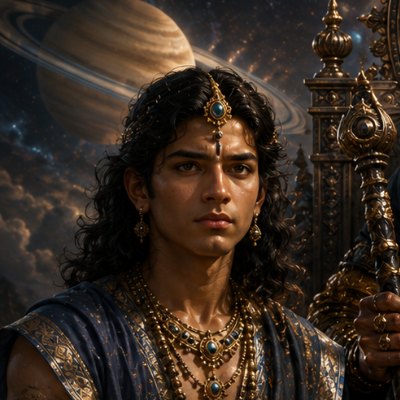
Chitraratha — Foremost of the Gandharvas, King of the Celestial Musicians
Chitraratha · Angaraparna · Bhagnaratha · Devagandharva · Gandharvaraja
Chitraratha is a prominent Gandharva — a member of the class of celestial beings associated with music, beauty, and the divine arts — who holds the distinction of being identified in multiple major Sanskrit texts as the foremost of his kind. His original name in the Mahabharata is Angaraparna, which he relinquished after his defeat at the hands of Arjuna. He appears first in the Atharvaveda, where he is named among the Gandharvas who perform the cosmic milking of the Viraj — the divine cosmic entity — alongside the Apsaras. He is most extensively narrated in the Adi Parva of the Mahabharata, where his encounter with the Pandavas on the banks of the Ganga leads to a dramatic battle, his capture, his liberation, and a remarkable friendship with Arjuna built upon an exchange of rare knowledge. Krishna singles him out in the Bhagavad Gita as the supreme exemplar among all Gandharvas, placing him in the same register of cosmic excellence as the sage Narada among divine seers and the Peepal tree among all trees. He is described in the Sabha Parva as a worshipper in the court of Kubera, the lord of wealth, and in the Shiva Purana as the paramount Gandharva invoked when the gods praise Shiva through the best of each cosmic category. The Brahma Vaivarta Purana records that his daughter Manda became the wife of Shani, the planetary deity of Saturn, and was the mother of Gulika. Chitraratha thus appears across Vedic, epic, and Puranic literature in distinct but consistently exalted roles.
✦ The Names
The name Chitraratha is a Sanskrit compound of chitra, meaning bright, variegated, beautiful, or marvellous, and ratha, meaning chariot. The full name thus signifies one who has a beautiful or resplendent chariot — an apt designation for a celestial king whose divine vehicle was central to his rank and power. The Mahabharata records that his original birth-name was Angaraparna: angara means glowing charcoal or ember, and parna means wing or leaf, yielding the meaning one with ember-coloured or coal-dark wings. This name evokes both the dark brilliance and the aerial nature attributed to Gandharva beings. After his defeat at Arjuna's hands, Chitraratha voluntarily abandoned the name Angaraparna and additionally earned the epithet Bhagnaratha — one whose chariot has been destroyed — a name signifying the completeness of his defeat, though the text presents this name in the context of his genuine self-acknowledgement rather than of humiliation.
He is further designated Devagandharva — a divine Gandharva, as distinct from earthly or lower-category Gandharvas — and is described in the Brahmaanda Purana and Vayu Purana as the Mauneya Gandharva who serves as the overlord of the Gandharvas, Kinnaras, and Vidyadharas.
✦ Lineage
- Father (Mahabharata): Kashyapa — the great progenitor-sage, one of the Saptarshis, whose vast progeny by his many wives encompasses the Adityas, Daityas, Danavas, Nagas, birds, and numerous other classes of being. Kashyapa's wife Muni is listed among his wives in the Puranic genealogies as the mother of Gandharvas and Apsaras.
- Mother (Mahabharata): Muni — one of the wives of Kashyapa, identified in the Puranic lists as the mother of Gandharvas; her name means sage or one who is silent and meditative.
- Father (Atharvaveda): Suryavarchas — named in the Atharvaveda hymn 8.10.27 as the father of Chitraratha among the Gandharvas. This represents a divergent parentage from the Mahabharata account and is addressed in the Variants section below.
- Brother: Vasuruchi — named as a sibling of Chitraratha in the Atharvaveda passage, where both are described as sons of Suryavarchas acting as calf and milker respectively in the cosmic milking of the Viraj.
- Wife: Kumbhinasi — the Gandharvi who accompanied Chitraratha on the night of his encounter with the Pandavas at the Ganga; she intervened decisively in his favour, pleading with Yudhishthira for her husband's release after Arjuna had bound him. Her background and lineage are not further elaborated in the surviving texts.
- Daughter: Manda — given in marriage to Shani, the planetary deity of Saturn, as recorded in the Brahma Vaivarta Purana, Ganapati Khanda, Chapter Eleven. She is the figure whose curse upon Shani rendered his direct gaze destructive, and she is the mother of Gulika, the shadow son of Saturn revered in Jyotisha tradition.
✦ The Vedic Appearance — Atharvaveda
Chitraratha's earliest attestation is in the Atharvaveda, Book Eight, Hymn Ten, verse twenty-seven, which is dedicated to the glorification of the Viraj — the divine cosmic entity conceived as a luminous cow whose milk nourishes all classes of existence. In this hymn, the Gandharvas and Apsaras are described as calling upon the Viraj. Chitraratha, identified as a son of Suryavarchas, acts as the calf who induces the Viraj's milk secretion, while his brother Vasuruchi acts as the milker. The milk drawn in a lotus-petal vessel yields the most sublime fragrance, which is the sustenance upon which the Gandharvas and Apsaras subsist. This early Vedic passage establishes Chitraratha within the cosmic order as a figure intimately connected to the sacred economy of divine nourishment.
A related episode — the milking of the earth by the Gandharvas during the reign of the emperor Prithu — is recorded in the Harivamsha, Chapter Six, verse thirty-nine, where Chitraratha again plays the role of the calf in a collective milking. This consistency across the Vedic and Puranic records suggests that Chitraratha's association with the calf-and-milking motif was a stable element of the tradition.
✦ The Encounter with Arjuna and the Pandavas
The principal narrative episode involving Chitraratha is recounted across Chapters 165 to 183 of the Adi Parva of the Mahabharata, in the section known as the Chaitraratha Parva — a sub-parva named after him. The Pandavas, having escaped from the lac palace of Varanavata through an underground tunnel and having killed the demons Hidimba and Baka, were travelling by night through a forest along the banks of the Ganga, making their way toward the kingdom of the Panchalas.
The twilight hours of the night, according to the cosmic regulation stated by Chitraratha himself in the text, are the appointed time for Yakshas, Gandharvas, and Rakshasas, who are permitted to move freely everywhere during this period. Human beings — including kings at the head of their armies — are not to approach pools of water or travel in the forest at such an hour. The Pandavas, unaware or heedless of this rule, came upon the river Ganga where Chitraratha was bathing with his wife Kumbhinasi. He identified himself to them under his name Angaraparna, declared himself a friend of Kubera, and warned them to withdraw.
Arjuna, undeterred, advanced with a burning torch. Chitraratha considered this a grave affront to the prerogative of the Gandharvas and the cosmic regulation of time. He drew his bow and a fierce battle erupted. Chitraratha unleashed divine weapons and his powers as a Devagandharva, but Arjuna — sustained, the Gandharva himself later acknowledged, by his vow of celibacy — overcame him completely. Arjuna bound Chitraratha hand and foot and brought him before his brothers. Kumbhinasi ran after them and appealed to Yudhishthira, who instructed Arjuna to release the defeated Gandharva. At this, Chitraratha relinquished his name Angaraparna.
What followed the release was a remarkable reconciliation and exchange. Chitraratha gifted Arjuna the Chakshushi Vidya — the art of supernatural sight, by which one can perceive anything in all three worlds: heaven, earth, and the underworld. The lineage of this knowledge as stated in the text runs: from Manu to Soma, from Soma to Vishvavasu, from Vishvavasu to Chitraratha, and now from Chitraratha to Arjuna. He also gave Arjuna a large number of celestial horses renowned for their speed. In return, Arjuna taught Chitraratha the secret of the missile Agnishira. The exchange bound the two in a friendship that would persist across the epic narrative.
Beyond the exchange of gifts and knowledge, Chitraratha served the Pandavas in a further capacity of great importance: he narrated to them a series of instructive tales. These included the history of the feud between Vasishtha and Vishvamitra, the story of Tapati and Samvarana, accounts of the sage Parashara, the legends of Kalmashapada and Adrishyanti, and the stories of the Bhargavas, Kritavirya, and Aurva. He also counselled the Pandavas to appoint a qualified brahmin as their family priest before undertaking any further journey; this counsel directly led to the engagement of the sage Dhaumya as the Pandavas' purohita, a relationship that would endure through the rest of the epic.
✦ Other Narrative Appearances
The Mahabharata records several further appearances of Chitraratha after the principal encounter. He attended one of Arjuna's birthday festivals, as noted in Adi Parva Chapter 122. He is recorded in the Sabha Parva, Chapter Ten, as worshipping in Kubera's celestial assembly — consistent with his stated identity as a close friend and devotee of the lord of wealth and the north. In the Vana Parva, Chapter Fifty-Two, he gifted Yudhishthira four hundred celestial horses renowned for their wind-like speed, demonstrating both his continued goodwill toward the Pandavas and the high regard in which he held Yudhishthira's moral authority. The gardens of Chitraratha are mentioned in the Mahabharata as a place of exquisite beauty where the king Yayati once sported with the Apsara Vishvachi.
In the Devi Bhagavata Purana, Navama Skandha, Chitraratha appears as an emissary of Shiva, sent with a divine message to the Asura Shankhachuda, urging him to abandon his demonic activities. This deployment as a divine messenger reflects the high standing Chitraratha holds in the celestial hierarchy across the Puranic tradition.
✦ Theological Significance — Identification as the Supreme Gandharva
Chitraratha's theological eminence is asserted most directly in the Bhagavad Gita, Chapter Ten, Verse Twenty-Six, where Krishna enumerates his own divine manifestations in the various categories of cosmic existence. Among the Gandharvas, Krishna declares himself to be Chitraratha — placing him in the same enumeration as the Peepal tree among trees, Narada among divine sages, and Kapila among perfected beings. This identification elevates Chitraratha beyond the status of a well-known mythological figure to that of a cosmic exemplar: the Gandharva in whose form the divine excellence of that entire class of being is most fully expressed.
The Shiva Purana, in a hymn of cosmic praise where the assembled gods eulogise Shiva by naming the best of every category of being, likewise identifies Chitraratha as foremost among the Gandharvas, reinforcing the Gita's testimony from within the Shaiva tradition. The Brahmaanda Purana and Vayu Purana further describe him as the Mauneya overlord of not only the Gandharvas but also the Kinnaras and Vidyadharas — the semi-divine musicians, horse-headed singers, and knowledge-bearing sky-beings who collectively populate the celestial realms below the gods and above humanity.
✦ Textual Variants
The primary divergence in Chitraratha's profile concerns his parentage. The Mahabharata, Adi Parva Chapter 65, Verse 43, identifies him as a son of the sage Kashyapa by his wife Muni — placing him squarely within the vast progeny of Kashyapa, through whom the Gandharvas as a class are generated in the Puranic creation accounts. The Atharvaveda passage, however, does not name Kashyapa as his father but refers to him as the son of Suryavarchas — a name meaning one whose brilliance equals the Sun. Suryavarchas himself appears in the Mahabharata's list of Gandharvas in the Sabha Parva, where he is named among the Gandharva chiefs who attend Kubera's court, suggesting he is a distinct Gandharva figure rather than an alternative name for Kashyapa. The two accounts thus present genuinely different genealogical framings: one places Chitraratha as a son of the primordial sage Kashyapa, situating him within the cosmogonic creation of classes of beings; the other gives him a purely Gandharva parentage through a celestial father of solar radiance. The texts do not resolve this divergence, and both are preserved as attestations from their respective sources.
The Wisdomlib definitional entry for Citraratha also notes several other figures bearing the same name in the corpus — including a minister of King Dasharatha, a king of Salva, a son of Gaya in the Bhagavata Purana, and a river mentioned in the Bhishma Parva — none of whom are to be identified with the Gandharva king who is the subject of the present profile. The name Citraratha was thus borne by multiple distinct figures across the tradition, and careful disambiguation is required in every instance.
✦ Connection to the Wider Genealogy
Through his daughter Manda, given in marriage to the planetary deity Shani as recorded in the Brahma Vaivarta Purana, Chitraratha is connected to the lineage of the Navagrahas. Shani is the son of Surya, the Sun deity, and Chhaya. Manda's curse upon Shani — pronounced after he neglected her during devotional absorption — became the Puranic explanation for Shani's downward gaze and for the destructive power attributed to his direct aspect. Through this same union came Gulika, known also as Maandi, who is both a figure of the Jyotisha shadow-planet tradition and, in South Indian ritual cult, a deity of considerable independent standing. Chitraratha's Gandharva lineage — celestial, musical, and occupying the upper intermediate realms — thus connects, through Manda, to the Navagraha system that governs astrological fate and karmic dispensation in the Hindu cosmological framework.
✦ References
Primary Sources
- Atharvaveda, Book 8, Hymn 10, verse 27: The earliest textual attestation; names Chitraratha as the son of Suryavarchas among the Gandharvas; narrates his role as the calf in the cosmic milking of the Viraj alongside his brother Vasuruchi.
- Mahabharata, Adi Parva, Chapter 65, verse 43: Identifies Chitraratha as a Devagandharva born of the sage Kashyapa by his wife Muni; places him among the sixteen sons of Kashyapa in the Gandharva lineage.
- Mahabharata, Adi Parva, Chapters 165–183 (Chaitraratha Parva): The principal narrative source; the full account of the night encounter with the Pandavas at the Ganga, the battle with Arjuna, the capture, the intercession of Kumbhinasi, the release, the exchange of the Chakshushi Vidya, the celestial horses, the Agnishira missile, and the counsel to appoint Dhaumya as the Pandava priest.
- Mahabharata, Sabha Parva, Chapter 10, verse 26: Records Chitraratha among the Gandharvas worshipping in Kubera's celestial court.
- Mahabharata, Vana Parva, Chapter 52, verse 23: Records Chitraratha's gift of four hundred swift celestial horses to Yudhishthira.
- Bhagavad Gita, Chapter 10, verse 26: Krishna identifies himself as Chitraratha among the Gandharvas in his enumeration of cosmic manifestations; the supreme theological statement of Chitraratha's primacy within his class.
- Shiva Purana, Chapter 2.5.2: The assembled gods praise Shiva by naming the foremost in each cosmic category; Chitraratha is named as the foremost of the Gandharvas.
- Brahmaanda Purana, Book 3, Chapters 7–8; Vayu Purana, Chapters 69–70: Identify Chitraratha as the Mauneya Gandharva and overlord of the Gandharvas, Kinnaras, and Vidyadharas.
- Harivamsha, Chapter 6, verse 39: Records Chitraratha acting as the calf in the Gandharvas' milking of the earth during the reign of Prithu.
- Brahma Vaivarta Purana, Ganapati Khanda, Chapter 11: Identifies Chitraratha as the Gandharva king whose daughter was given in marriage to Shani; establishes him as the maternal grandfather of Gulika.
- Devi Bhagavata Purana, Navama Skandha: Records Chitraratha acting as Shiva's messenger to the Asura Shankhachuda.
Secondary Sources
- Mani, Vettam, Puranic Encyclopaedia (1975): Entry on Citraratha; consolidates cross-textual narrative references; provides verse-level citations for the Adi Parva account and miscellaneous other appearances; consulted for narrative detail and source verification.
- Wisdomlib.org, definition of Citraratha: Aggregates definitions and attestations from the Puranic Encyclopaedia, Bhagavata Purana, Shiva Purana, and other texts; documents the multiple distinct figures named Citraratha across the corpus, enabling disambiguation.
- Wikipedia, Chitraratha article: Standard secondary summary of parentage, wife, narrative role, and cross-textual standing; consulted for confirmation of key identifications.