
About
Rodasi — Lightning Companion of the Maruts
Rodasi · companion of the Marutagana · atmospheric personification of lightning and the storm cloud
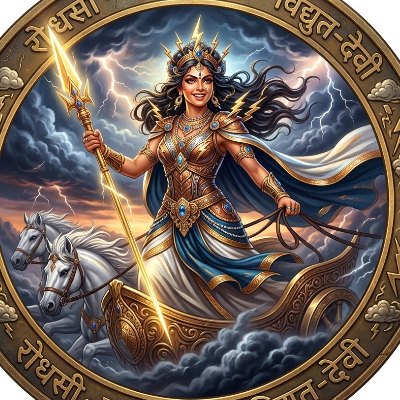
Rodasi is a divine female figure of the Rig Veda, celebrated as the collective companion of the Maruts — the divine host of storm and wind deities who serve as the atmospheric vanguard of Indra. She is associated with lightning or the sudden brilliance of a moisture-laden storm cloud, and her presence in the Rig Veda is consistently inseparable from that of the Marut host: she rides upon their golden chariot, moves with them across the sky, and is described in terms of luminous beauty and commanding presence among the howling warriors. She receives no independent invocation, no standalone hymn, and no narrative episode in any primary source. Her entire textual existence is descriptive and iconographic, confined to the hymns in which the Maruts are praised. She does not appear as a named character in any of the eighteen Mahapuranas or the two Itihasas, and this profile is kept proportionally brief in accordance with the strictly limited textual record.
✦ The Name
The name Rodasi presents a significant philological complexity that must be stated clearly. The same word appears hundreds of times throughout the Rig Veda as a common dual noun meaning heaven and earth, referring to the two cosmic realms as a paired unit. This usage is entirely distinct from the deity name, and the two are differentiated in the Sanskrit text by accentuation: the common noun carries its stress on the first syllable, while the deity name carries its stress on the final syllable. The distinction is phonological in the original Sanskrit and is not preserved in plain English transliteration, which is why secondary sources and translations frequently conflate the two usages. Throughout this profile the name refers exclusively to the deity figure who accompanies the Maruts, and all references to the common noun meaning heaven and earth are treated as a separate lexical item.
As a deity name, Rodasi is connected etymologically to the Sanskrit root rud, carrying associations with weeping, howling, or the loud cry of the storm, and to rod, associated with the raining or pouring of moisture. Vedic scholarship classifies her as a personification of the terrifying brilliance of lightning or of the moisture-heavy storm cloud that flashes and moves across the sky in direct response to the driving force of the storm winds. Her name in this sense is inseparable from the atmospheric phenomenon she embodies: she is the lightning that appears precisely when and where the Maruts strike. No epithets or alternate names beyond the deity name itself are recorded for her in any primary source.
✦ Lineage and Relationship
- Companions: The Maruts — the divine host of storm and wind deities, sons of Rudra and Prsni in the Vedic tradition and sons of Kashyapa and Diti in the Puranic tradition. Rodasi is their shared collective companion. She is not recorded as the individual wife of any single Marut in any primary source, and the Rig Veda consistently presents her association with the host as collective and inseparable from their group identity.
No parentage, siblings, or children are recorded for Rodasi in any primary source, and these sections are accordingly omitted.
✦ Rodasi in the Rig Veda
Rodasi is explicitly named as a deity in six hymns of the Rig Veda: Mandala I, Hymns 61, 167, and 168; Mandala V, Hymn 56; and Mandala VI, Hymn 66. In each of these appearances she is described in relation to the Maruts and their chariot rather than in any independent context. The textual treatment across all six hymns is consistently descriptive and iconographic rather than narrative.
She is depicted as a figure of striking luminous beauty, adorned with golden ornaments, who stands or rides majestically upon the golden chariot of the storm host. The hymns describe her posture among the Maruts as that of a commanding presence amid fierce divine warriors, her brilliance complementing and intensifying the ferocity of the host she accompanies. The atmospheric logic of her presence is consistent across all appearances: she is the lightning flash or the luminous storm cloud that is inseparable from the wind force that drives it, and her beauty in the hymns is the beauty of atmospheric power made visible.
Rig Veda I.168.3 contains the closest the textual record comes to a narrative element involving Rodasi. The verse employs a poetic simile comparing her movement with the Maruts to the proud bearing of a young woman who selects her own husband in a public assembly — the classical Vedic and later Sanskrit concept of the svayamvara. This comparison is an extended poetic figure for the natural and voluntary way in which lightning attaches itself to the storm wind host, moving with them as a matter of intrinsic affinity rather than compulsion. The simile does not constitute a narrative episode, contains no dialogue, and attributes no independent agency to Rodasi beyond the atmospheric phenomenon it describes. It is a rhetorical device expressing the inseparability of lightning from the storm winds, not an account of an event in which Rodasi acts as a participant.
✦ Identity and Classification
Rodasi does not receive independent invocation in any hymn of the Rig Veda. There are no standalone Rodasi hymns in the corpus, and she is never addressed as the primary recipient of a Soma offering in isolation from the Maruts. Vedic scholarship classifies her uniformly as an atmospheric personification — a figure whose existence in the text is entirely constituted by her relationship to and co-presence with the Marut host — rather than as an independently worshipped deity with her own cult, iconographic tradition, or theological elaboration. This classification is consistent with her textual treatment: she is never invoked for her own qualities or powers independently of what those qualities contribute to the description of the storm host she accompanies.
✦ Absence from the Puranic and Epic Record
Rodasi does not appear as a named character in any of the eighteen Mahapuranas or in either of the two Itihasas, the Mahabharata and the Ramayana. The word rodasi does occur in later classical Sanskrit texts, including the Bhagavata Purana, but in these contexts it functions exclusively as the standard vocabulary noun meaning the space between heaven and earth, having entirely shed its identity as a deity name. The figure herself was not carried forward into the Puranic mythological system, where the storm cloud and lightning functions she personified were absorbed into other divine figures and frameworks, including the goddess Vidyut. Her textual existence is therefore wholly confined to the Rig Veda, and her profile in any genealogical reference system must rest entirely on that single body of primary evidence.
✦ References
Primary Sources
- Rig Veda, Mandala I, Hymn 61, Verse 14: One of six hymns in which Rodasi is explicitly named as the companion of the Maruts, describing her presence among the storm host.
- Rig Veda, Mandala I, Hymn 167, Verses 4–5: Names Rodasi explicitly as the collective companion who rides with the Marut host on their golden chariot.
- Rig Veda, Mandala I, Hymn 168, Verse 3: Contains the svayamvara simile comparing Rodasi's movement with the Maruts to a young woman proudly choosing her husband, used as a poetic figure for the natural affinity of lightning with the storm wind host.
- Rig Veda, Mandala V, Hymn 56, Verse 8: Names Rodasi as the companion of the Maruts and describes her in terms of luminous beauty and commanding presence among the storm warriors.
- Rig Veda, Mandala VI, Hymn 66, Verse 6: Names Rodasi explicitly in the context of the same hymn that establishes the Rudra-Prsni parentage of the Maruts, placing her description within the most concentrated primary account of the Marut host.
Secondary and Reference Sources
- Wisdomlib.org, "Rodas: definitions": Aggregates the Rig Vedic references to Rodasi and notes the philological distinction between the deity name and the common dual noun meaning heaven and earth.
- Rigvedaanalysis.wordpress.com, "Rodasi": Secondary analysis of the Rig Vedic hymns in which Rodasi appears by name, with discussion of her classification as an atmospheric personification and her relationship to the Marut host.
- Divingintothevedas.quora.com, "Vedic lexicons give meaning of Rodasi": Discusses the accentual distinction between the deity name and the common noun and the resulting interpretive complications in translation, used here for cross-verification of the philological point stated in the Name section.
- Wikipedia, "Maruts": References Rodasi as the companion of the Maruts and notes her Rig Vedic attestation, used for general cross-verification of her relationship to the storm host.