
About
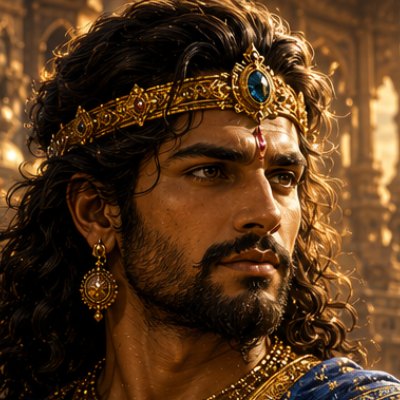
Yuvanashva I — Early Ikshvaku King, Ancestor of the Founder of Shravasti
Yuvanashva · Yuvanasva · Chandrayuvanashva (in composite form in some Puranic lists)
Yuvanashva I is a king of the Ikshvaku dynasty, the Solar lineage (Suryavamsha) that ruled the Kosala kingdom from Ayodhya. He is distinguished in the Puranic tradition as the earlier of at least two kings who bore the name Yuvanashva within the same dynastic line. His principal significance in the genealogical record is as the link between a sequence of early Ikshvaku sovereigns and the generation that founded the major city of Shravasti. He appears by name in the Vishnu Purana (Book IV, Chapter 2), the Bhagavata Purana (Canto 9, Chapter 6), and the Mahabharata (Vana Parva, Chapter 202), each of which places him in the descent from Kakutstha (also known as Puranjaya) through successive generations down to the city-founding king Shravasta and beyond him to Kuvalayashva, the celebrated demon-slayer known as Dhundhumara.
✦ The Name
The name Yuvanashva is a Sanskrit compound. The first element, yuvana, derives from the root meaning "young" or "youthful," and the second element, ashva, means "horse." The compound thus carries a sense of "he who has youthful or vigorous horses," a name consistent with the Kshatriya equestrian tradition in which the horse was the paramount symbol of royal power, conquest, and sacrifice. The name recurs across generations in the Solar dynasty, most notably in the later king Yuvanashva II, whose story of the miraculous birth of Mandhata became one of the most celebrated episodes in Puranic literature. The recurrence of the name within a single lineage made it necessary for traditional scholars and genealogical commentators to distinguish the two bearers of the name by their respective positions in the dynastic sequence.
✦ Lineage
- Dynasty: Ikshvaku dynasty (Suryavamsha / Solar lineage), ruling from Ayodhya in the Kosala kingdom.
- Distant ancestor: Kakutstha (also called Puranjaya), an early Ikshvaku king celebrated in the Puranas for his role in the war between the gods and the Asuras, in whom a portion of Vishnu is said to have resided during battle. He is named as the starting point of this particular branch of the lineage in the Vishnu Purana's genealogical recital.
- Second ancestor: King Anenas (also spelled Aneyna), son of Kakutstha, from whom the unbroken line of descent runs to Yuvanashva I.
- Great-grandfather: King Prithu, son of Anenas. Named directly in the Vishnu Purana's sequential genealogical list.
- Grandfather: King Vishvagashva (also rendered Viswagashva or Vishvagandhi in different texts), son of Prithu. He is named in both the Vishnu Purana and the Bhagavata Purana genealogical lists, and the Mahabharata's Vana Parva identifies Yuvanashva I specifically as the grandson of Vishvagashva.
- Father: King Ardra (also rendered Adri in the Mahabharata and as Candra or Indu in certain other Puranic recensions — see Textual Variants below), son of Vishvagashva.
- Son: King Shravasta, the founder of the city of Shravasti. His founding of that city is recorded in the Vishnu Purana, the Bhagavata Purana, the Brahmanda Purana, and the Matsya Purana. The Mahabharata's Vana Parva gives a variant name for this son as Shrava.
- Grandson: King Brihadashva, son of Shravasta. Named as a link in the dynastic sequence in the Bhagavata Purana (9.6.21), the Brahmanda Purana (III.63.28), the Matsya Purana (12.31), the Vayu Purana (88.27), and the Vishnu Purana (IV.2).
- Great-grandson: King Kuvalayashva, son of Brihadashva. He is celebrated across multiple Puranas as the slayer of the Asura Dhundhu and is accordingly given the title Dhundhumara. In the course of that battle, twenty-one thousand of his sons — who had accompanied him — perished in the flames that issued from the demon's body, with only three sons surviving. He is recorded in the Vishnu Purana (IV.2), the Bhagavata Purana (9.6.21), the Brahmanda Purana, and the Matsya Purana.
✦ Place in the Dynastic Sequence
The Vishnu Purana presents the lineage from Kakutstha to Yuvanashva I as a direct chain running through Anenas, Prithu, Vishvagashva, and Ardra before arriving at Yuvanashva I. The Bhagavata Purana's account of the same stretch of the Solar genealogy largely agrees with this sequence, naming Vishvagandhi (a form of the same name) as grandfather and giving the intermediate figure as Candra rather than Ardra. In all accounts, Yuvanashva I's position immediately precedes Shravasta, the city-founder, and through him precedes Brihadashva and Kuvalayashva (Dhundhumara). He is thus the progenitor of a sub-branch of the Ikshvaku line that included both a celebrated urban founder and a celebrated demon-slayer. His own reign is recorded in the genealogical sections of the Puranas without elaboration of specific military or spiritual episodes, the texts being content to fix his position in the dynastic succession as a link of recognised legitimacy between the older Kakutstha branch and the generations that followed him.
✦ Textual Variants and Inconsistencies
The primary textual inconsistency concerns the name and identity of Yuvanashva I's father, the king who stands between Vishvagashva and Yuvanashva I in the dynastic line. The Vishnu Purana (IV.2) gives his name as Ardra. The Mahabharata (Vana Parva, Chapter 202, Verse 3) calls him Adri — likely a variant spelling of the same name. However, the Bhagavata Purana (9.6.20) names this same position as Candra (son of Vishvagandhi), and certain Puranic list-traditions render the name as Indu or in composite form as Chandrayuvanashva, collapsing the two generations into a single name-compound. One widely circulated enumeration of the Solar dynasty kings identifies this figure as Chandra while also noting the equivalence Ardra or Chandra at the same generational slot. The Vishnu Purana's version, giving the unambiguous personal name Ardra, and the Bhagavata Purana's version, giving Candra, are thus the two principal accounts, and commentators have generally read them as referring to the same individual under different epithets or name-forms, though the texts themselves do not explicitly reconcile the discrepancy.
A second variant concerns the name of Yuvanashva I's son. The Vishnu Purana, the Bhagavata Purana, the Brahmanda Purana, and the Matsya Purana all give the name as Shravasta, the founder of Shravasti. The Mahabharata's Vana Parva (Chapter 202, Verse 3), however, gives the name as Shrava, presenting Shravasta as a subsequent generation derived from Shrava. Most Puranic authorities treat Shravasta and Shrava as the same individual under variant name-forms, and the city-founding narrative is uniformly associated with this figure regardless of the name-form used.
A third and important textual point concerns the distinction between Yuvanashva I and Yuvanashva II. The Puranic Encyclopedia explicitly distinguishes the two figures. Yuvanashva I is the earlier king, son of Ardra or Candra and grandson of Vishvagashva, whose son Shravasta founded Shravasti. Yuvanashva II is a later king of the same lineage, identified in the Bhagavata Purana (9.6.26–34) as son of Senajit (son of Krishashva), who, being without an heir despite a hundred wives, performed a ritual and mistakenly drank the consecrated water himself, after which the world-conquering king Mandhata was born from his abdomen. The Puranic Encyclopedia and certain secondary list-traditions also identify a third Yuvanashva — son of Vrishadarbha, mentioned in the Mahabharata's Shanti Parva (Chapter 234, Verse 15) in the context of charitable giving — and a fourth, the grandson of Mandhata, whose name appears in the Rigveda (Mandala 10, hymn 134) in the lineage of ancestors of Rama. These four distinct figures share the same name but occupy well-separated positions in the dynastic sequence.
✦ Connection to the Wider Genealogy
Yuvanashva I belongs to the main trunk of the Ikshvaku Solar lineage tracing its origin from Vaivasvata Manu — himself regarded as the progenitor of humanity in the current cosmic age and son of Vivasvan (the Sun) — through Ikshvaku, the eponymous founder of the dynasty, and through the Kakutstha branch descended from Vikukshi (Ikshvaku's son Sasada) and Kakutstha (Puranjaya). His position as father of Shravasta places him at a genealogically significant node: it is through Shravasta that the city of Shravasti, which became one of the most prominent urban centres of ancient northern India and later a site of great importance in Buddhist tradition, received its founding name and its dynastic legitimacy. Through Shravasta's son Brihadashva and that king's son Kuvalayashva (Dhundhumara), the line continued toward the later Solar kings, eventually reaching the generations of Sagara, Bhagiratha, and ultimately Rama of Ayodhya, the most celebrated figure of the Ikshvaku lineage.
✦ References
Primary Sources
- Vishnu Purana, Book IV (Vamsha Khanda), Chapter 2 — The principal genealogical source for Yuvanashva I. Gives the direct lineage Kakutstha–Anenas–Prithu–Vishvagashva–Ardra–Yuvanashva–Shravasta (founder of Shravasti)–Brihadashva–Kuvalayashva (Dhundhumara), establishing Yuvanashva I's position with precision. Available in the translation by H. H. Wilson and in the Wisdomlib edition.
- Bhagavata Purana, Canto 9, Chapter 6, Verses 20–21 — Corroborates the lineage, naming Yuvanashva as son of Candra (son of Vishvagandhi) and father of Shravasta, who founded Shravasti Puri; also names Shravasta's son as Brihadashva.
- Bhagavata Purana, Canto 9, Chapter 6, Verses 26–34 — Records the distinct episode of Yuvanashva II (son of Senajit), who drank the consecrated sacrificial water and from whose body Mandhata was miraculously born; establishes that this is a separate figure from Yuvanashva I.
- Mahabharata, Vana Parva (Book of the Forest), Chapter 202, Verse 3 — Names Yuvanashva as grandson of Vishvagashva and son of Adri, and his son as Shrava, within the Solar dynasty genealogy as recited in that section of the epic.
- Brahmanda Purana, Section III (Upodghata-pada), Chapter 63, Verse 27 — Corroborates the Ikshvaku dynastic sequence including Shravasta (son of Yuvanashva) and Brihadashva.
- Matsya Purana, Chapter 12, Verse 30–31 — Confirms Shravasta as son of Yuvanashva and Brihadashva as son of Shravasta, in its account of the Ikshvaku dynasty.
- Vayu Purana, Chapter 88, Verses 26–27 — Lists the same genealogical sequence including Shravasta (Yuvanashva's son) and Brihadashva.
- Rigveda, Mandala 10, Hymn 134 — References a Yuvanashva who is grandson of Mandhata (a much later figure in the same lineage), establishing that the name Yuvanashva recurs in a yet later generation and is distinct from Yuvanashva I.
Secondary and Reference Works
- Vettam Mani, Puranic Encyclopaedia (Motilal Banarsidass, 1975) — Article on Yuvanashva, pp. 878–879. Provides the clearest enumeration of the distinct kings named Yuvanashva in the tradition, distinguishing Yuvanashva I (father of Shravasta/Shrava), Yuvanashva II (father of Mandhata), a third Yuvanashva (son of Vrishadarbha, Shanti Parva), and a fourth (Rigvedic, grandson of Mandhata). The primary source for the scholarly separation of these figures.
- Wisdomlib Glossary, entry "Yuvanashva" (wisdomlib.org) — Compiles definitions from the Bhagavata Purana, the Puranic Encyclopedia, and Cologne Sanskrit dictionaries, providing a consolidated secondary reference for the variant genealogical accounts and Puranic citations.
- Wisdomlib Glossary, entry "Shravasta" (wisdomlib.org) — Confirms Shravasta as son of Yuvanashva and founder of Shravasti, with citations to the Bhagavata Purana (9.6.21), Brahmanda Purana (III.63.27), Matsya Purana (12.30), Vayu Purana (88.26–27), and Vishnu Purana (IV.2.38–39).
- Wisdomlib Glossary, entry "Brihadashva" (wisdomlib.org) — Confirms Brihadashva as son of Shravasta, with cross-references to the same Puranic passages.
- F. E. Pargiter, Ancient Indian Historical Tradition (1922; repr. Motilal Banarsidass, 1972) — Chapter on the Solar dynasty genealogies discusses the Ikshvaku line and the textual variants between Puranic recensions, including the intermediate generations between Prithu and Yuvanashva I.