
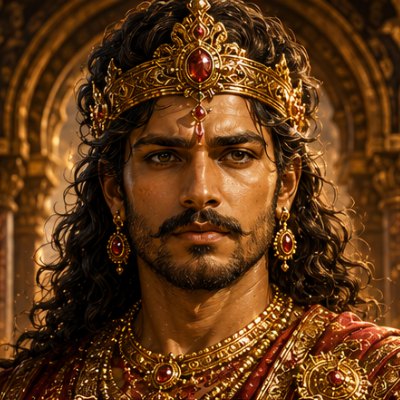
About
Shravasta — Ikshvaku King, Founder of the City of Shravasti
Shravasta · Shrava · Sravasta · Shabasta · Shravastaka
Shravasta is a king of the Ikshvaku dynasty, the Solar lineage (Suryavamsha) that ruled the Kosala kingdom from Ayodhya. His principal significance in the tradition rests on a single, consistently attested achievement: the founding of the city of Shravasti, one of the most prominent urban centres of ancient northern India, which carried his name across subsequent centuries and became the site of major events in Buddhist and Jain religious history. Shravasta appears in the genealogical recitals of the Vishnu Purana (Book IV, Chapter 2), the Bhagavata Purana (Canto 9, Chapter 6), the Brahmanda Purana, the Matsya Purana, the Vayu Purana, and the Harivamsha, in each of which his sole recorded action is the establishment of that city. He is further referenced in the genealogical sections of the Mahabharata (Vana Parva, Chapter 202) and is named in both the Cologne Sanskrit dictionaries and the Monier-Williams Sanskrit-English dictionary as a historical royal figure whose name gave rise to the feminine toponym Shravasti.
✦ The Name
The name Shravasta is Sanskrit. The Monier-Williams Sanskrit-English dictionary notes that it is probably connected with the verbal root sru, which carries the meanings of hearing, flowing, and by extension the acquisition of fame and glory — concepts closely associated with the ideal of a celebrated sovereign in the Kshatriya tradition. The feminine form of the name, Shravasti, became the toponym of the city he founded, following the common Sanskrit pattern by which a city takes the feminised name of its royal founder. The Pali equivalent, Savatthi, is the form most widely attested in Buddhist canonical literature. The name-form Shrava, which appears in certain Puranic recensions as the name of Shravasta's father rather than of Shravasta himself, reflects a closely related root form; the relationship between the two names accounts for the genealogical ambiguity found in some sources (see Textual Variants below). The Cologne Sanskrit dictionaries confirm the masculine form Shravasta as the name of a king and the feminine Shravasti as the name of the city derived from him.
✦ Lineage
- Dynasty: Ikshvaku dynasty (Suryavamsha / Solar lineage), ruling from Ayodhya in the Kosala kingdom.
- Distant ancestor: Kakutstha (also known as Puranjaya), the celebrated early Ikshvaku king associated with the defeat of the Asuras, in whose body a portion of Vishnu was said to have dwelt. He is the node from which this particular branch of the Solar lineage descends in the Puranic genealogical recitals.
- Third ancestor: King Prithu, son of Anenas (son of Kakutstha), named directly in the Vishnu Purana's sequential genealogy upstream of Shravasta.
- Great-grandfather: King Vishvagashva (also rendered Vishvagandhi or Vishtarashva in different textual traditions), son of Prithu. Named in the Vishnu Purana and Bhagavata Purana genealogical lists as the progenitor of this sub-branch of the Ikshvaku line.
- Grandfather: King Ardra (also rendered Adri in the Mahabharata, and as Candra or Indu in the Bhagavata Purana and certain related texts), son of Vishvagashva.
- Father: King Yuvanashva I, son of Ardra (or Candra). He is the predecessor of Shravasta in all primary genealogical sources and is distinguished in the tradition from the later king Yuvanashva II, whose miraculous begetting of Mandhata is a separate and celebrated Puranic episode.
- Son: King Brihadashva, named as Shravasta's son and successor in the Bhagavata Purana (9.6.21), the Vishnu Purana (IV.2), the Matsya Purana (12.31), and the Vayu Purana (88.27). The Brahmanda Purana (III.63.27) gives the son's name as Brahmadashva — a variant discussed under Textual Variants below.
- Grandson: King Kuvalayashva, son of Brihadashva, celebrated across multiple Puranas as the slayer of the demon Dhundhu and accordingly surnamed Dhundhumara. In the battle against Dhundhu — fought on behalf of the sage Uttanka — all but three of Kuvalayashva's twenty-one thousand sons were consumed by the flames issuing from the demon's body.
✦ The Founding of Shravasti
The sole act attributed to Shravasta in every primary source that names him is the establishment of the city of Shravasti. The Vishnu Purana states that the city of Shravasti was founded by him; the Bhagavata Purana records that he constructed a township known as Shravasti Puri; and the Brahmanda Purana, the Matsya Purana, and the Vayu Purana all corroborate him as the city's founder. No primary source provides details of the method, scale, or circumstances of the foundation beyond the bare fact of his authorship.
The city was situated on the banks of the river Aciravati, identified with the modern Rapti River in what is now the Shravasti district of Uttar Pradesh in northern India. In its historical period, from approximately the sixth century BCE onward, Shravasti served as the capital of the northern Kosala kingdom and was one of the six largest cities of ancient India during the lifetime of the Gautama Buddha. The Bhagavata Purana's naming of the foundation as Shravasti Puri — using the term puri, meaning a walled or fortified settlement — indicates that the tradition understood the original foundation as a planned urban centre rather than an organic settlement.
The city's later religious significance is well attested across Buddhist, Jain, and Hindu sources, though all of this significance accrued many generations after Shravasta's time. In the Buddhist tradition, Shravasti was the location where the Gautama Buddha spent the greatest number of his annual rainy-season retreats (vassa): traditional accounts place this figure at twenty-five in total, of which nineteen were spent at the Jetavana monastery (founded by the merchant Anathapindika) and six at the Pubbarama monastery (built by the laywoman Visakha). The largest single collection of discourses in the Pali canon — numbering in the hundreds — is set at Shravasti. In Jain tradition, Shravasti is identified as the birthplace of Sambhavanatha, the third Tirthankara. The Ramayana contains a separate tradition that Shravasti was established or re-established for Lava, the son of Rama, when Rama divided the Kosala kingdom between his two sons — a tradition that does not contradict the Puranic account of Shravasta's original foundation but represents an independent narrative layer.
✦ Textual Variants and Inconsistencies
The most significant genealogical variant concerns whether Shravasta is the direct son of Yuvanashva I or whether an intermediate generation — a king named Shrava — stands between them. The Vishnu Purana, the Bhagavata Purana, the Brahmanda Purana, the Matsya Purana, and the Vayu Purana all treat Shravasta as the direct son of Yuvanashva. The Puranic Encyclopedia, however, records Shravasta as the son of King Shrava, who is himself the son of Yuvanashva. The Mahabharata's Vana Parva (Chapter 202, Verse 3) similarly gives the name of Yuvanashva I's son as Shrava rather than Shravasta, implying that Shravasta is a grandson of Yuvanashva I in that recension. The Cologne Sanskrit dictionaries, following the Harivamsha and Vishnu Purana, describe Shravasta as son of Shrava and grandson of Yuvanashva, thus supporting the three-generation reading even within texts that elsewhere seem to collapse the two figures. The most probable explanation, accepted by traditional commentators, is that Shrava and Shravasta are variant names of the same individual, and the discrepancy is one of name-form rather than of actual genealogical position — but the primary sources themselves do not explicitly reconcile the matter.
A second variant concerns the name of Shravasta's son. The Bhagavata Purana, the Vishnu Purana, the Matsya Purana, and the Vayu Purana give the son's name as Brihadashva. The Brahmanda Purana (III.63.27), however, names the son as Brahmadashva. The Cologne Purana Index follows the Brahmanda Purana in this reading. Most Puranic authorities treat Brihadashva and Brahmadashva as variant name-forms of the same king, but the two readings are textually distinct.
Regarding the city itself, multiple traditions offer competing etymologies for the name Shravasti. The Puranic tradition derives the name directly from the king Shravasta. Buddhist tradition attributes the name to a sage named Savattha who is said to have dwelled in the area. A third popular etymology, preserved in later Pali sources, derives the name from the phrase sabbam atthi ("we have everything"), reflecting the city's legendary prosperity. The Mahabharata's account attributes the name to the king Shravasta without ambiguity, and this is consistent with the Puranic genealogical record.
✦ Connection to the Wider Genealogy
Shravasta stands at a pivotal point in the Ikshvaku dynastic sequence. He is descended through a chain of seven or eight generations from Kakutstha (Puranjaya), who was himself an early hero of the Solar line. Through his son Brihadashva and grandson Kuvalayashva (Dhundhumara), Shravasta is the progenitor of the branch of the lineage that continued — through the three sons of Kuvalayashva who survived the battle with Dhundhu, namely Dridashva, Chandrasva, and Kapilashva — down through successive generations to eventually reach Krishashva and his son Senajit, and thence to Yuvanashva II, the father of the celebrated emperor Mandhata. Mandhata is described in both epic and Puranic sources as a world-conquering sovereign and is associated with the composition of a hymn in the Rigveda (Mandala 10). Beyond Mandhata, the lineage proceeds through Purukutsa, Trasadasyu, Sambhuta, and many further generations to the later Solar kings including Sagara, Bhagiratha, Dilipa, Raghu, Dasharatha, and ultimately Rama of Ayodhya. Shravasta is thus an ancestor, many generations removed, of the most celebrated figure of the Ikshvaku line. The city he founded continued to bear his name through all subsequent history and served as the capital of the Kosala kingdom during the very era when the Solar dynasty's later royal descendants — kings such as Prasenajit — ruled from that same city.
✦ References
Primary Sources
- Vishnu Purana, Book IV (Vamsha Khanda), Chapter 2 — States directly that the city of Shravasti was founded by Shravasta, son of Yuvanashva, and names his son as Brihadashva, whose son was Kuvalayashva (Dhundhumara). The primary Puranic source for Shravasta's city-founding act. Available in H. H. Wilson's translation and at the Wisdomlib edition.
- Bhagavata Purana, Canto 9, Chapter 6, Verse 21 — Confirms Shravasta as son of Yuvanashva (son of Candra), records that he constructed Shravasti Puri, and names his son as Brihadashva.
- Brahmanda Purana, Section III (Upodghata-pada), Chapter 63, Verse 27 — Corroborates Shravasta as son of Yuvanashva and founder of Shravasti; names the son as Brahmadashva (the principal variant to Brihadashva).
- Matsya Purana, Chapter 12, Verse 30 — Confirms the lineage Yuvanashva–Shravasta–Brihadashva and the founding of Shravasti by Shravasta.
- Vayu Purana, Chapter 88, Verses 26–27 — Confirms the same lineage and the city-founding act in its account of the Ikshvaku dynasty.
- Harivamsha — Named by the Monier-Williams dictionary as a source attesting to Shravasta as a royal figure and as the individual from whom the city of Shravasti derived its name.
- Mahabharata, Vana Parva (Book of the Forest), Chapter 202, Verse 3 — Names Shrava (the variant form) as son of Yuvanashva in the Solar dynasty genealogy; the city's foundation is associated with this figure in the epic tradition.
- Ramayana (various recensions) — Contains the tradition that Shravasti was established or assigned to Lava, son of Rama, as his capital — a parallel foundation tradition distinct from the Puranic account.
Secondary and Reference Works
- Vettam Mani, Puranic Encyclopaedia (Motilal Banarsidass, 1975) — Article on Shravasta: places him as son of King Shrava (who is himself son of Yuvanashva), thus recording the three-generation reading that interposes Shrava between Yuvanashva and Shravasta.
- Sir Monier Monier-Williams, Sanskrit-English Dictionary (Oxford, 1899; repr. Motilal Banarsidass) — Entry on Shravasta: gives the name as masculine, identifies him as a king, notes the probable connection with the root sru, and cites both the Harivamsha and the Vishnu Purana as sources. The feminine form Shravasti is listed as the derived city name.
- Cologne Digital Sanskrit Dictionaries, The Purana Index (University of Cologne) — Entry on Shravasta: identifies him as son of Yuvanashva and founder of Shravasti; gives his son as Brahmadashva (following the Brahmanda Purana reading); cross-references the Matsya Purana and Vayu Purana.
- Wisdomlib Glossary, entry "Shravasta" (wisdomlib.org) — Compiles definitions from the Bhagavata Purana, the Puranic Encyclopedia, and the Cologne dictionaries; the primary online secondary reference consolidating the variant genealogical accounts.
- Wisdomlib Glossary, entry "Shravasti" (wisdomlib.org) — Notes the city as capital of Uttara-Kosala and places it within the Ikshvaku dynastic context; includes references to Lava's rule there per the Puranic tradition.
- Wikipedia, article "Shravasti" (en.wikipedia.org) — Summarises the city's founding attribution from the Bhagavata Purana, its Buddhist significance, its identification with the Saheth-Maheth archaeological site, and its location on the Rapti River; notes the scholarly consensus on the number of vassas the Buddha spent there.
- F. E. Pargiter, Ancient Indian Historical Tradition (1922; repr. Motilal Banarsidass, 1972) — Discusses the Solar dynasty genealogies across Puranic recensions and addresses the variant name-forms (Shrava / Shravasta) within the Ikshvaku succession.