
About
Brihadashva — Ikshvaku King, Father of Kuvalayashva (Dhundhumara)
Brihadashva · Vrihadaswa · Brihad-ashva · Brahmadashva (Brahmanda Purana variant) · Rajarishi
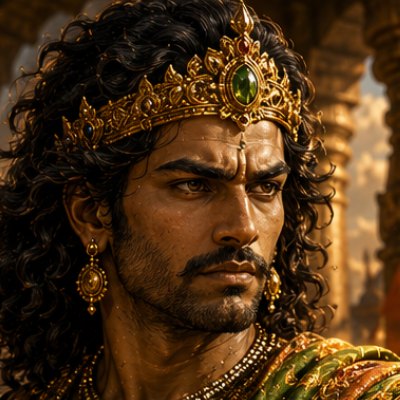
Brihadashva is a king of the Ikshvaku dynasty, the Solar lineage (Suryavamsha) that ruled the Kosala kingdom from Ayodhya. He is the son of Shravasta — the founder of the city of Shravasti — and the father of Kuvalayashva, the celebrated Ikshvaku warrior who slew the subterranean Asura Dhundhu and thereby earned the enduring epithet Dhundhumara. Brihadashva's principal significance in the Puranic and epic traditions lies in the episode of his abdication: having installed his son on the throne and resolved to depart for the forest in pursuit of ascetic practice, he was approached by the sage Utanka with an appeal to exterminate Dhundhu. Brihadashva replied that, having already laid aside his weapons, the task fell rightly to his son, and then departed as planned. This episode is narrated at length in the Mahabharata (Vana Parva, Sections CC through CCIII) and is corroborated in the genealogical and narrative sections of the Vishnu Purana, the Bhagavata Purana, the Brahmanda Purana, the Matsya Purana, and the Vayu Purana. He bears the title of Rajarishi — a royal sage — in the Puranic Index, signifying recognition of both his royal and spiritual standing.
✦ The Name
The name Brihadashva is a Sanskrit compound formed from brihad (large, great, mighty) and ashva (horse). The compound thus means "he who possesses large or mighty horses," a name that evokes the martial and sacrificial traditions of Kshatriya kingship in which the horse — central to the Ashvamedha sacrifice and to cavalry power — was the supreme symbol of sovereign authority. The same root ashva appears across the names of many kings in the Ikshvaku lineage, reflecting a consistent naming pattern within the Solar dynasty. The Brahmanda Purana records the name of Shravasta's son as Brahmadashva rather than Brihadashva; this is treated by most authorities as a variant name-form rather than a distinct individual (see Textual Variants below). The Mahabharata consistently uses the form Vrihadaswa in the Ganguli transliteration, which is the same name in an older English rendering.
✦ Lineage
- Dynasty: Ikshvaku dynasty (Suryavamsha / Solar lineage), ruling from Ayodhya in the Kosala kingdom.
- Great-grandfather: King Vishvagashva (also rendered Vishvagandhi in the Bhagavata Purana), son of Prithu. The progenitor of this sub-branch of the Ikshvaku line in the genealogical recitals of the Vishnu Purana and Bhagavata Purana.
- Grandfather: King Ardra (also rendered Adri in the Mahabharata; Candra or Indu in certain Puranic recensions), son of Vishvagashva. The variant name-forms across texts are discussed in the Yuvanashva I entry of this series.
- Father: King Yuvanashva I, son of Ardra. He is the earlier of at least two kings named Yuvanashva in the Solar dynasty, distinguished from Yuvanashva II, whose miraculous begetting of the world-emperor Mandhata is a separate and celebrated Puranic episode occurring several generations later.
- Father's father: King Shravasta, son of Yuvanashva I, who founded the city of Shravasti and from whom the city took its name. His founding act is recorded in the Vishnu Purana, the Bhagavata Purana, the Brahmanda Purana, the Matsya Purana, and the Vayu Purana.
- Son: King Kuvalayashva, surnamed Dhundhumara. He is the hero of the demon-slaying narrative related in the Mahabharata and the Vishnu Purana: imbued with a portion of Vishnu's energy at Utanka's behest, he led a vast force to the desert of Ujjalaka and slew the Asura Dhundhu after excavating the sands for seven days.
- Grandsons: Of Kuvalayashva's twenty-one thousand sons, all but three perished in the flames that issued from Dhundhu's body. The three survivors were Dridashva, Kapilashva, and Chandraswa (rendered Dridaswa, Kapilaswa, and Chandraswa in the Ganguli translation of the Mahabharata). From these three the Solar lineage continued toward its later generations.
✦ The Abdication and the Encounter with Sage Utanka
The narrative most closely associated with Brihadashva concerns the circumstances of his transition from active kingship to forest asceticism. According to the Mahabharata (Vana Parva, Sections CC through CCII), Brihadashva had raised a son — Kuvalayashva — who excelled his father in every quality. When the time came, Brihadashva formally installed Kuvalayashva on the throne and then prepared to retire into the forest for ascetic practice. The text of the Mahabharata describes him at this juncture as a royal sage of great intelligence.
Learning of Brihadashva's impending departure, the sage Utanka — who had long maintained his hermitage in a desolate wilderness — came before the king and urged him to remain. Utanka declared that a king's true duty was to protect the people, a merit no forest retreat could equal, and then disclosed the specific cause of his appeal. Near his hermitage lay the Ujjalaka, a vast expanse of sand stretching many yojanas in all directions, without water and lying over a flat country. Within its depths, buried beneath the sands in his underground cave, dwelt the Danava Dhundhu, son of the ancient demons Madhu and Kaitabha — those very Asuras whom Vishnu had slain at the dawn of creation. Possessed of great energy, Dhundhu lay practicing intense austerities with the object of gaining dominion over the three worlds. Each time the demon breathed, the earth trembled, and fires and smoke issued from the sands, disturbing the sun and disrupting Utanka's rituals for an entire week at a time.
Brihadashva received Utanka's appeal with full respect and, folding his hands, replied that his visit would not go unrewarded. He acknowledged that he had already laid aside his weapons and formally resigned the duty of active protection. In his place, he presented his son Kuvalayashva as equal to the task: a warrior of steadiness, activity, and unequalled prowess on earth, accompanied by all his brave sons. Brihadashva then gave his blessing and instructed Kuvalayashva to proceed, after which the royal sage departed for the forest as he had intended. This speech and departure, rendered in Section CCII of the Vana Parva, are the fullest direct characterisation of Brihadashva's voice and values recorded in the primary sources.
The subsequent campaign of Kuvalayashva, led under divine sanction and filled by Vishnu himself with celestial energy, resulted in the slaying of Dhundhu and the death of all but three of Kuvalayashva's sons in the process. For this feat Kuvalayashva received from that point forward the name Dhundhumara — Slayer of Dhundhu. The heavens rained flowers, and the gods, Gandharvas, and great sages gathered to witness the encounter. The three surviving sons — Dridashva, Kapilashva, and Chandraswa — became the progenitors of the continuing Solar line. The overall narrative, recounted to Yudhishthira by the sage Markandeya, is set within the larger frame of the Pandavas' forest exile and serves to illustrate the theme of divinely ordained cosmic protection carried out through heroic kingship.
The Vishnu Purana (IV.2) corroborates the essential structure of the narrative: Shravasta's son was Brihadashva, whose son was Kuvalayashva, who destroyed the Asura Dhundhu — thereby receiving his epithet — at the request of the sage Uttanka (rendered Uttanka in the Vishnu Purana; Utanka in the Mahabharata). The Bhagavata Purana (9.6.21) likewise confirms the line Shravasta–Brihadashva–Kuvalayashva and notes the demon-slaying as the deed that gave Kuvalayashva his additional name.
✦ Brihadashva as Sage in the Nalopakhyana
A figure named Vrihadaswa (Brihadashva) also appears in a quite different episode of the Mahabharata's Vana Parva — the Nalopakhyana, or story of Nala, found in Section 52. In that passage, a sage or ascetic named Vrihadaswa visits the Pandavas at the Kamyaka forest while they are in exile. Yudhishthira laments that no man can have suffered misfortune greater than his own, whereupon Vrihadaswa consoles him by narrating the story of the Nishadha king Nala, whose ordeal through gambling and forest exile was in certain respects still more extreme. The sage also imparts to Yudhishthira the Aksha-hridaya, the secret knowledge of dice, before departing.
The Puranic Encyclopedia explicitly distinguishes this sage-Vrihadaswa from the Ikshvaku king Brihadashva who is the subject of the Dhundhu narrative. The two are separate figures who happen to share the same name. The sage who narrates the Nala story is not given a dynastic or genealogical identity in the Mahabharata text itself, while the Ikshvaku king's entire significance is genealogical and his presence in the Vana Parva belongs to a quite different narrative frame (Sections CC–CCIII, delivered as part of Markandeya's discourses). Conflating the two figures — as some secondary sources do — results in an inaccurate composite.
✦ Textual Variants and Inconsistencies
The primary variant concerns Brihadashva's name. The Bhagavata Purana, the Vishnu Purana, the Matsya Purana, and the Vayu Purana all give the name Brihadashva. The Brahmanda Purana (III.63.27–28), however, gives the same position in the lineage as Brahmadashva. The Cologne Purana Index, following the Brahmanda Purana, records the name as Brahmadashva while cross-referencing it with the Brihadashva of the other texts. Traditional scholars treat these as variant name-forms of the same individual, but the two readings are distinct in their respective texts.
A second variant concerns Brihadashva's father. The Bhagavata Purana (9.6.21) identifies the father straightforwardly as Shravasta, who is himself the son of Yuvanashva, who is the son of Candra (son of Vishvagandhi). The Mahabharata's Vana Parva (Section CCI, Ganguli translation) gives a slightly compressed lineage: from Anenas to Prithu to Viswagaswa to Adri to Yuvanaswa to Sravastha (founder of Shravasti) to Vrihadaswa — omitting the intermediate Candra/Ardra figure and placing the lineage as Yuvanaswa directly to Sravastha. This compression is consistent with the Mahabharata's tendency toward abbreviated genealogical recitals and does not represent a genuine contradiction with the Puranic sequence.
A third matter requiring note is the attribution of "twenty-one thousand sons" across sources. The primary texts — the Mahabharata, the Vishnu Purana, and the Bhagavata Purana — consistently attribute the twenty-one thousand sons to Kuvalayashva, not to Brihadashva himself. The Cologne Purana Index records Brihadashva as "father of 21000 sons" as a compressed secondary description, meaning he was the father of the king who had those sons; this compressed phrasing should not be taken to mean that the twenty-one thousand sons were Brihadashva's own children.
✦ Connection to the Wider Genealogy
Brihadashva stands at the generational midpoint between the city-founding Shravasta and the battle-hero Kuvalayashva (Dhundhumara). Through Kuvalayashva's three surviving sons — Dridashva, Kapilashva, and Chandraswa — the Solar lineage passed forward through successive generations: Dridashva's son was Haryashva, whose son was Nikumbha, whose son was Sanhatashva (or Bahulashva in some lists), whose son was Krishashva (or Krishasva), whose son was Prasenajit I, and from Prasenajit came Yuvanashva II. Yuvanashva II is the Ikshvaku king whose miraculous drinking of consecrated sacrificial water resulted in the birth of the world-conquering emperor Mandhata from his own body — one of the most celebrated episodes in Puranic literature. From Mandhata the line proceeded through Purukutsa, Trasadasyu, and many further generations to Sagara, Bhagiratha, Dilipa, Raghu, Dasharatha, and Rama of Ayodhya. Brihadashva is thus an ancestor many generations removed of the most celebrated figure of the Ikshvaku lineage, with his own place in the genealogy securely fixed between the city-builder Shravasta and the demon-slayer Kuvalayashva.
✦ References
Primary Sources
- Mahabharata, Vana Parva (Book of the Forest), Section CC (Chapter 200, Ganguli numbering) — Contains Vishnu's prophecy to Utanka foretelling that a king of Ikshvaku's race named Vrihadaswa will father Kuvalaswa, who will slay Dhundhu. Establishes the divine foreknowledge framing the narrative.
- Mahabharata, Vana Parva, Section CCI (Chapter 201) — Narrates Brihadashva's installation of Kuvalayashva on the throne, his preparation to retire to the forest, Utanka's approach and plea, the description of Dhundhu hidden beneath the sands of Ujjalaka, and Utanka's account of the demon's parentage (son of Madhu and Kaitabha) and the disruption of his sacrifices. Also contains the genealogical sequence from Anenas down to Vrihadaswa and Kuvalaswa.
- Mahabharata, Vana Parva, Section CCII (Chapter 202) — Records Brihadashva's direct reply to Utanka: that having laid aside his weapons he directs the task to his son Kuvalayashva, whose prowess he commends, and then departs for the forest. The primary textual source for Brihadashva's own words.
- Mahabharata, Vana Parva, Section CCIII (Chapter 203) — Narrates the march of Kuvalayashva and his twenty-one thousand sons to Ujjalaka, infused with Vishnu's energy; the seven-day excavation; the appearance and slaying of Dhundhu; the deaths of all but three sons (Dridashva, Kapilashva, Chandraswa); and the conferring of the name Dhundhumara on Kuvalayashva.
- Mahabharata, Vana Parva, Section 52 (Nalopakhyana Parva) — A separate episode in which a sage also named Vrihadaswa visits the Pandavas in the Kamyaka forest, consoles Yudhishthira after his loss at dice by narrating the story of Nala, and imparts the Aksha-hridaya. The Puranic Encyclopedia identifies this sage as a distinct person from the Ikshvaku king Brihadashva.
- Vishnu Purana, Book IV (Vamsha Khanda), Chapter 2 — Records the direct lineage Shravasta–Brihadashva–Kuvalayashva (Dhundhumara) and notes that Kuvalayashva destroyed the Asura Dhundhu at the behest of the sage Uttanka, with the spirit of Vishnu infused within him.
- Bhagavata Purana, Canto 9, Chapter 6, Verse 21 — Confirms Brihadashva as son of Shravasta and father of Kuvalayashva; provides the lineage trace from Vishvagandhi through Candra, Yuvanashva, and Shravasta down to Brihadashva.
- Brahmanda Purana, Section III, Chapter 63, Verse 28 — Corroborates the genealogical position of Brihadashva (under the variant name Brahmadashva) as son of Shravasta and father of Kuvalayashva.
- Matsya Purana, Chapter 12, Verse 31 — Confirms Brihadashva as son of Shravasta in the Ikshvaku dynastic sequence.
- Vayu Purana, Chapter 88, Verses 27–30 — Corroborates the lineage and records Brihadashva's retirement, Utanka's appeal, and the Dhundhu episode in its account of the Solar dynasty.
- Harivamsha — Named alongside the Vishnu Purana in the Cologne Sanskrit dictionary entry as a source attesting Brihadashva's genealogical position.
Secondary and Reference Works
- Vettam Mani, Puranic Encyclopaedia (Motilal Banarsidass, 1975) — Entry on Brihadashva: distinguishes the Ikshvaku king from the sage of the Nalopakhyana and from a third Brihadashva (future king, son of Sahadeva, referenced in Bhagavata Purana 9.12.11); gives the Mahabharata chapter reference for the king as Vana Parva, Chapter 122, Stanza 7.
- Cologne Digital Sanskrit Dictionaries, The Purana Index (University of Cologne) — Entry on Brihadashva: identifies him as son of Shava/Shravasta; describes him as a Rajarishi who retired to the forest after consecrating his son; records the Utanka episode; and notes the Brahmadashva variant from the Brahmanda Purana. Cross-references Bhagavata Purana IX.6.21, Brahmanda Purana III.63.28, Matsya Purana 12.31, Vayu Purana 88.27–30, and Vishnu Purana IV.2.38–39.
- Wisdomlib Glossary, entry "Brihadashva" (wisdomlib.org) — Compiles definitions from the Bhagavata Purana, the Puranic Encyclopedia, and the Cologne Purana Index; notes the three distinct individuals bearing this name in the Mahabharata tradition.
- Kisari Mohan Ganguli (trans.), The Mahabharata (Munshiram Manoharlal, repr. 1970) — The primary complete English translation of the Mahabharata used for Vana Parva Sections CC–CCIII; the source for the direct speech of Vrihadaswa in reply to Utanka (Section CCII) and for the surviving sons' names (Dridashva, Kapilashva, Chandraswa, Section CCIII).
- F. E. Pargiter, Ancient Indian Historical Tradition (1922; repr. Motilal Banarsidass, 1972) — Discusses the Solar dynasty genealogies across Puranic recensions, including the Brihadashva–Kuvalayashva generation and the textual variants within that stretch of the Ikshvaku succession.