
About
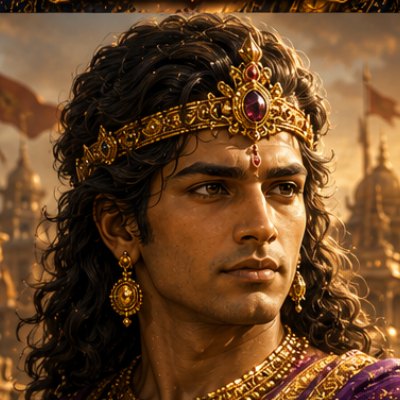
Kuvalayashva — Ikshvaku King, Slayer of Dhundhu, Surnamed Dhundhumara
Kuvalayashva · Kuvalasva · Dhundhumara · Dhundhumarika · Kuvalashva
Kuvalayashva is a king of the Ikshvaku dynasty, the Solar lineage (Suryavamsha) that ruled the Kosala kingdom from Ayodhya. He is the son of Brihadashva — the pious Ikshvaku king who abdicated his throne for forest asceticism — and the grandson of Shravasta, the founder of the city of Shravasti. Kuvalayashva's enduring fame in the tradition rests on a single, decisive act: the slaying of the Asura Dhundhu, a son of the ancient demons Madhu and Kaitabha, who lay buried beneath the desert sands of the Ujjalaka wilderness and disturbed the sacrifices of the sage Utanka. For this act, performed at Utanka's request and with the energy of Vishnu infused within him, Kuvalayashva received the perpetual epithet Dhundhumara, meaning "the slayer of Dhundhu." The narrative is recorded at length in the Mahabharata (Vana Parva, Sections CC through CCIII), the Vishnu Purana (Book IV, Chapter 2), the Bhagavata Purana (Canto 9, Chapter 6), and the Harivamsha (Adi Parva, Chapter 11), with additional mention in the Matsya Purana and the Vayu Purana.
✦ The Name
The name Kuvalayashva is a Sanskrit compound. The first element, kuvalaya, denotes the blue water-lily (the lotus of the genus Nymphaea), and the second, ashva, means horse. The compound thus carries a sense of "he who has horses (resplendent) like blue lotuses," a poetic name in keeping with the Solar dynasty's consistent use of the horse as its central symbol of royal power. The epithet Dhundhumara is a straightforward compound from Dhundhu (the demon's name) and mara (slayer), meaning literally "the slayer of Dhundhu." The Mahabharata explicitly remarks that this name was no empty title but a literally true one. The Monier-Williams Sanskrit-English dictionary lists Kuvalayashva as a royal name in the Vishnu Purana, with the feminine form Dhundhumari attested as a derivative. The Cologne Sanskrit dictionaries note a second figure bearing the name Kuvalayashva — a king of the Lunar dynasty (also known as Ritadhvaja or Dyuman) recorded in the Bhagavata Purana (9.17.5–6) — entirely distinct from the Ikshvaku king who is the subject of this profile.
✦ Lineage
- Dynasty: Ikshvaku dynasty (Suryavamsha / Solar lineage), ruling from Ayodhya in the Kosala kingdom.
- Great-grandfather: King Yuvanashva I, son of Ardra (or Candra in the Bhagavata Purana), the earlier of at least two Ikshvaku kings who bore the name Yuvanashva. He is distinguished from Yuvanashva II, whose miraculous begetting of Mandhata is a separate Puranic episode.
- Grandfather: King Shravasta, son of Yuvanashva I. He is recorded in the Vishnu Purana, the Bhagavata Purana, the Brahmanda Purana, the Matsya Purana, and the Vayu Purana as the founder of the city of Shravasti, which carried his name across all subsequent history.
- Father: King Brihadashva (also rendered Vrihadaswa), son of Shravasta. A king of great merit who installed Kuvalayashva on the throne and then retired to the mountains for ascetic practice. He is described in the Mahabharata as a Rajarishi — a royal sage.
- Sons: According to the Mahabharata (Vana Parva, Section CCI) and the Vishnu Purana, Kuvalayashva had twenty-one thousand sons, all of whom accompanied him to battle Dhundhu; all but three were consumed by the fire issuing from the demon's mouth. The three who survived were Dridhashva (also Dridashva), Kapilashva (also Kapilaswa), and a third son whose name varies by source — the Vishnu Purana and the Mahabharata give this son as Chandrasva (Chandraswa), while the Bhagavata Purana gives Bhadrashva (see Textual Variants). From Dridhashva, the eldest survivor, the subsequent Solar lineage of Ayodhya descended.
✦ Dhundhu: The Demon and the Threat
The Mahabharata (Vana Parva, Section CCIII) presents an account of Dhundhu's identity and the nature of his threat. Dhundhu was a Danava — a son of the ancient demons Madhu and Kaitabha, those very beings whom Vishnu had slain at the dawn of creation. Motivated by the memory of his parents' deaths at Vishnu's hands, Dhundhu performed intense austerities of great severity — standing on one leg and reducing his body to a mass of veins and arteries — with the aim of obtaining a boon that would grant him sovereignty over the three worlds. Brahma, gratified by these austerities, granted him the boon he sought: that no being among the gods, Danavas, Rakshasas, serpents, Gandharvas, or Rakshasas could slay him. Armed with this protection, Dhundhu vanquished the gods and even distressed Vishnu himself, until at last he withdrew and buried himself beneath a vast expanse of sand known as the Ujjalaka, in a desolate, flat, waterless country stretching many yojanas in extent. There he lay in his subterranean cave, continuing his ascetic practice. Once each year he exhaled a great breath: the earth shook, fires and dust erupted from the sands, the sky was darkened for a week, and the ritual observances of the sage Utanka — whose hermitage bordered the Ujjalaka — were systematically disrupted.
The Harivamsha and certain Puranic recensions describe the country of the Ujjalaka under the name Marudhanva, identifying it as a barren sandy waste in a region associated with the desert landscape of western India. The Cologne Purana Index records variant traditions for Dhundhu's parentage: the Bhagavata Purana, the Brahmanda Purana, and the Matsya Purana name his father as Pitriyudha (or Pitreyudha) rather than Madhu; another tradition makes him a son of Madhu the Rakshasa (distinct from Madhu the demon paired with Kaitabha); and a fourth account, from the Saurapurana, identifies a different Dhundhu as son of Rohita and grandson of Harishchandra — an entirely distinct figure of the same name in the Solar lineage itself (see Textual Variants).
✦ The Dhundhu Narrative: Encounter and Victory
Vishnu, during his earlier appearance before Utanka, had already foretold that a king of Ikshvaku's race named Vrihadaswa would have a son named Kuvalaswa, and that it was this son who was destined to slay Dhundhu. When the time came and Brihadashva installed Kuvalayashva on the throne and prepared to retire to the forest, Utanka arrived at court and urged the king to remain. Brihadashva replied that he had already laid aside his weapons, but directed Utanka to his son: Kuvalayashva was, he said, endowed with steadiness, activity, and prowess unequalled on earth, and fully capable of the task. He then departed for the mountains.
Kuvalayashva set out with his sons and the sage Utanka for the Ujjalaka desert. As the force marched, Vishnu infused Kuvalayashva with his own divine energy at Utanka's direction and for the welfare of the three worlds. A voice was heard in the sky proclaiming the hero's imminent victory, gods rained flowers upon the march, and celestial drums sounded without being played. Upon arriving at the desert, Kuvalayashva ordered its excavation. After seven days of digging, the force uncovered Dhundhu lying in the western part of the desert, blazing with his own energy like the sun itself. The demon, roused from his recumbent posture in wrath, unleashed fire, smoke, and torments that consumed virtually all of Kuvalayashva's sons as they pressed the assault.
Kuvalayashva himself, however, could not be harmed. The Harivamsha account records that he drew upon a yogic power to absorb or drink up the demon's watery and fiery energy, quenching the fires with water, and then advanced to slay Dhundhu directly. The Mahabharata attributes his invincibility throughout to the divine energy of Vishnu that pervaded him. Having slain the demon, the assembled gods, sages, and Utanka came before Kuvalayashva and invited him to ask for boons. He asked for five: the power always to bestow wealth upon worthy Brahmanas; invincibility against all enemies; friendship with Vishnu; freedom from ill-feeling toward any creature; and perpetual dwelling in heaven at the end of his life. The gods, the sages, and Utanka granted all five, and departed to their respective abodes. From that day, the king was celebrated as Dhundhumara throughout the three worlds.
✦ Theological Significance
The Dhundhu narrative carries explicit theological weight as a story of Vishnu's protective function operating through the medium of a human hero. In the Mahabharata's framing, the sage Markandeya recounts the story to Yudhishthira during the Pandavas' forest exile, and the account is presented as a narrative connected to the glory of Vishnu: listening to it confers virtue, progeny, long life, and good fortune. The Mahabharata emphasises that Kuvalayashva's role was not purely his own but was the instrument of a divine plan announced by Vishnu himself to Utanka: the king was preordained as the agent of cosmic protection, and Vishnu's energy literally entered and animated him during the campaign. The Harivamsha account similarly stresses that it was the resplendence of Vishnu that filled Kuvalayashva for the welfare of the worlds. This pattern — the earthly king as vehicle of Vishnu's protective energy — recurs in the Puranic tradition as a standard motif in the Ikshvaku dynastic narrative and is one of the defining theological threads of the Solar lineage's self-presentation.
✦ Textual Variants and Inconsistencies
The most numerically significant variant concerns the number of Kuvalayashva's sons. The Mahabharata (Vana Parva, Section CCI) and the Vishnu Purana both give the number as twenty-one thousand. The Harivamsha (Adi Parva, Chapter 11, verse 44 in the Sanskrit text) states explicitly that Kuvalayashva journeyed with his hundred sons. The Cologne Purana Index notes this discrepancy directly, giving twenty-one thousand as the Vishnu Purana figure and one hundred as the Harivamsha figure. The two accounts are irreconcilable on this point, and the texts do not explain the difference.
A second variant concerns the name of the third surviving son. The Vishnu Purana and the Mahabharata agree on Dridhashva and Kapilashva but give the third as Chandrasva (Chandraswa in Ganguli's translation). The Bhagavata Purana (9.6.23–24) agrees on Dridhashva and Kapilashva but gives the third as Bhadrashva. The Wisdomlib Bhagavata Purana glossary follows the Bhagavata Purana in naming Bhadrashva, while the Cologne Purana Index, following the combined evidence, lists Dridashva, Bhadrashva, and Kapilashva. The differences are not reconciled in the primary texts themselves.
A third variant concerns Dhundhu's parentage. The Mahabharata (Vana Parva, Section CCIII) identifies him consistently as the son of Madhu and Kaitabha — the two primordial Asuras slain by Vishnu at the dawn of creation. However, the Cologne Purana Index, drawing on the Bhagavata Purana (9.6.22), the Brahmanda Purana, and the Matsya Purana, names Dhundhu's father as Pitriyudha, not Madhu. A further Puranic tradition names his father as Madhu the Rakshasa (a different Madhu from the cosmogonic demon paired with Kaitabha). The Saurapurana adds further complexity by mentioning a separate Dhundhu who was son of Rohita and grandson of Harishchandra — an Ikshvaku king of the same lineage several generations later — a coincidence of names that is wholly unrelated to the Asura Dhundhu of the Ujjalaka narrative.
✦ Connection to the Wider Genealogy
Kuvalayashva stands at a critical juncture in the Ikshvaku dynastic sequence. Through his son Dridhashva, the Solar lineage continued through Haryashva (son of Dridhashva), then Nikumbha, Sanhatashva (also recorded as Bahulashva in certain lists), Krishashva (also Krishasva), Prasenajit I, and finally Yuvanashva II. Yuvanashva II is the Ikshvaku king who, being without an heir despite a hundred wives, performed a sacrificial ritual during which he mistakenly drank the consecrated water, with the result that the world-conquering emperor Mandhata was born from his own body. Mandhata — celebrated in both Puranic and Vedic literature and credited with the composition of Rigveda Mandala 10, hymn 134 — is regarded as one of the greatest rulers of the Solar dynasty, and his lineage proceeded through Purukutsa, Trasadasyu, and many further generations to eventually reach Sagara, Bhagiratha, Dilipa, Raghu, Dasharatha, and Rama of Ayodhya. Kuvalayashva is accordingly an ancestor many generations removed of the most celebrated figure of the Ikshvaku lineage, and the three sons who survived the Dhundhu battle — Dridhashva, Kapilashva, and Chandrasva (or Bhadrashva) — are the sole conduits through whom that lineage passed forward from his generation.
✦ References
Primary Sources
- Mahabharata, Vana Parva, Section CC (Chapter 200, Ganguli numbering) — Vishnu's prophecy to Utanka naming Vrihadaswa and his son Kuvalaswa as the instrument of Dhundhu's destruction; establishes the divine-plan framing of the entire narrative.
- Mahabharata, Vana Parva, Section CCI (Chapter 201) — Full genealogical recital from Anenas to Kuvalaswa; description of the Ujjalaka desert and Dhundhu's disruption of Utanka's rituals; Utanka's approach to Brihadashva.
- Mahabharata, Vana Parva, Section CCII (Chapter 202) — Brihadashva's direction of the task to Kuvalayashva and his departure to the forest.
- Mahabharata, Vana Parva, Section CCIII (Chapter 203) — Dhundhu's mythological identity as son of Madhu and Kaitabha; his boon from Brahma; Kuvalayashva's march with his twenty-one thousand sons; Vishnu's infusion of divine energy; the seven-day excavation; the slaying of Dhundhu; the deaths of all sons except Dridashva, Kapilashva, and Chandraswa; the five boons asked and granted; conferring of the name Dhundhumara. The primary and most detailed narrative source.
- Vishnu Purana, Book IV (Vamsha Khanda), Chapter 2, Verses 39–42 — Confirms the lineage Brihadashva–Kuvalayashva, names the twenty-one thousand sons, states three survivors (Dridhashva, Chandrasva, and Kapilashva), and gives the subsequent lineage through Haryashva, Nikumbha, Sanhatashva, Krishasva, Prasenajit, and Yuvanashva II.
- Bhagavata Purana, Canto 9, Chapter 6, Verses 21–24 — Confirms Kuvalayashva as son of Brihadashva and grandson of Shravasta; records the slaying of Dhundhu with the help of twenty-one thousand sons; names the three survivors as Dridhashva, Kapilashva, and Bhadrashva (the variant differing from the Vishnu Purana and Mahabharata on the third name).
- Harivamsha, Adi Parva (Harivamsha Parva), Chapter 11 — Narrates the same episode with Kuvalayashva's hundred sons (rather than twenty-one thousand); describes Vishnu's energy entering Kuvalayashva; records the excavation and battle; states that all sons except three were consumed; and notes that Kuvalayashva quenched the demon's fire by absorbing the watery energy through his yoga power. The primary source for the variant number of sons and the yogic mechanism of the demon's defeat.
- Matsya Purana, Chapter 12, Verse 31 — Confirms the lineage position of Kuvalayashva and the Dhundhu-slaying episode.
- Vayu Purana, Chapter 88, Verses 28, 48–61 — Corroborates the episode and the lineage, including the account of Brihadashva's retirement and Utanka's appeal, in its treatment of the Ikshvaku dynasty.
- Brahmanda Purana, Section III, Chapter 63, Verse 31 — Mentions Dhundhu as an Asura slain by Kuvalayashva, naming his father as Pitriyudha (the variant distinct from the Mahabharata's Madhu and Kaitabha).
Secondary and Reference Works
- Wisdomlib Glossary, entry "Kuvalayashva" (wisdomlib.org) — Compiles definitions from the Bhagavata Purana, the Cologne Purana Index, and the Yoga-Vidya Hinduism glossary; explicitly notes the discrepancy between twenty-one thousand sons (Vishnu Purana) and one hundred sons (Harivamsha); identifies the second Kuvalayashva (Lunar dynasty, Bhagavata Purana 9.17.5–6) as a distinct figure.
- Wisdomlib Glossary, entry "Dhundhumara" (wisdomlib.org) — Confirms the epithet as belonging to Kuvalayashva (Bhagavata Purana 9.6.23; Vayu Purana 88.28); records the Vishnudharmottara's geographical note on Dhundhu's domain covering one-ninth of Bharatavarsha in sand.
- Wisdomlib Glossary, entry "Dhundhu" (wisdomlib.org) — Compiles the variant accounts of Dhundhu's parentage across the Mahabharata, the Bhagavata Purana, the Brahmanda Purana, the Matsya Purana, and the Saurapurana; notes the distinct Saurapurana figure of the same name as son of Rohita.
- Cologne Digital Sanskrit Dictionaries, The Purana Index (University of Cologne) — Entry on Kuvalayashva: confirms lineage, records the 21,000 / 1021 (Vishnu Purana) variant, names three surviving sons as Dridashva, Bhadrashva, and Kapilashva (Brahmanda Purana reading), and notes the reference to "lust after more territory" in Bhagavata Purana 12.3.10 as an additional characterisation of Kuvalayashva's reign.
- Sir Monier Monier-Williams, Sanskrit-English Dictionary (Oxford, 1899) — Entry on Kuvalayashva: identifies him as the prince Dhundhumara; cites the Vishnu Purana as the primary source; notes the etymological components of both names.
- Kisari Mohan Ganguli (trans.), The Mahabharata (Munshiram Manoharlal, repr.) — The primary complete English translation used for Vana Parva Sections CC–CCIII; source for Kuvalaswa's five boons, the name-forms of surviving sons (Dridashva, Kapilaswa, Chandraswa), and the direct description of Dhundhu's identity and defeat.
- M. N. Dutt (trans.), Harivamsha Purana (Elysium Press, 1897) — The prose English translation of Harivamsha Chapter 11, the source for the hundred-son variant and the yogic/watery-energy mechanism of Dhundhu's defeat.
- F. E. Pargiter, Ancient Indian Historical Tradition (1922; repr. Motilal Banarsidass, 1972) — Discusses the Solar dynasty genealogies across Puranic recensions and addresses the Kuvalayashva generation, the Dhundhu episode, and the subsequent continuation of the Ikshvaku line through Dridhashva.