
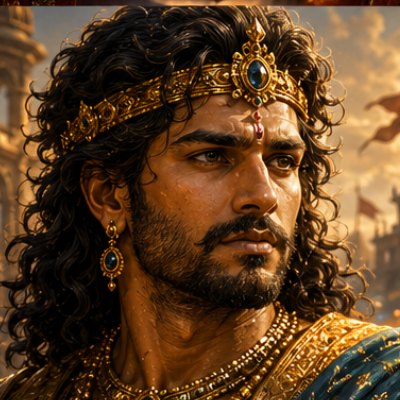
About
Dridhashva — The Steadfast Heir of Ayodhya
Dridhashva · Dridashva · Drdhashva · Dridhasva
Dridhashva is a king of the Solar Dynasty, the Surya Vansha, who ruled from the capital of Ayodhya as part of the Ikshvaku lineage. He is the son of King Kuvalayashva — celebrated throughout the Puranic and epic tradition under the epithet Dhundhumara, meaning the slayer of Dhundhu, for his destruction of a fire-breathing ash-demon of that name who had long menaced the ashram of the sage Utanka — and the father of King Haryashva I, through whom the Solar line continues its descent toward the later imperial kings of Ayodhya. Dridhashva's accession to the throne was shaped by one of the most catastrophic losses recorded in the Solar Dynasty's history: of the twenty-one thousand sons born to Kuvalayashva, all but three were incinerated by the fiery breath of the demon Dhundhu during the battle that destroyed it. Dridhashva was the eldest of the three survivors and inherited the throne of Ayodhya as his father's primary heir. His reign is characterised in the Puranic sources as one of determined reconstruction — the rebuilding of military strength, administrative order, and economic stability in a kingdom whose royal fighting force had been effectively annihilated. His position in the dynastic succession is confirmed in the Vishnu Purana, the Bhagavata Purana, the Vayu Purana, the Harivamsa, and the Mahabharata.
✦ The Name
The name Dridhashva is a Sanskrit compound of two elements: Dridha, meaning firm, steady, strong, or resolute, and Ashva, meaning horse. The compound therefore carries the meaning one who possesses firm or steady horses, with the horse functioning in the royal naming tradition as a symbol of military power, speed, and sovereign authority. The name carries an implicit characterisation of the king as one whose martial resources and royal power are stable and unyielding — a resonance that the tradition treats as fitting for a monarch who inherited the throne under conditions of extreme dynastic vulnerability and was required to consolidate and fortify rather than expand. The name appears in variant spellings across different manuscript traditions, including Dridashva and Drdhashva, all of which refer to the same figure in the same genealogical position.
✦ Lineage
- Founding patriarch: Ikshvaku — eldest son of Vaivasvata Manu, the seventh Manu and progenitor of the current human race, founder of the royal house of Ayodhya, and patriarch of the Solar Dynasty from whom all Ikshvaku kings descend.
- Grandfather: Brihadashva — king of Ayodhya, father of Kuvalayashva, described in the Puranic sources as a king of ascetic temperament who retired to the forest in his later years, entrusting the throne to his son before withdrawing from royal life.
- Father: Kuvalayashva, known by his earned epithet Dhundhumara — king of Ayodhya who led an expedition of his twenty-one thousand sons at the request of the sage Utanka to destroy the demon Dhundhu, a fire-breathing being who had buried himself beneath a sand sea and whose periodic exhalations threatened the surrounding regions; the battle resulted in the destruction of Dhundhu but the incineration of all but three of Kuvalayashva's sons by the demon's fiery breath, after which Kuvalayashva, grief-stricken and spiritually detached, retired from rule and passed the throne to Dridhashva.
- Surviving brothers: Chandrashva and Kapilashva — the two other sons of Kuvalayashva who survived the battle against Dhundhu; both were appointed by Dridhashva to govern secondary territorial provinces while he ruled from the central capital of Ayodhya, ensuring administrative continuity across the kingdom's wider domain.
- Son and successor: Haryashva I — king of Ayodhya, son of Dridhashva, and the next generational link in the Solar Dynasty succession through whom the line descends toward the later imperial kings of the Ikshvaku house.
No wife or wives of Dridhashva are named in any of the primary sources consulted. The texts record only the patrilineal succession.
✦ The Slaying of Dhundhu and the Context of Accession
The episode that defines the circumstances of Dridhashva's accession is narrated in the Mahabharata's Vana Parva and corroborated in the Vishnu Purana and the Harivamsa. The sage Utanka, whose hermitage was situated near a vast desert of sand, approached the reigning king Kuvalayashva with an appeal for protection. Beneath the sand sea, the demon Dhundhu lay sleeping in a cycle of cosmic slumber; his every exhalation sent tremors, fire, and smoke across the land, and the sage's meditations were perpetually disrupted. Kuvalayashva, endowed with divine strength and accompanied by his twenty-one thousand sons, undertook the campaign to destroy the demon. The army drained the sand sea by excavating it over many days until Dhundhu was exposed. When the demon was attacked, he retaliated by releasing torrents of fire from his mouth that consumed nearly the entire royal host. All but three of Kuvalayashva's sons — Dridhashva, Chandrashva, and Kapilashva — were killed in the conflagration. Kuvalayashva himself destroyed Dhundhu, earning his epithet Dhundhumara, but the price of the victory was the near-total annihilation of his line. The Mahabharata records that the sage Utanka, in recognition of the sacrifice made, granted blessings to the surviving king and his remaining sons.
Following the battle, Kuvalayashva's detachment from material life deepened under the weight of his grief. He retired to the forest, and the throne passed to Dridhashva as the eldest surviving heir. The Puranic sources present Dridhashva's reign as one defined by the practical necessities of this inheritance — the reconstruction of a royal army, the fortification of Ayodhya's administrative structure, and the maintenance of stability in a kingdom whose military strength had been catastrophically reduced. The division of governance between Dridhashva and his two surviving brothers Chandrashva and Kapilashva is noted in the sources as a pragmatic arrangement designed to ensure coherent administration across the wider territorial domain of the Kosala kingdom during this period of vulnerability.
✦ Textual Variants and Inconsistencies
The primary textual variation associated with Dridhashva concerns the spelling of his name across manuscript traditions, the forms Dridashva, Drdhashva, and Dridhasva all appearing in different recensions without substantive difference in the genealogical information attached to them. The Vishnu Purana is explicit in recording that only three sons of Kuvalayashva survived — Dridhashva, Chandrashva, and Kapilashva — and that the son of Dridhashva was Haryashva. The Bhagavata Purana at Canto 9, Chapter 6 corroborates Dridhashva's position as the father of Haryashva and the inheritor of the main Solar Dynasty line. No substantive contradiction between the major Puranic sources regarding Dridhashva's genealogical placement has been identified; the sources agree on his parentage, his two surviving brothers, and his son.
It should be noted that a king named Haryashva appears at an earlier point in the Solar Dynasty succession — as the son of Prishadasva, a king who ruled Ayodhya several generations before the era of Kuvalayashva. Dridhashva's son Haryashva I is a distinct figure from that earlier Haryashva, the shared name being one of several instances of name recurrence within the long Ikshvaku king-list that require careful generational identification to avoid conflation.
✦ Connection to the Wider Genealogy
Dridhashva belongs to a generation of the Solar Dynasty that stands at a significant structural point in the Ikshvaku lineage — after the founding era of Ikshvaku, Vikukshi, Kakutstha, Anenas, Prithu, Visvagashva, Ardra, Yuvanashva I, and Shravasta, and before the dynasty reaches the extraordinary imperial figures of its middle and later periods. Through his son Haryashva I the line descends toward the celebrated emperor Mandhata — son of the later Yuvanashva, whose miraculous gestation and birth from his father's abdomen after the king accidentally drank a consecrated ritual liquid is one of the most extensively narrated episodes in the Puranic Solar Dynasty accounts. The descent continues further through Mandhata's successors and beyond, passing through Trishanku, Harishchandra, Sagara, Bhagiratha, Dilipa, Raghu, Aja, Dasharatha, and finally to Rama, the seventh avatar of Vishnu and the hero of the Valmiki Ramayana. Dridhashva's reign represents the generation in which the Solar Dynasty, having been brought to the brink of extinction by the losses of the Dhundhu battle, was stabilised and set on a course of recovery that made possible the dynasty's subsequent imperial achievements.
✦ References
Primary Sources
- Vishnu Purana, Book 4, Chapter 2: The foundational genealogical source for this profile, explicitly recording that only three sons of Kuvalayashva survived — Dridhashva, Chandrashva, and Kapilashva — and that the son of Dridhashva was Haryashva.
- Bhagavata Purana, Canto 9, Chapter 6, verses 23–24: Validates Dridhashva's position as the inheritor of the main Solar Dynasty line and identifies him as the father of Haryashva, corroborating the Vishnu Purana's succession.
- Vayu Purana — Solar Dynasty genealogical chapters: Details the post-battle recovery of Ayodhya under Dridhashva's leadership and the administrative arrangements made with his two surviving brothers.
- Harivamsa — Solar Dynasty genealogical chapters: Corroborates the succession and the characterisation of Dridhashva's reign as a period of reconstruction and consolidation following the losses of the Dhundhu battle.
- Mahabharata, Vana Parva, Chapter 204: Narrates the Dhundhu-Vadha episode in full, establishing the context of mass fraternal loss that shaped Dridhashva's accession, and records the blessings of the sage Utanka upon the surviving heirs of Kuvalayashva.
Secondary and Reference Sources
- Vettam Mani, Puranic Encyclopaedia (1975): Supplies the consolidated reference entry for Dridhashva within the Ikshvaku lineage, drawing on the Vishnu Purana and Mahabharata passages and noting his role as the stabilising heir following the catastrophic losses of his father's campaign.
- Wisdomlib — definition entry for Dridhashva: Aggregates cross-references across multiple texts and identifies the relevant primary passages, useful for confirming the range of sources in which the name appears and for tracking the orthographic variants across manuscript traditions.
- F. E. Pargiter, Ancient Indian Historical Tradition (1922): Provides systematic comparison of Solar Dynasty king-lists across the major Puranas, confirming the consistent placement of Dridhashva between Kuvalayashva and Haryashva I and noting the name variants across manuscript traditions.