
About
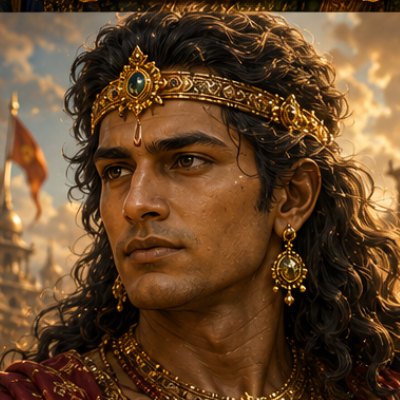
Haryashva I — King of Ayodhya of the Solar Dynasty
Haryashva I · Haryasva · Haryashva · Haryyaswa
Haryashva I is a king of the Solar Dynasty, the Surya Vansha, who ruled from the capital of Ayodhya as part of the Ikshvaku lineage. The numeral distinguishes him from at least two other kings of the same name who appear at later points in the Solar Dynasty succession. He is the son of King Dridhashva — the eldest of the three sons of Kuvalayashva who survived the incineration of their twenty-one thousand brothers during the battle against the fire-breathing demon Dhundhu, and who rebuilt Ayodhya's administrative and military strength in the aftermath of that catastrophe — and the father of King Prasenajit, through whom the Solar line continues its descent toward the later imperial kings of the Ayodhya throne. His position in the dynastic succession is confirmed in the Vishnu Purana, the Bhagavata Purana, the Vayu Purana, and the Brahma Purana, all of which name him as the generational link between Dridhashva and Prasenajit in the Ikshvaku king-list. Through his son Prasenajit and grandson Yuvanashva II, the line reaches his great-grandson Mandhata — one of the most celebrated emperors in the entire Puranic Solar Dynasty tradition, whose miraculous birth from his father's abdomen and subsequent world-conquest are among the most extensively narrated episodes in the Puranic accounts of the Ikshvaku house. No independent narrative episode is attributed to Haryashva I in the primary sources; his significance is genealogical and dynastic, and the Vayu Purana and Brahma Purana characterise his reign as a period of remarkable peace and prosperity.
✦ The Name
The name Haryashva is a Sanskrit compound of Hari and Ashva. Hari carries a range of meanings in Sanskrit — tawny, bay-coloured, lion, and also a frequently used name of Vishnu or Indra — and Ashva means horse. The compound therefore denotes one who possesses tawny or bay horses, or one whose horses are worthy of Hari, with the latter reading lending the name a devotional or divine association appropriate to a Solar Dynasty king operating within the Vaishnava theological framework of the Puranic tradition. The name is among the more frequently recurring royal names in the Ikshvaku king-list, appearing at a minimum of three distinct points in the Solar Dynasty succession, which makes precise generational identification essential. The earliest instance is a king named Haryashva who appears as the son of Prishadasva, several generations before the era of Kuvalayashva and his sons; this figure is entirely distinct from Haryashva I of this profile. The name variants Haryasva and Haryyaswa found in different manuscript traditions and transliteration systems refer to the same figure.
✦ Lineage
- Founding patriarch: Ikshvaku — eldest son of Vaivasvata Manu, the seventh Manu and progenitor of the current human race, founder of the royal house of Ayodhya, and patriarch of the Solar Dynasty from whom all Ikshvaku kings descend.
- Great-grandfather: Brihadashva — king of Ayodhya, father of Kuvalayashva, described in the Puranic sources as a king of ascetic temperament who retired to the forest in his later years before passing the throne to his son.
- Grandfather: Kuvalayashva, known by his earned epithet Dhundhumara, meaning the slayer of Dhundhu — the king of Ayodhya who led his twenty-one thousand sons at the request of the sage Utanka to destroy the fire-breathing demon Dhundhu, buried beneath a sand sea; the battle resulted in the demon's destruction but the incineration of all but three of the royal sons by Dhundhu's fiery breath, after which Kuvalayashva, grief-stricken and spiritually detached, retired from rule.
- Father: Dridhashva — eldest of the three surviving sons of Kuvalayashva, who inherited the throne of Ayodhya and devoted his reign to rebuilding the kingdom's military strength and administrative order following the catastrophic losses of the Dhundhu battle.
- Paternal uncles: Chandrashva and Kapilashva — the two other surviving sons of Kuvalayashva who were appointed by Dridhashva to govern secondary territorial provinces while Dridhashva ruled from the central capital.
- Son and successor: Prasenajit — king of Ayodhya, son of Haryashva I, and the next generational link in the Solar Dynasty succession; to be carefully distinguished from the Buddhist-era King Prasenajit of Kosala, a figure from an entirely different historical period with no genealogical connection to this early Puranic king of the same name.
- Grandson: Yuvanashva II — son of Prasenajit, king of Ayodhya; to be distinguished from the earlier Yuvanashva I, son of Ardra, who appears several generations prior in the same dynastic line.
- Great-grandson: Mandhata — son of Yuvanashva II, one of the most celebrated emperors in the entire Puranic Solar Dynasty tradition, whose birth occurred under extraordinary circumstances after his father accidentally drank a consecrated ritual liquid prepared for his wives, resulting in Mandhata gestating within and being born from the king's own abdomen; his subsequent reign and world-conquest are among the most extensively narrated episodes in the Puranic accounts of the Ikshvaku house.
No wife or wives of Haryashva I are named in any of the primary sources consulted. The texts record only the patrilineal succession.
✦ Textual Attestation and Reign Character
Haryashva I's position in the Solar Dynasty king-list is confirmed across the major Puranic genealogical sources. The Vishnu Purana at Book 4, Chapter 2 provides the most precise succession statement, recording that the son of Dridhashva was Haryashva, the son of Haryashva was Prasenajit, and the son of Prasenajit was Yuvanashva — establishing the three-generation chain with explicit clarity. The Bhagavata Purana at Canto 9, Chapter 6 corroborates this placement, identifying Haryashva as the direct link between Dridhashva and Prasenajit in the Ikshvaku succession. The Vayu Purana and the Brahma Purana replicate the succession order and add characterisations of his reign as a period of favourable conditions — optimal rainfall, abundant harvests, and an absence of untimely deaths among his subjects — presenting his rule as one in which the kingdom enjoyed the fruits of the dharmic governance established by his father's reconstruction efforts. The Mahabharata's Anushasana Parva includes Haryashva I among the exemplary Solar kings cited in didactic passages on righteous royal conduct, though without narrating any specific episode associated with him.
✦ Textual Variants and Name Disambiguation
The name Haryashva appears at a minimum of three distinct points in the Puranic Solar Dynasty succession, and careful disambiguation is necessary in each case. The earliest figure named Haryashva in the Ikshvaku line is the son of Prishadasva — a king who ruled Ayodhya in the generations between Trasadasyu and Anaranya, well before the era of Kuvalayashva and his sons. This early Haryashva has no connection to Haryashva I of this profile beyond the shared name. Haryashva I, son of Dridhashva and father of Prasenajit, is the second instance. A third king named Haryashva appears later in the Solar Dynasty succession, after the era of Mandhata, as a further generational recurrence of the name within the same Ikshvaku house. Additionally, a king named Haryashva is associated with the Janaka lineage of Mithila — the collateral Solar Dynasty branch from which the Videha kings descend — who is an entirely separate figure from all three of the Ayodhya kings bearing the same name. The Puranic sources do not always apply distinguishing numerals to these figures, and their identification depends on careful attention to the genealogical context in which each instance of the name appears.
✦ Connection to the Wider Genealogy
Haryashva I occupies a position in the Solar Dynasty that sits precisely between the generation of catastrophe — the mass destruction of Kuvalayashva's sons in the Dhundhu battle — and the generation of miraculous imperial renewal represented by his great-grandson Mandhata. His father Dridhashva inherited a dynasty reduced to three surviving princes and devoted his reign to reconstruction; Haryashva I inherited a stabilised kingdom and, through his son Prasenajit and grandson Yuvanashva II, transmitted it intact to Mandhata, whose reign represents one of the peaks of Solar Dynasty imperial achievement in the Puranic tradition. Beyond Mandhata, the descent continues through a long succession of Solar kings — including Trishanku, whose desire to ascend bodily to heaven generated one of the tradition's most celebrated conflicts between royal will and brahminical authority; Harishchandra, the supreme exemplar of truth among all Ikshvaku kings; Sagara, whose sixty thousand sons dug the ocean; Bhagiratha, who brought the river Ganga down from heaven to earth; Dilipa; Raghu, who gave the dynasty its later designation Raghu-vamsha; Aja; Dasharatha; and finally Rama, the seventh avatar of Vishnu and the hero of the Valmiki Ramayana. Haryashva I's quiet and stable reign is the generational fulcrum on which this entire subsequent descent depends.
✦ References
Primary Sources
- Vishnu Purana, Book 4, Chapter 2: The foundational genealogical source for this profile, providing the explicit succession statement naming Dridhashva, Haryashva, Prasenajit, and Yuvanashva in the Ikshvaku Solar Dynasty king-list.
- Bhagavata Purana, Canto 9, Chapter 6, verse 24: Corroborates Haryashva I's position as the direct link between Dridhashva and Prasenajit in the Solar succession.
- Vayu Purana — Solar Dynasty genealogical chapters: Replicates the succession order and adds the characterisation of Haryashva I's reign as a period of favourable natural conditions and prosperity in the Kosala kingdom.
- Brahma Purana — Solar Dynasty genealogical chapters: Corroborates the succession and the characterisation of the reign as one of peace and abundance.
- Mahabharata, Anushasana Parva: Includes Haryashva I among the exemplary Solar Dynasty kings cited in didactic passages on dharmic royal conduct and the protection of subjects.
Secondary and Reference Sources
- Vettam Mani, Puranic Encyclopaedia (1975): Supplies the consolidated reference entry for Haryashva within the Ikshvaku lineage, drawing on the Vishnu Purana and Bhagavata Purana passages and noting the multiple instances of the name across the Solar Dynasty succession.
- Wisdomlib — definition entry for Haryashva: Aggregates cross-references to all figures bearing the name Haryashva across the Puranic corpus, useful for disambiguation and for confirming the range of sources in which each instance appears.
- F. E. Pargiter, Ancient Indian Historical Tradition (1922): Provides systematic comparison of Solar Dynasty king-lists across the major Puranas, confirming the consistent placement of Haryashva I between Dridhashva and Prasenajit and noting the recurrence of the name at multiple generational points in the Ikshvaku succession.