
About
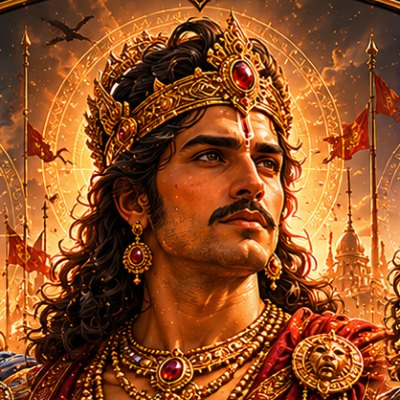
Khatvanga — The Saint-King Who Attained Liberation in a Single Moment
Khatvanga · Khatvangah · Dilipa I · Rajarshi Khatvanga · Chakravartin Khatvanga
Khatvanga is a king of the Solar Dynasty, the Surya Vansha, who ruled from the capital of Ayodhya as part of the Ikshvaku lineage. He is the son of King Vishvasaha — a monarch of the post-Parashurama Solar line recorded in the Puranic king-lists without extended narrative — and the father of King Dirghabahu, also known in some traditions as Dilipa, through whom the line reaches the celebrated conqueror Raghu and ultimately Rama, the seventh avatar of Vishnu. In the Puranic tradition he is identified as Dilipa I, the first of two Solar Dynasty kings bearing the name Dilipa, to distinguish him from the later Dilipa II who was Raghu's father and whose devoted service to the divine cow Nandini is one of the tradition's most celebrated narratives of royal piety. Khatvanga is celebrated across the Puranic, epic, and Vaishnava devotional literature as one of the supreme exemplars of spiritual detachment and the power of one-pointed surrender to the divine. His central episode — learning that he had only a single muhurta, approximately forty-eight minutes, remaining in his life, and achieving complete liberation within that interval by fixing his consciousness entirely upon the Supreme — is cited in the Bhagavata Purana as a benchmark of the highest spiritual accomplishment available to a human being. He appears prominently in the Bhagavata Purana, the Vishnu Purana, the Valmiki Ramayana, and Kalidasa's Raghuvamsha, and is invoked in the Bhagavata Purana's second canto as an example of the sufficiency of even a single moment for liberation when the mind is wholly surrendered.
✦ The Name
The name Khatvanga is a Sanskrit compound that has been interpreted in two principal ways. The first reading takes khatva as a bedstead or cot and anga as limb or part, yielding the meaning one whose limb is a bedstead or one associated with a bedstead — an obscure compound that may refer to a specific weapon or ritual object. The second and more commonly cited reading in the commentarial tradition takes khatvanga as the name of a specific type of weapon — a staff or club topped with a skull or skeletal ornament — making the name mean one who wields the khatvanga weapon or one identified with the skull-topped staff. The khatvanga as a weapon or emblem is associated in the broader Hindu iconographic tradition with Shiva and with certain ascetic figures, lending the name an ascetic and martial resonance simultaneously appropriate to a figure the tradition classifies as both a world-conquering emperor and a saint-king. The epithet Dilipa I is a Puranic identifier applied to Khatvanga to distinguish him from the later Dilipa II, Raghu's father; it is not a name used for Khatvanga independently in the primary texts but a scholarly and traditional convention for navigating the two-Dilipa succession within the Solar Dynasty king-list.
✦ Lineage
- Founding patriarch: Ikshvaku — eldest son of Vaivasvata Manu, the seventh Manu and progenitor of the current human race, founder of the royal house of Ayodhya, and patriarch of the Solar Dynasty from whom all Ikshvaku kings descend.
- Remote ancestor: Mulaka, also known as Balika and Narikavacha — the king of Ayodhya who survived Parashurama's campaigns against the Kshatriya class by being concealed among women in the royal inner quarters; named Mulaka, meaning the root, because he was the sole surviving heir from whom all subsequent Solar Dynasty generations descended; without his survival the lineage that produced Khatvanga and all subsequent kings including Rama would have been permanently severed.
- Great-grandfather: Dasharatha I — the immediate successor of Mulaka in the Bhagavata Purana's king-list; an early Solar Dynasty king entirely distinct from the celebrated Dasharatha who was Rama's father many generations later.
- Grandfather: Ilavila — son of Dasharatha I, recorded in the Puranic king-list as a generational link without extended narrative episode.
- Father: Vishvasaha — son of Ilavila, whose name carries the Sanskrit sense of one who endures all or the all-sustaining; recorded in the Puranic succession without independent narrative episode, his reign representing one of the peacetime generations of the post-Parashurama Solar Dynasty restoration.
- Son: Dirghabahu — recorded in the Bhagavata Purana as the son of Khatvanga; the name means long-armed, a standard royal epithet suggesting great physical strength and martial reach. The Valmiki Ramayana and Kalidasa's Raghuvamsha, which compress the genealogy for poetic and narrative purposes, use the name Dilipa for the son of Khatvanga, treating Dirghabahu and Dilipa II as the same figure or omitting the generational step entirely. This divergence is addressed in the Variants section below.
- Grandson: Raghu — the celebrated world-conquering emperor whose name gave the Solar Dynasty its enduring classical designation as the Raghuvamsha; renowned for the completeness of his conquest of the known world, his extreme generosity in the great Vishvajit sacrifice during which he gave away his entire treasury, and his production of an heir Aja through the same Putrakameshti ritual his grandson Dasharatha would later perform.
- Great-grandson: Aja — son of Raghu, father of Dasharatha, whose reign is marked in Kalidasa's Raghuvamsha by his deep and enduring love for his wife Indumati and his profound grief at her sudden death.
- Great-great-grandson: Dasharatha — son of Aja, king of Ayodhya, father of Rama, Lakshmana, Bharata, and Shatrughna by his three principal wives Kaushalya, Kaikeyi, and Sumitra.
✦ The War in Heaven and the Question of Lifespan
The central narrative of Khatvanga's life is recorded in the Bhagavata Purana at Canto 9, Chapter 9, verses 41 through 45, and referenced again at Canto 2, Chapter 1. During a great cosmic war between the Devas and the Asuras, the gods found themselves unable to overcome the demonic forces without additional assistance. Recognising Khatvanga's unmatched military capacity and the purity of his character, the gods — led by Indra, their king — descended to the mortal realm and requested the king's personal participation in the celestial battle. Khatvanga ascended to the heavenly regions and fought alongside the Devas, his martial power proving decisive in routing the Asura armies and securing the gods' victory.
The Devas, deeply pleased, offered Khatvanga any boon he wished — including celestial wealth, heavenly pleasures, or the extension of his life within the divine realms. Khatvanga declined all material benedictions and asked instead a single question: how much time remained in his earthly life. The gods consulted and returned with an answer that carried the weight of an absolute limit — only one muhurta remained, a measure of time approximately equivalent to forty-eight minutes. The Bhagavata Purana records that on receiving this information, Khatvanga did not express grief, fear, or regret. He boarded a celestial vehicle and returned immediately to the earth.
✦ Liberation Within a Single Muhurta
Upon returning to the mortal world, Khatvanga renounced his entire empire — his global sovereignty, his material possessions, his relationships, and all sensory engagement with the world — without hesitation or delay. The Bhagavata Purana describes his internal process in the final moments of his life as a systematic withdrawal of consciousness from every object of material attachment, a complete severing of identification with body, kingdom, family, and the accumulated fruits of a lifetime of world-conquest and royal administration. He fixed his mind entirely and without remainder upon the Supreme, achieving in that single interval of forty-eight minutes the complete cessation of material identification and the liberation that the tradition designates as parā gati — the supreme destination.
The Bhagavata Purana at Canto 2, Chapter 1 invokes Khatvanga's example explicitly when Sukadeva Gosvami addresses King Parikshit, who has himself just learned he has only seven days to live. Sukadeva cites Khatvanga as the supreme proof that the duration of remaining life is irrelevant to the possibility of liberation — what matters is the quality of surrender in whatever time remains. A single muhurta was sufficient for Khatvanga because his surrender was total and unconditional. The passage establishes Khatvanga not merely as a biographical figure but as a recurring doctrinal reference point in the Bhagavata Purana's teaching on death, time, and liberation.
The Vishnu Purana's account at Book 4, Chapter 4 corroborates the episode and records Khatvanga's final declaration — a statement of complete disidentification from all material designations and total absorption in the divine reality — before his death. The text confirms his position as the father of Dirghabahu and his role as the Solar Dynasty's supreme spiritual exemplar in the post-Parashurama era.
✦ Textual Variants and Inconsistencies
The principal textual divergence surrounding Khatvanga concerns the identity of his son and the number of generations between him and Raghu. The Bhagavata Purana names Khatvanga's son as Dirghabahu, and Dirghabahu's son as Dilipa — who is then the father of Raghu. Under this sequence, there are two generations between Khatvanga and Raghu: Dirghabahu and Dilipa II. The Valmiki Ramayana's genealogical recitation and Kalidasa's Raghuvamsha compress this segment, presenting the son of Khatvanga directly as Dilipa without naming Dirghabahu as an intermediate generation, resulting in a single generation between Khatvanga and Raghu in those texts. The two traditions are consistent on the identity of the major figures — Khatvanga, Dilipa, and Raghu — but differ on whether Dirghabahu is a distinct intermediate king or whether the name is omitted in the compressed epic and classical poetic accounts for narrative economy. This is the same pattern of compression identified elsewhere in this portion of the Solar Dynasty succession, where the Puranas preserve the fuller genealogical record and the epic and classical traditions select the most narratively significant figures.
The identification of Khatvanga as Dilipa I is a traditional Puranic convention for handling the two kings named Dilipa in the Solar line and does not appear as a primary designation in the texts themselves, which name him consistently as Khatvanga. Some secondary and regional traditions use the name Dilipa I for Khatvanga while reserving Dilipa II for Raghu's father, but this is a classificatory convenience rather than an alternative name attested in the primary sources.
✦ Theological and Philosophical Significance
Khatvanga occupies a unique position in the Puranic tradition as a figure who combines two qualities that are rarely presented together in the same biographical subject: supreme worldly achievement and supreme spiritual realisation. He was a Chakravartin — a wheel-turning universal emperor — who had conquered the material world entirely, and yet his response to the news of his imminent death was not grief at the loss of his empire but an immediate and complete renunciation of everything he had accumulated. The tradition treats this combination as the highest possible demonstration of the principle that material success and spiritual liberation are not mutually exclusive but that liberation requires a quality of non-attachment that the most powerful and successful kings find the most difficult to cultivate.
The Bhagavata Purana's deployment of Khatvanga as a doctrinal example in its second canto — where his achievement is used to reframe the significance of time remaining in a life — gives him a function beyond biography. He becomes, within the text's soteriological architecture, the proof-case for the teaching that liberation is a matter of the quality of consciousness rather than its duration, and that a single moment of absolute surrender is equivalent in its liberating power to a lifetime of gradual practice. This teaching, delivered by Sukadeva to the dying Parikshit, uses Khatvanga as its supreme historical exemplar.
✦ Connection to the Wider Genealogy
Khatvanga stands in the Solar Dynasty as the fourth generation after Mulaka — the root-king who survived Parashurama's campaigns — counting through Dasharatha I, Ilavila, and Vishvasaha before reaching him. Through his son Dirghabahu and grandson Dilipa II, the line reaches Raghu — the conqueror whose world-girdling campaigns and extraordinary generosity gave the dynasty its enduring name Raghuvamsha and whose story is the centrepiece of Kalidasa's classical mahakavya. From Raghu the descent continues through Aja and Dasharatha to Rama, the seventh avatar of Vishnu and the hero of the Valmiki Ramayana. Khatvanga's position in the genealogy is therefore both structurally important as a transmitter of the dynastic line and theologically significant as the Solar Dynasty's supreme exemplar of spiritual realisation — the king who demonstrated that the entire accumulated weight of worldly sovereignty could be released in a single act of surrender and that liberation follows instantaneously from the completeness of that release.
✦ References
Primary Sources
- Bhagavata Purana, Canto 9, Chapter 9, verses 41–45: The principal narrative source for the Khatvanga episode — the cosmic war, the gods' appeal, the offer of boons, Khatvanga's single question about his remaining lifespan, the return to earth, and the achievement of liberation within one muhurta.
- Bhagavata Purana, Canto 2, Chapter 1, verse 13: The doctrinal deployment of Khatvanga as the supreme exemplar of liberation through concentrated surrender, cited by Sukadeva Gosvami to the dying King Parikshit as proof that even a single moment is sufficient for liberation when surrender is complete.
- Vishnu Purana, Book 4, Chapter 4: Corroborates the episode, records Khatvanga's final declaration of total disidentification from material designations, confirms his position as the father of Dirghabahu, and places him in the seven-generation Solar Dynasty succession from Mulaka to Raghu.
- Valmiki Ramayana, Bala Kanda, Sarga 70: Includes Khatvanga in the formal genealogical recitation of Rama's Solar ancestry at Mithila, presenting the compressed sequence in which his son is named directly as Dilipa without the intermediate Dirghabahu.
- Kalidasa, Raghuvamsha: References Khatvanga within the dynastic narrative of the Solar line and presents the compressed genealogical sequence consistent with the Ramayana's account.
Secondary and Reference Sources
- Vettam Mani, Puranic Encyclopaedia (1975): Supplies the consolidated reference entry for Khatvanga, covering the narrative episode, the Dilipa I identification, the genealogical position in the post-Mulaka Solar succession, and the doctrinal significance of the muhurta liberation.
- Wisdomlib — definition entry for Khatvanga: Aggregates cross-references across the Bhagavata Purana, Vishnu Purana, and Ramayana, useful for tracking the variant succession sequences and the multiple textual invocations of the muhurta liberation episode.
- F. E. Pargiter, Ancient Indian Historical Tradition (1922): Provides systematic comparison of Solar Dynasty king-lists, addressing the divergence between the Puranic sequence naming Dirghabahu and the Ramayana and classical poetic tradition's compressed sequence naming Dilipa directly as Khatvanga's son.