
About
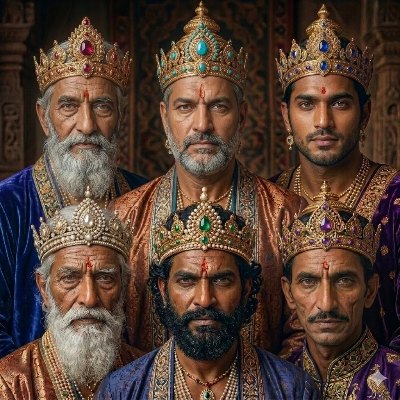
Citrasena, Riksha, Midhvan, Purna, Indrasena, Vitihotra, Satyashrava, Urushrava, and Devadatta — The Intermediate Kings of the Narishyanta Line
Citrasena · Riksha · Midhvan · Purna · Indrasena · Vitihotra · Satyashrava · Urushrava · Devadatta · Suryavanshi · Vaideha
These nine figures are consecutive kings of the solar dynasty, recorded in the Bhagavata Purana as the generational links between Narishyanta — a son of Vaivasvata Manu, the seventh Manu and progenitor of the current human race — and Agniveshya, the celebrated sage identified in that same text as an incarnation of the fire-god Agni and the progenitor of the brahminical Agniveshyayana dynasty. Vaivasvata Manu, also known as Shraddhadeva and Satyavrata, was the son of Vivasvan the sun-god and his wife Saranyu, and is the fountainhead of all solar dynastic lines of the current age. The nine kings are attested solely in the genealogical list of Bhagavata Purana Skandha IX, Chapter 2, which names each as the son of the one preceding him and the father of the one following, without assigning to any of them an independent narrative episode, a named spouse, or any recorded achievement beyond their place in the succession. Their collective significance is genealogical: together they constitute the chain through which the Narishyanta sub-branch of the solar dynasty passed from its royal origins to its culmination in a figure of major theological and textual importance.
✦ The Names
Each of the nine names is of Sanskrit formation and carries a meaning consistent with royal or auspicious Kshatriya naming conventions. Citrasena is a compound of citra, meaning bright, variegated, or distinguished, and sena, meaning army or commander; the name thus conveys the sense of one with a distinguished or brilliant host. Riksha means a bear, or alternatively a star, and is a name found in several distinct figures across the Puranic and epic corpus. Midhvan derives from a root conveying the sense of one who bestows or is liberal, indicating a quality of generosity. Purna means full, complete, or abundant, a common auspicious name in the royal tradition. Indrasena is a compound of Indra, the king of the gods, and sena, army; it conveys the sense of one whose army is like that of Indra, a name of evident martial and royal prestige. Vitihotra is a compound associated with the sacred fire and ritual offering, suggesting a connection to sacrificial or priestly virtue alongside royal status. Satyashrava is a compound of satya, meaning truth, and shrava, meaning fame or that which is heard; the name thus means one whose fame is true or one renowned for truth. Urushrava is similarly compounded of uru, meaning great or wide, and shrava, fame; it conveys the sense of one of great or widespread renown. Devadatta means given by the gods, a name of clearly auspicious and devotional character common across many dynasties and periods of the tradition.
✦ Succession in the Narishyanta Line
- Narishyanta: Son of Vaivasvata Manu; progenitor of this branch of the solar dynasty; one of the ten sons born to Manu after a century of austerities and worship of Vishnu on the bank of the Yamuna river.
- Citrasena: Son of Narishyanta; first of the nine intermediate kings; father of Riksha.
- Riksha: Son of Citrasena; father of Midhvan. A textual variant within the Bhagavata Purana tradition records the name of Citrasena's son as Daksha in one recension and Riksha in another; the Vedabase rendering of Skandha IX.2 gives Riksha, while an alternative translation renders the same verse as Daksha. The variance is internal to the Bhagavata Purana transmission and is not a conflict between separate Puranas.
- Midhvan: Son of Riksha; father of Purna. A parallel variant in the same transmission records Kurca in place of Midhvan at this position in the succession, reflecting the same pattern of internal textual variance noted above.
- Purna: Son of Midhvan; father of Indrasena.
- Indrasena: Son of Purna; father of Vitihotra.
- Vitihotra: Son of Indrasena; father of Satyashrava.
- Satyashrava: Son of Vitihotra; father of Urushrava.
- Urushrava: Son of Satyashrava; father of Devadatta.
- Devadatta: Son of Urushrava; father of Agniveshya, the fire-god Agni incarnate, who was also known as Kanina and Jatukarnya, and from whom the brahminical Agniveshyayana dynasty descended.
✦ Textual Variants and Inconsistencies
The Bhagavata Purana is the sole primary source that records this succession in any detail, and even there the treatment is confined to a single passage of a few verses in Skandha IX, Chapter 2. The Vishnu Purana names Narishyanta among the sons of Manu but does not trace his descendants beyond that initial mention. No other Mahapurana or Upapurana records this particular succession independently. Within the Bhagavata Purana transmission itself, two translation traditions present minor variant names at the Riksha and Midhvan positions — one rendering gives Riksha and Midhvan, while another gives Daksha and Kurca for the same generational slots. These variants reflect differences in manuscript readings rather than contradictions between independent textual sources, and they affect only the second and third kings of the nine. The remaining seven names — Purna, Indrasena, Vitihotra, Satyashrava, Urushrava, Devadatta, and the terminal Agniveshya — are consistent across all available translations of the relevant passage.
It should further be noted that several of these nine names are shared by entirely distinct figures elsewhere in the Puranic and epic corpus. Indrasena, for instance, is also the name of the wife of Narishyanta in the Markandeya Purana's account of the separate figure of that name — the son of King Marutta — and appears additionally as the name of a character in the Mahabharata. Riksha is the name of two separate kings in the lunar dynasty. Devadatta is a common name appearing in multiple contexts across the literature. None of these coincidences of name indicates any genealogical or narrative connection between the figures so named; the nine kings of this profile are identified exclusively through their position in the Narishyanta succession as recorded in Bhagavata Purana Skandha IX, Chapter 2.
✦ Connection to the Wider Genealogy
The nine kings collectively represent the middle portion of a dynastic line that originates in Vaivasvata Manu and terminates, at its tenth remove from Narishyanta, in Agniveshya. The line is one of several sub-branches of the solar dynasty established by the sons of Manu at the opening of the current age. Its sibling lines include the Ikshvaku line — the principal solar succession that produced the kings of Ayodhya and ultimately Rama — as well as the lines of Dhrishta, Nriga, Sharyati, and the other sons of Manu. The Narishyanta line is distinctive in that it does not continue as a royal dynasty beyond Agniveshya but instead transforms into a brahminical lineage, the Agniveshyayana, a pattern also observed in the line of Manu's son Dhrishta, whose descendants likewise became brahmanas despite their kshatriya origin. The nine intermediate kings are the vehicle through which this transformation was prepared across the generations, though the primary source assigns none of them any individual role in bringing it about.
✦ References
- Bhagavata Purana, Skandha IX, Chapter 2, verses 19–22: The sole primary source for the complete succession from Citrasena through Devadatta to Agniveshya; names each king in sequence and closes with the identification of Agniveshya as Agni incarnate and the progenitor of the Agniveshyayana brahminical dynasty.
- Vishnu Purana, Book IV, Chapter I: Names Narishyanta among the sons of Vaivasvata Manu but does not extend the succession into his descendants; consulted to confirm the absence of an independent account of this line in that text.
- Vettam Mani, Puranic Encyclopaedia: Secondary reference consulted for entries on Citrasena and Indrasena to confirm that namesake figures elsewhere in the corpus are distinct individuals unrelated to the kings of this succession.
- V. S. Agrawala, Matsya Purana — A Study: Modern secondary work on solar dynasty genealogies; consulted for contextualisation of the Narishyanta sub-branch within the broader structure of Manu's descendants.