
About
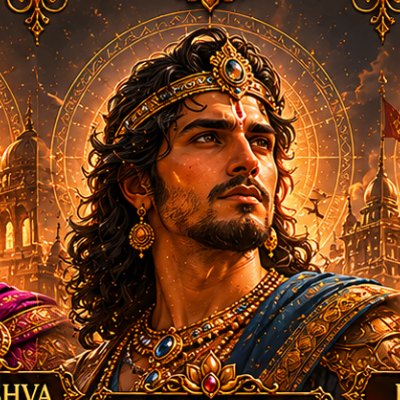
Nabhaga — Son of Vaivasvata Manu, Father of Naabhaaga, and Grandfather of Ambarisha
Nabhaga · Naabhaaga · Nabhaga I · Suryavanshi
Nabhaga is a king of the solar dynasty, recorded in the Bhagavata Purana, the Vishnu Purana, the Harivamsha, the Brahmanda Purana, the Vayu Purana, and the Mahabharata as one of the ten sons of Vaivasvata Manu, the seventh Manu, progenitor of the current human race, and son of Vivasvan the sun-god. He is the father of Naabhaaga — a son who spent an exceptionally long period at his preceptor's hermitage and who is the subject of a narrative of some significance in the Bhagavata Purana — and the grandfather of Ambarisha, one of the most celebrated devotees of Vishnu in the entire Puranic tradition, famous for the episode of the sage Durvasa's wrath and the protection afforded by the Sudarshana Chakra. Nabhaga is also noted in the Mahabharata as a king of great dharmic conduct who, at the close of his reign, gifted the entire earth to brahmanas, an act of such extraordinary generosity that Bhumidevi, the goddess of the earth, assumed physical form rather than leave his side. He appears in the Mahabharata's Vana Parva, Shanti Parva, and Anushasana Parva, as well as in the Puranic genealogical lists, and is distinguished from at least three other figures bearing the name Nabhaga or a closely related form in the same tradition.
✦ The Name
The name Nabhaga derives from a Sanskrit root relating to nabha, meaning sky, navel, or centre, and conveys a sense of centrality, eminence, or one who is of the innermost or highest. It is an auspicious name consistent with the royal Kshatriya naming conventions of Manu's sons. The name is shared across several distinct figures in the Puranic and epic tradition, generating considerable complexity in the literature. To avoid confusion, this figure — the direct son of Vaivasvata Manu and father of Naabhaaga — is here designated Nabhaga I. His son, who bears the same name in a slightly differentiated spelling as Naabhaaga, and who is a separate individual, is designated Naabhaaga or Nabhaga II in modern genealogical reference. The Bhagavata Purana at Skandha IX, Chapter 4, Verse 1 opens its account of this generation by stating explicitly that Naabhaaga was the son of Nabhaga, taking care to establish the father-son relationship clearly before narrating the episode of the son. The dynastic epithet Suryavanshi, meaning one of the solar race, applies to Nabhaga by virtue of his descent from Vivasvan the sun-god through Vaivasvata Manu.
✦ Lineage
- Paternal grandfather: Vivasvan — the sun-god, also known as Surya and Aditya, son of the sage Kashyapa and his wife Aditi; divine progenitor of the entire solar dynasty.
- Father: Vaivasvata Manu — the seventh Manu, also called Shraddhadeva and Satyavrata, son of Vivasvan and his wife Saranyu; progenitor of the current human race. The Bhagavata Purana records that Manu performed a century of austerities on the bank of the Yamuna and worshipped Vishnu, from which ten sons were born to him, all resembling him in qualities.
- Brothers: Ikshvaku — eldest son of Manu and founder of the principal Ikshvaku solar line from which the kings of Ayodhya and ultimately Rama descended; Dhrishta — from whose kshatriya descendants a brahminical clan arose; Narishyanta — progenitor of the line ending in Agniveshya, an incarnation of Agni; Dishta — progenitor of the line through Nabhanedishta and the seven further kings to Vivimshati; Nriga — progenitor of a sub-line through Sumati, Bhutajyoti, and Vasu; Karusha — from whom the Karusha clan of kshatriyas arose; Sharyati — a son of Manu of independent narrative significance; Prishadhra — who was cursed to become a shudra after accidentally slaying his preceptor's cow; Kavi — youngest son of Manu and a great devotee of Vishnu from childhood.
- Son: Naabhaaga — also known as Nabhaga II, the son who spent an exceptionally long period in his preceptor's hermitage, was excluded from his brothers' division of the ancestral property, was guided by his father Nabhaga to resolve the sacrificial confusion of the descendants of Angira, and who is the subject of a celebrated narrative in Bhagavata Purana Skandha IX, Chapter 4. Naabhaaga is the father of Ambarisha, the great devotee.
- Grandson: Ambarisha — son of Naabhaaga, celebrated as one of the most exalted devotees of Vishnu in the entire Puranic tradition; ruler of the entire earth consisting of seven islands; the figure at the centre of the famous episode in which the sage Durvasa cursed him, the curse proving ineffective owing to Vishnu's protection through the Sudarshana Chakra. Ambarisha had three sons named Virupa, Ketuman, and Shambhu.
✦ The Gift of the Earth and the Appearance of Bhumidevi
The Mahabharata records a narrative of considerable theological import associated with Nabhaga. The Vana Parva records that Nabhaga, after ruling the entire earth with strict adherence to truth and righteousness, gifted the whole of the earth to brahmanas at the close of his reign. This act of extraordinary dana — the gift of land, the most fundamental of royal possessions — was of such moral and devotional quality that Bhumidevi, the goddess of the earth personified, found herself unable to depart from Nabhaga and instead assumed physical form, presenting herself to him at the moment of the gift. The Shanti Parva records further that Nabhaga never consumed meat throughout his life, a detail consistent with the portrait of a king of exceptional dharmic discipline. The Anushasana Parva records that Nabhaga resides in Brahmaloka, the highest realm of Brahma, as a consequence of his righteousness — a destination reserved in the tradition for figures of the most exalted virtue. These three notices across different sections of the Mahabharata collectively present Nabhaga as a king whose reign was defined by dharmic governance, whose renunciation was marked by the most generous of gifts, and whose post-mortem destination confirms his spiritual eminence.
✦ Nabhaga's Role in the Naabhaaga Episode
The Bhagavata Purana Skandha IX, Chapter 4 opens by establishing that Naabhaaga, the youngest of Nabhaga's sons, had spent so long at his preceptor's hermitage pursuing mastery of the scriptures that his brothers, presuming he would remain a lifelong celibate student, divided their father's estate among themselves without reserving a share for him. When Naabhaaga returned and found himself without an inheritance, his brothers informed him that his share was their father himself — that is, the duty of caring for the aged Nabhaga. Naabhaaga then went to his father and reported what his brothers had done. Nabhaga, described as compassionate toward his son, acknowledged that the brothers had in effect cheated Naabhaaga, and counselled him on how to obtain his own livelihood. Nabhaga directed his son to go to the sacrificial arena of the descendants of Angira, where the performers became periodically confused in the execution of their rites on every sixth day, and to recite to them two specific Rigvedic suktas that would resolve their confusion. Nabhaga thereby acts as the father who, having been made Naabhaaga's inheritance, discharges that inheritance through guidance and knowledge rather than through material wealth. This episode presents Nabhaga not merely as a genealogical link but as a figure of active wisdom, the source of the sacred knowledge that enables his son's entry into the brahminical realm of yajna and ultimately into the lineage that produced Ambarisha.
✦ Textual Variants and Inconsistencies
The most persistent difficulty surrounding Nabhaga is the proliferation of figures bearing closely related names in the same textual tradition. At least four distinct figures are attested: Nabhaga the direct son of Manu profiled here; Nabhanedishta, also called Nabhaga, the son of Dishta and grandson of Manu; the Nabhaga who is son of Naabhaaga and father of a further figure in another Puranic reference; and the Nabhaga of the Ikshvaku main line who is the son of Shruta and grandson of Bhagiratha, attested in the Garuda Purana, Vishnu Purana IV.4, and the Saurapurana. The Bhagavata Purana itself is alert to the naming complexity and at Skandha IX, Chapter 4, Verse 1 opens by specifying the relationship — Naabhaaga was the son of Nabhaga — to anchor the succession clearly. The Wisdomlib Puranic encyclopaedia entry on Nabhaga lists the figure attested at Bhagavata Purana VIII.13.2 and IX.1.12 as a direct son of Manu, and distinguishes him from the son of Dishta at IX.2.23–24 and from the further Nabhaga at IX.4.1. The Bhagavata Purana itself, the Brahmanda Purana III.63.5, and the Vayu Purana 88.5 are consistent in identifying this Nabhaga as a direct son of Manu. The Mahabharata passages in the Vana Parva, Shanti Parva, and Anushasana Parva describe the same figure under the name Nabhaga as a brother of Ikshvaku and father of the famous Ambarisha, consistent with the Puranic genealogical position.
✦ Connection to the Wider Genealogy
Nabhaga stands in the first generation of the solar dynasty as constituted in the present age, as a direct son of Vaivasvata Manu and a brother of Ikshvaku, the founder of the main Ayodhya royal line. Through his son Naabhaaga and his grandson Ambarisha, Nabhaga is the progenitor of one of the most celebrated devotional lineages in the Puranic tradition. Ambarisha's three sons Virupa, Ketuman, and Shambhu continue the line further. The Bhagavata Purana presents the arc from Nabhaga through Naabhaaga to Ambarisha as a progression of increasing spiritual eminence — Nabhaga the righteous king who gifts the earth; Naabhaaga who enters the realm of yajna and encounters the divine through the Angira sacrifice episode; and Ambarisha the supreme devotee whose entire being is absorbed in the service of Vishnu. Nabhaga's role as the wise father who guides his displaced son toward knowledge rather than wealth makes him, within this arc, the foundational figure from whom the devotional orientation of the subsequent generations ultimately flows.
✦ References
- Bhagavata Purana, Skandha VIII, Chapter 13, verses 2–3: Names Nabhaga among the sons of Vaivasvata Manu in the listing of Manu's sons for the present Manvantara.
- Bhagavata Purana, Skandha IX, Chapter 1, verse 12: Names Nabhaga among the ten sons born to Manu following his century of austerities and worship of Vishnu.
- Bhagavata Purana, Skandha IX, Chapter 4, verses 1–13: Primary narrative source; opens by establishing Nabhaga as father of Naabhaaga, records the brothers' division of the estate, and narrates Nabhaga's counsel to his son regarding the descendants of Angira and the two Rigvedic suktas.
- Mahabharata, Vana Parva, Chapter 25, verse 12: Records Nabhaga as a brother of Ikshvaku and father of the famous Ambarisha; notes his righteous rule and gift of the entire earth to brahmanas.
- Mahabharata, Shanti Parva, Chapter 96, verse 124: Notes Nabhaga's abstention from meat throughout his life as a mark of his dharmic conduct.
- Mahabharata, Anushasana Parva, Chapter 115: Records that Nabhaga resides in Brahmaloka as a consequence of his righteousness.
- Brahmanda Purana, III.63.5: Confirms Nabhaga as a son of Vaivasvata Manu in the genealogical lists of the solar dynasty.
- Vayu Purana, 88.5: Confirms Nabhaga among the sons of Manu in parallel Puranic enumeration.
- Harivamsha, Chapter 10, verses 1–2: Names Nabhaga among the nine sons of Vaivasvata Manu in the opening verses of its solar dynasty genealogy.
- Vettam Mani, Puranic Encyclopaedia: Secondary reference compiling the multiple entries on figures named Nabhaga and Naabhaaga with citations to primary texts; essential for disambiguation across the four distinct figures bearing closely related forms of this name.
- V. S. Agrawala, Matsya Purana — A Study: Modern secondary work on solar dynasty genealogies; consulted for contextualisation of Nabhaga's position within the broader structure of Manu's sons and the distinct sub-lines each established.