
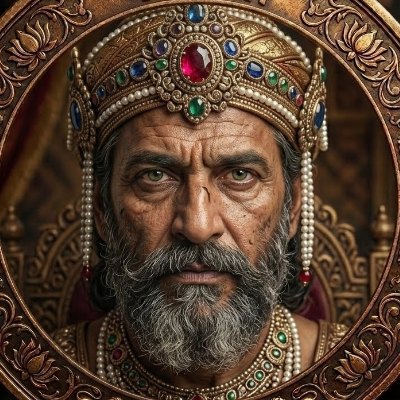
About
Karandhama — King of the Dishta Line, Son of Khaninetra, and Father of Avikshit
Karandhama · Balasva · Balaashva · Suryavanshi
Karandhama is a king of the Dishta sub-line of the solar dynasty, recorded in the Bhagavata Purana, the Vishnu Purana, and the Markandeya Purana as the son of Khaninetra and the father of Avikshit. Khaninetra was the son of Rambha, who was the son of Vivimshati, who was the son of Cakshusha, descending through the successive kings of the Dishta line from Nabhaga — the son of Dishta and grandson of Vaivasvata Manu, the seventh Manu and progenitor of the current human race. The Markandeya Purana, which is the primary narrative source for Karandhama, reveals that his personal name at birth was Balasva, and that the name Karandhama was acquired through a particular episode of military victory. The Markandeya Purana devotes Canto CXXI to his exploits, recording his origin through the austerities of Khaninetra, the manner in which he acquired his celebrated name, his just and compassionate reign, his marriage to a princess named Shubhvrata — also referred to as Veera in some renderings — daughter of King Veerachandra or Viryachandra, and his military intervention to rescue his son Avikshit from captivity after the prince's defeat by a coalition of kings. Karandhama is presented in the Markandeya Purana as a figure of royal courage and parental steadfastness, whose calm conduct in the face of his son's disgrace and his successful campaign to free Avikshit stand as the defining episodes of his reign.
✦ The Names
The name Balasva, given at birth, is a compound of bala meaning strength or force and ashva meaning horse; the compound thus conveys the sense of one possessed of the strength of a horse or one whose power is horse-like, a name of martial and auspicious character consistent with Kshatriya naming conventions. The name Karandhama, by which this king became celebrated and is known in the genealogical tradition, is explained in the Markandeya Purana through a specific military episode. When Balasva was surrounded by his enemies and found himself in desperate straits, he covered his face with both hands and exhaled with great force. From this exhalation there manifested a vast army of warriors, chariots, elephants, and horses that filled the surrounding territory and under whose leadership the enemies were defeated. The Markandeya Purana records that Balasva thereafter became known as Karandhama because of this extraordinary manner of victory — the name encoding the means by which the army was produced. The name Karandhama may be understood as a compound relating to the hands or instrument of action and to the breath or the army produced thereby, though the Markandeya Purana's explanation is the tradition's own account of the name's origin rather than a standard etymological derivation.
✦ Lineage
- Paternal line in summary: Vivasvan the sun-god → Vaivasvata Manu → Dishta → Nabhaga (Nabhanedishta) → Bhalandana → Vatsapriti → Pramshu → Pramati → Khanitra → Cakshusha → Vivimshati → Rambha → Khaninetra → Karandhama.
- Father: Khaninetra — son of Rambha and the immediate predecessor of Karandhama in the Dishta succession; described in the Bhagavata Purana as most religious; his birth was obtained by his father through a prolonged penance on the bank of the river Gomti to please Indra, who granted the boon of a virtuous son.
- Wife: Shubhvrata, also referred to in some renderings as Veera — daughter of King Veerachandra or Viryachandra, who invited Karandhama to a svayamvara at which she chose him as her husband. The Markandeya Purana's Canto CXXI records this marriage as the occasion for the birth of Avikshit.
- Son: Avikshit — son of Karandhama and Shubhvrata, raised and educated at the hermitage of the sage Kanva's son where he mastered the Vedas, martial sciences, and the art of wielding weapons; a king of considerable narrative prominence in the Markandeya Purana; father of the emperor Marutta.
- Grandson: Marutta — son of Avikshit; celebrated as a universal monarch and the performer of the most magnificent sacrifice ever conducted, attended by all the gods and officiated by the sage Samvarta son of Angiras.
✦ The Origin of Karandhama Through Khaninetra's Austerities
The Markandeya Purana records that Khaninetra, finding himself without a son, undertook severe austerities on the bank of the river Gomti in order to propitiate Indra. When Indra was satisfied by his devotion and appeared before him, Khaninetra requested the boon of a religious and virtuous son. Indra granted the boon and Khaninetra returned to his palace. In the course of time a son was born to him and named Balasva. The manner of the son's birth through divine favour granted as the fruit of austerity is consistent with the Markandeya Purana's earlier narrative for Khaninetra's own birth — the text presents a pattern of divine intervention recurring across successive generations of this line, each king's birth or naming connected to an encounter with a divine power.
✦ The Military Reversal and the Acquisition of the Name Karandhama
When Balasva became king after his father Khaninetra's death, he proceeded to annex many kingdoms by defeating their rulers and imposing tribute on them. After a period of successful expansion, the subjugated kings refused to continue paying tribute, regrouped, and recaptured their lost territories. Weakened by constant warfare, Balasva found himself reduced to holding only his own capital city, which his regrouped enemies then surrounded. Faced with the prospect of imminent defeat with no army sufficient to withstand the combined forces encircling him, Balasva fell into despair, covered his face with both his hands, and exhaled a profound breath of anguish. From this exhalation there emerged a vast host — warriors, chariots, elephants, and horses manifesting from the space between his trembling hands. This supernatural army, fighting under his leadership, defeated the surrounding enemies entirely. The king thereafter became known as Karandhama on account of this remarkable victory, the name encoding the memory of the extraordinary manner in which his army had been produced.
✦ The Marriage to Shubhvrata and the Birth of Avikshit
Karandhama ruled his kingdom with justice and compassion following his restoration to power. He was subsequently invited to the court of King Veerachandra for the svayamvara of the king's daughter Shubhvrata. The princess chose Karandhama as her husband at the ceremony. The Markandeya Purana records that the birth of Avikshit to Karandhama and Shubhvrata was attended by auspicious astrological omens — the palace astrologers predicted at the prince's birth that the planets were in especially favourable positions and that Avikshit would grow up to be a great warrior king of exceptional qualities.
✦ The Rescue of Avikshit
The most significant episode recorded for Karandhama in the Markandeya Purana following his son's birth is his military intervention to free Avikshit from captivity. Avikshit, having attended a svayamvara held by the king of Vishala for his daughter Vaishalini and having forcibly abducted her after she declined to choose him, was subsequently defeated in battle by a coalition of kings who had gathered at the ceremony. Avikshit was captured and brought to Vishala in bonds, while Vaishalini refused to choose any other husband and the svayamvara was suspended. When news of Avikshit's defeat and capture reached Karandhama, he was saddened. His wife Shubhvrata, however, declared with steadfast composure that their son had fought bravely against many enemies simultaneously, that the combined assault of many kings against one warrior was adharmic and not sanctioned by the rules of righteous battle, and that Avikshit's courage deserved pride rather than shame. She urged Karandhama to march with his army and rescue their son. Karandhama was encouraged by his wife's words and marched to Vishala. A terrible battle lasting three days was fought between Karandhama and the coalition of princes led by King Vishala. Karandhama was victorious. King Vishala promptly released Avikshit, came to meet Karandhama bearing auspicious gifts, and offered the hand of his own daughter Mudati in marriage to the prince. The Vishnu Purana's account of Avikshit confirms this episode — it notes that Avikshit was attacked and captured by his confederated rivals and was rescued by his father, and that Avikshit, mortified by his disgrace, subsequently vowed never to marry or reign.
✦ Textual Variants and Inconsistencies
The Bhagavata Purana and Vishnu Purana name Karandhama consistently as the son of Khaninetra and the father of Avikshit without providing narrative detail. The Markandeya Purana, which is the primary narrative source for Karandhama, gives his birth name as Balasva and explains the acquisition of the name Karandhama through the episode of the supernaturally produced army. The name of Karandhama's wife is given as Shubhvrata in the Markandeya Purana blog translation, while the Manjula Tekal retelling of the same Puranic material names her Veera — daughter of King Veerachandra — which appears to be a variant rendering of the same figure from different translations of the original Sanskrit text. The Wisdomlib entry on Avikshit, drawing directly on the Markandeya Purana, describes Karandhama's wife as the mother of Avikshit without naming her independently, noting only that she was unfazed by the news of her son's defeat and urged Karandhama to rescue him. A further figure named Marutta, son of Karandhama, appears in the Harivamsha (Chapter 32) and Vishnu Purana IV.16 as a descendant of Yayati's son Turvasu — this is a distinct figure belonging to a separate dynastic line and bearing no genealogical connection to the Karandhama of the Dishta line profiled here.
✦ Connection to the Wider Genealogy
Karandhama stands three generations before Marutta, the most celebrated figure of the entire Dishta sub-line. Through Avikshit, Karandhama is the grandfather of the emperor Marutta, whose sacrifice conducted by Samvarta son of Angiras is described across the Bhagavata Purana, Vishnu Purana, Vayu Purana, Markandeya Purana, Mahabharata, and Aitareya Brahmana as the most magnificent sacrificial rite ever performed. Through Marutta the line continued through Dama, Rajyavardhana, Sudhriti, Nara, Kevala, Vegavan, Budha, and Trinabindu, whose daughter Ilavila married the sage Vishrava and became the mother of Kubera, lord of wealth. Karandhama's courage in battle, his just governance, his dignified response to his son's humiliation, and his decisive military action to restore Avikshit mark him as one of the more fully characterised figures of the Dishta line in the primary sources, standing in contrast to the purely genealogical figures of the earlier generations of the same succession.
✦ References
- Bhagavata Purana, Skandha IX, Chapter 2, verse 25: Names Karandhama as the son of Khaninetra and confirms his position in the Dishta succession leading to Avikshit and Marutta.
- Vishnu Purana, Book IV, Chapter I: Confirms Karandhama in the Dishta succession; its account of Avikshit records the rescue by Karandhama following the prince's defeat and capture, and notes Avikshit's subsequent vow never to marry or reign.
- Markandeya Purana, Canto CXXI: Primary narrative source for Karandhama's exploits; records the birth of Balasva through Khaninetra's austerities, the episode of the supernaturally produced army and the acquisition of the name Karandhama, the svayamvara marriage to Shubhvrata, the birth of Avikshit with auspicious omens, and the three-day battle to rescue Avikshit from the coalition of princes at Vishala.
- Wisdomlib, definition of Avikshit: Secondary reference drawing on the Markandeya Purana and Bhagavata Purana; confirms the succession Khaninetra → Karandhama → Avikshit → Marutta and provides cross-references to the relevant primary passages.
- Markandeya Purana blog (markandeyapurana.blogspot.com), Karandham entry: Translation of the relevant Markandeya Purana canto; consulted for the narrative details of the supernaturally produced army and the acquisition of the name Karandhama.
- Vettam Mani, Puranic Encyclopaedia: Secondary reference compiling the Puranic entries on Karandhama with citations to primary sources; consulted for disambiguation from the distinct figure named Marutta son of Karandhama in the Harivamsha and Vishnu Purana IV.16.
- V. S. Agrawala, Matsya Purana — A Study: Modern secondary work on solar dynasty genealogies; consulted for contextualisation of Karandhama's position within the broader Dishta sub-line and the variant succession sequences across Puranic sources.