
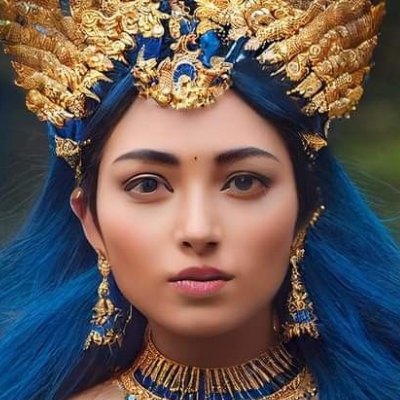
About
Shubhvrata — Queen of the Dishta Line, Wife of Karandhama, and Mother of Avikshit
Shubhvrata · Veera · Suryavanshi-patni
Shubhvrata is a queen of the Dishta sub-line of the solar dynasty, recorded in the Markandeya Purana as the wife of Karandhama and the mother of Avikshit. Karandhama was the son of Khaninetra, who was the son of Rambha, descending through the successive kings of the Dishta line from Nabhaga — the son of Dishta and grandson of Vaivasvata Manu, the seventh Manu and progenitor of the current human race. Shubhvrata is attested solely in the Markandeya Purana, which is the only primary source to record her identity, her parentage, her marriage, and her role in the narrative of her son Avikshit. She appears across multiple cantos of the Markandeya Purana's extended narrative of the Dishta line, and despite the relative brevity of her individual appearances she is one of the more consequential female figures in the tradition — her steadfast declaration of her son's honour at the moment of his worst humiliation, and her strategic deployment of the Kimichhak Vrata to extract from him a promise to marry and beget an heir, are the two interventions that make possible the succession to Marutta, the most celebrated emperor of her line. She is the grandmother of Marutta and her maternal line thus connects directly to one of the most magnificent sacrificial traditions in the entire Puranic corpus.
✦ The Names
The name Shubhvrata is a compound Sanskrit name. Shubha means auspicious, beautiful, or of good omen, while vrata means vow, observance, or sacred practice. The compound thus conveys the sense of one who observes auspicious vows or one characterised by sacred conduct — a name fitting for a queen of pronounced ritual and moral virtue. The name Veera, by which she is referred to in a separate translation tradition of the same Markandeya Purana cantos, means brave, heroic, or courageous, and is entirely consistent with her characterisation in the text as a woman of unshaken fortitude in the face of crisis. As explained in the Textual Variants section below, Shubhvrata and Veera are two renderings of the same figure from different translation traditions of the Markandeya Purana rather than two distinct persons. The Markandeya Purana's Canto CXXIX, which records the later phase of Marutta's reign, refers to her as Marutta's grandmother Vira — confirming that the Veera rendering is used consistently across the later cantos of the same text when referring back to this figure.
✦ Lineage
- Father: Veeryachandra — also rendered as Veerachandra — a king whose daughter was offered in marriage through a svayamvara at which Karandhama was invited as a suitor. The name Veeryachandra is a compound of veerya meaning valour or heroic strength and chandra meaning moon, conveying the sense of one of moonlike heroic brilliance. No further details about his lineage, kingdom, or narrative significance are recorded in the available primary sources beyond his role as Shubhvrata's father and the host of the svayamvara at which the marriage was arranged.
- Husband: Karandhama — son of Khaninetra; originally named Balasva; acquired the name Karandhama through an episode in which a supernatural army manifested from his breath to defeat his enemies; a just and compassionate king who rescued his son Avikshit from captivity following the prince's defeat by a coalition of kings. Karandhama is treated in a separate profile.
- Son: Avikshit — son of Karandhama and Shubhvrata; educated at the hermitage of the son of the sage Kanva; a warrior of exceptional prowess who performed a hundred horse sacrifices and was honoured by Brihaspati; whose long arc of defeat, disillusionment, and eventual marriage produced the emperor Marutta. Avikshit is treated in a separate profile.
- Grandson: Marutta — son of Avikshit and Vaishalini; the most celebrated emperor of the Dishta sub-line, whose sacrifice officiated by Samvarta son of Angiras is described across the Bhagavata Purana, Vishnu Purana, Vayu Purana, Markandeya Purana, Mahabharata, and Aitareya Brahmana as the most magnificent ever performed. Marutta is treated in a separate profile.
✦ The Svayamvara and the Marriage to Karandhama
The Markandeya Purana records that Karandhama was invited to the svayamvara held by King Veeryachandra for his daughter. At the ceremony, Shubhvrata chose Karandhama as her husband. The text does not record additional details about the svayamvara itself beyond this selection. The birth of Avikshit to the couple was attended by auspicious astrological omens which the palace astrologers interpreted as predicting that the prince would grow to become a great warrior king, and Shubhvrata is thus the mother at whose birth the trajectory of the line's greatest generation was foretold.
✦ The Declaration of Avikshit's Honour
The most dramatically rendered moment of Shubhvrata's narrative in the Markandeya Purana occurs when news arrives that Avikshit has been defeated in battle and taken captive by a coalition of kings at the svayamvara of Vaishalini of Vishala. While Karandhama was saddened by the news and fell into anxious consultation with his advisors, Shubhvrata was entirely unshaken. She declared that Avikshit had fought all the assembled princes simultaneously to win a bride, that the combined assault of many kings against a single warrior was an adharmic form of battle not sanctioned by the code of righteous warfare, that he had been overcome only by sheer numbers rather than by any failure of courage, and that far from being a source of shame his conduct was a cause for pride. She then urged Karandhama to mobilise his army and march to her son's rescue. The Markandeya Purana presents this declaration as the direct impetus for Karandhama's decision to launch the campaign that freed Avikshit — it was Shubhvrata's forceful reframing of the defeat as an honourable contest corrupted by the enemy's tactics that enabled Karandhama to act with resolution rather than remain paralysed by grief and uncertainty.
✦ The Kimichhak Vrata and the Extraction of Avikshit's Promise
After Avikshit's rescue, he refused all entreaties — from the king of Vishala, from the princess Vaishalini herself, and from Karandhama — to marry and accept the succession, maintaining his vow of celibacy and renunciation as a consequence of his battlefield humiliation. The continued absence of an heir became a matter of grave concern to the entire court. Shubhvrata undertook the performance of a demanding ritual observance known as the Kimichhak Vrata. This particular vow had a binding characteristic of unusual consequence: any request made during its performance had to be fulfilled without exception, failing which all the merit accumulated through the austerity would be forfeited. While Shubhvrata was engaged in this vow, Karandhama — aware of its binding nature and perceiving an opportunity — waited for the precise moment when Avikshit arrived at the scene of the ritual. The attending priest announced, in accordance with the vow's requirements, that any demand made at that moment would be obligatorily fulfilled. Before anyone else could speak, Avikshit gave his assurance that demands would be met. Karandhama immediately stated his demand: that he wished for a grandson, which required Avikshit to marry. Avikshit, bound by the word he had already given in the sacred context of his mother's ongoing vow, attempted to argue the impossibility of the demand but ultimately relented. Though it was Karandhama who articulated the demand, the entire mechanism that made it binding was the Kimichhak Vrata that Shubhvrata had undertaken. The Markandeya Purana presents the summary of this episode in its contents as Avikshit's mother obtaining a promise from him through a ruse — acknowledging that the stratagem was hers in conception even if it was Karandhama who executed it in the moment of opportunity.
✦ The Counsel to Marutta During His Reign
The Markandeya Purana's Canto CXXIX records that during Marutta's reign as universal emperor, the Nagas were causing great distress to the sages residing in the realm. Shubhvrata — referred to in this passage as Marutta's grandmother Vira — sent a message to Marutta through a hermit, advising him to administer justice and secure peace for the rishis. This detail, though brief, indicates that Shubhvrata was still alive during her grandson's reign, that she continued to exercise a voice of moral counsel in the affairs of the dynasty, and that the tradition remembered her as a figure of continuing authority rather than one whose narrative function ended with the birth and succession of Avikshit.
✦ Textual Variants and Inconsistencies
The principal textual complexity surrounding this figure is the divergence between two translation traditions of the Markandeya Purana in rendering her name. The Markandeya Purana blog translation of Canto CXXI identifies her as Shubhvrata, daughter of Veeryachandra, who chose Karandhama at a svayamvara. The Manjula Tekal retelling of the same material identifies her as Veera, daughter of Veerachandra, who chose Karandhama at a svayamvara. The essential facts — princess daughter of a king named Veeryachandra or Veerachandra who selected Karandhama at a svayamvara — are consistent across both renderings; the difference is in the transliteration and possibly the rendering of her personal name from the original Sanskrit. The Markandeya Purana's Canto CXXIX, in the Wisdomlib translation, refers to her as Marutta's grandmother Vira, which aligns with the Veera rendering rather than Shubhvrata, and suggests that the Veera rendering may be closer to the Sanskrit original at least for her personal name as it appears in the later cantos. The Indiadivine.org summary of the relevant Markandeya Purana cantos does not name her at all, referring only to Avikshit's mother. No other Mahapurana or primary source independently records this figure, and the Bhagavata Purana and Vishnu Purana make no reference to her by name.
✦ Connection to the Wider Genealogy
Shubhvrata enters the Dishta sub-line of the solar dynasty through her marriage to Karandhama, whose paternal ancestry traces back through Khaninetra, Rambha, Vivimshati, and the successive kings of the Dishta line to Nabhaga, Dishta, and Vaivasvata Manu. Through her son Avikshit and her grandson Marutta, she stands as the maternal anchor of the most celebrated generation of her dynastic line. The succession through Marutta continued through Narishyanta or Dama — the sources give variant accounts — and then through Rajyavardhana, Sudhriti, Nara, Kevala, Vegavan, Budha, and Trinabindu, the last of whom had a daughter named Ilavila who married the sage Vishrava and became the mother of Kubera, lord of wealth. Shubhvrata's role in ensuring the succession through Avikshit makes her, in the terms of the tradition, the figure without whose decisive action at two critical moments — the declaration of Avikshit's honour and the Kimichhak Vrata stratagem — the entire post-Karandhama portion of this lineage, culminating in Kubera's parentage, might not have come to pass.
✦ References
- Markandeya Purana, Canto CXXI: Primary source for Shubhvrata's introduction as the daughter of Veeryachandra who chose Karandhama at a svayamvara and became the mother of Avikshit; records the auspicious astrological omens at Avikshit's birth.
- Markandeya Purana, Cantos CXXIII–CXXIV: Source for Shubhvrata's declaration of Avikshit's honour following his defeat and captivity at Vishala, and her urging of Karandhama to march to his rescue.
- Markandeya Purana, Canto CXXV: Source for the Kimichhak Vrata episode; records Shubhvrata's ritual observance and the mechanism by which Avikshit was bound to a promise of marriage and succession through the binding conditions of the vow.
- Markandeya Purana, Canto CXXIX: Source for Shubhvrata's continued presence and moral authority during Marutta's reign; records her message to Marutta through a hermit advising him to administer justice to the Nagas who were troubling the sages; refers to her as Marutta's grandmother Vira.
- Markandeya Purana blog (markandeyapurana.blogspot.com), Birth of Aveekshit entry and Aveekshit Promises his Father entry: Translations of the relevant cantos consulted for narrative details of the svayamvara, the birth of Avikshit, the response to defeat, and the Kimichhak Vrata episode.
- Manjula Tekal, The Prince Who Refused to be King (Medium, 2020): Retelling of the Markandeya Purana cantos drawing on the same primary text; identifies the figure as Veera daughter of Veerachandra; consulted for cross-referencing the name variant and confirming the consistent underlying narrative across both translation traditions.
- Wisdomlib, Markandeya Purana, Canto CXXIX translation: Confirms the reference to Vira as Marutta's grandmother who sent a message advising the king on the Naga disturbance; used to establish the continuity of this figure across the later cantos of the text.