
About
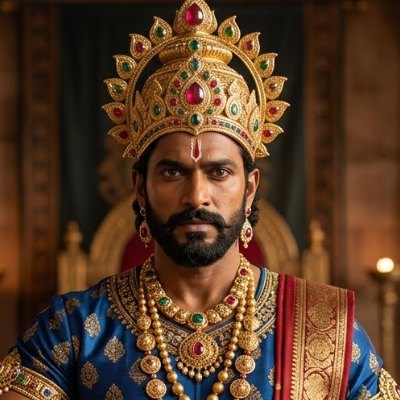
Narishyanta — King of the Solar Line, Son and Successor of Marutta
Narishyanta · Narishanta · Jyeshtha-putra of Marutta
Narishyanta was a king of the Solar dynasty (Suryavamsha), belonging to the line of Dishta, one of the sons of Vaivasvata Manu, the progenitor of the present age. He was the eldest among the eighteen sons of the celebrated emperor Marutta, and succeeded his father to the throne when Marutta retired to the forest. Narishyanta is principally remembered for a remarkable episode of sacrificial piety recorded in the Markandeya Purana, in which his extraordinary generosity towards the Brahmin priesthood produced an unprecedented crisis in his ability to perform Vedic ritual. His son Dama continued the royal line after him. He appears in the genealogical lists of the Bhagavata Purana and is the subject of an extended narrative in the Markandeya Purana spanning Cantos 128 through 130.
✦ The Name
The name Narishyanta is Sanskrit in origin. It does not carry a widely elaborated etymological tradition in the primary sources, and no major epithets or secondary names are attached to this figure in the texts that survive. He is distinguished in scholarly discussion primarily by his position as son of Marutta, and by the need to distinguish him from a second entirely separate figure of the same name — Narishyanta the son of Vaivasvata Manu — who belongs to a different branch of the Solar lineage and a different body of narrative tradition altogether.
✦ Lineage
- Dynasty: Suryavamsha (Solar dynasty), through the line of Dishta — son of Vaivasvata Manu — continuing through Nabhanedishta (son of Dishta), Bhalandana, Vatsapriti, Pramshu, Pramati, Khanitra, Cakshusha, Vivimshati, Rambha, Khaninetra, Karandhama, and Avikshit
- Father: Marutta — emperor of the Solar line, celebrated across the Mahabharata, Vishnu Purana, Bhagavata Purana, and Markandeya Purana for his legendary gold-laden Vedic sacrifices conducted with the sage Samvarta, himself the son of Avikshit
- Position among siblings: Eldest of eighteen sons born to Marutta, selected to inherit the kingdom upon Marutta's retirement to the forest
- Son: Dama — Narishyanta's successor as king, recorded in the genealogical list of the Bhagavata Purana
✦ Succession and the Weight of Ancestry
According to the Markandeya Purana, when Marutta concluded his worldly duties and withdrew to the forest, Narishyanta, as the eldest and most distinguished of his sons, was installed as king. He inherited a realm shaped by his father's extraordinary generosity and the towering reputation of Marutta's sacrifices, which were said to have filled the ritual ground with gold. This inheritance of renown set the precise conditions for the defining episode of Narishyanta's own reign.
✦ The First Sacrifice and the Enrichment of the Priesthood
Wishing to honour the example of his forefathers, Narishyanta organised a grand Vedic sacrifice early in his reign. He discharged his duties as royal patron with exceptional thoroughness, distributing to the officiating Brahmin priests quantities of food, gold, cattle, and land so vast that the entire priestly community within his kingdom was rendered completely self-sufficient. No priest who attended his first great yajna was left in any material want. The Markandeya Purana presents this not as excess but as the fulfilment of the royal duty of dana — the obligation of a king to give — carried to its utmost limit.
✦ The Second Sacrifice and the Crisis of the Empty Altar
When Narishyanta subsequently sought to organise a second grand sacrifice, he sent out the customary invitations to Brahmin priests to serve as officiants. None accepted. The Markandeya Purana records that the priests, having been so thoroughly provided for by the first sacrifice, had no remaining desire for further wealth or donations. They were already engaged in their own household observances and had no material incentive to attend. The altar stood prepared, the ritual arrangements were complete, but no qualified officiant came forward to begin the rites.
This created an unprecedented theological difficulty. A king was bound by dharma to complete his sacrificial vows, yet the very generosity that was the measure of a righteous ruler had removed all possibility of the ritual's normal execution. The text describes Narishyanta entering a state of deep distress — referred to in commentary as the condition of the dejected king — caught between the obligation to perform and the absence of any conventional means to do so.
✦ The Resolution
Narishyanta resolved the crisis by personally undertaking the physical conduct of the sacrifice himself, acting simultaneously as the royal sponsor and as the direct participant in the ritual labour. By stepping down from the elevated position of the patron and engaging directly in the demanding work of the ceremony, he fulfilled his vow and completed his sacrificial obligation. The Markandeya Purana presents this resolution as a genuine act of piety — the king subordinating royal dignity to the imperatives of dharmic duty.
✦ Textual Variants and the Two Narishyantas
The primary texts record two entirely distinct royal figures bearing the name Narishyanta, and care is required to keep them separate. The first is Narishyanta the son of Vaivasvata Manu, who appears in the lineage chapters of the Vishnu Purana and Bhagavata Purana as one of Manu's direct sons and belongs to the earliest generation of the Solar line. The second is Narishyanta the son of Marutta, the subject of this profile, who belongs to the Dishta branch of the Solar dynasty many generations later. The Markandeya Purana explicitly addresses this distinction in its lineage chapters. The two figures share no narrative episodes and should not be conflated.
The genealogical lists for the post-Narishyanta line — from his son Dama onward — show minor variation between the Vishnu Purana, Bhagavata Purana, and Harivamsa in the names and sequence of subsequent kings, though Narishyanta's own position as son of Marutta and father of Dama is consistent across these sources.
✦ Theological and Dharmic Significance
The episode recorded in the Markandeya Purana presents Narishyanta as an illustration of a particular tension within the Puranic ideal of kingship. The king's dharma requires him to give without limit; yet giving without limit can paradoxically destroy the very social structures — including a priesthood motivated to perform — that ritual giving is meant to sustain. Narishyanta's predicament is the consequence of perfect compliance with one dimension of royal duty producing an obstacle to the fulfilment of another. His resolution — personal participation in place of patronage — represents an adaptation of duty to circumstance, a theme that recurs across Puranic royal narratives.
✦ Connection to the Wider Genealogy
Narishyanta stands as the direct link between the celebrated reign of Marutta — whose sacrifices with the sage Samvarta are among the most elaborately described royal rituals in the Puranic corpus — and the continuation of the Dishta branch of the Solar dynasty through his son Dama and the kings who follow. The full dynastic chain from Vaivasvata Manu runs through Dishta, Nabhanedishta, Bhalandana, Vatsapriti, Pramshu, Pramati, Khanitra, Cakshusha, Vivimshati, Rambha, Khaninetra, Karandhama, Avikshit, and Marutta before reaching Narishyanta. His position as eldest of eighteen sons and chosen successor places him at the head of this branch of the lineage, transmitting the Solar royal tradition into the generations that follow Marutta's withdrawal from worldly life.
✦ References
- Primary Sources
- Markandeya Purana, Cantos 128–130 (F. E. Pargiter's translation) — principal narrative source for Narishyanta's succession, the eighteen sons of Marutta, the first and second sacrifices, and the resolution of the sacrificial crisis; the distinction between the two figures named Narishyanta is also addressed in these cantos
- Bhagavata Purana, Skandha 9 — includes Narishyanta in the genealogical list of the Dishta Solar line, recording Dama as his son and successor
- Vishnu Purana, Book 4 — contains the Solar royal genealogy through the Dishta branch, providing the dynastic framework within which Marutta and Narishyanta are placed; also records the separate Narishyanta son of Vaivasvata Manu
- Harivamsa — supplementary genealogical list of the Solar kings in the Dishta line; shows minor variation in sequence from the Vishnu and Bhagavata accounts from Dama onward
- Mahabharata — references Marutta's line in the context of royal genealogies; provides background lineage context for Narishyanta's dynastic position
- Secondary Sources
- F. E. Pargiter, The Markandeya Purana (1904), Bibliotheca Indica — standard English translation of the Markandeya Purana used to locate and interpret the Cantos 128–130 narrative sequence
- Wisdomlib — concept entries on King Narishyanta and related terms — secondary reference aggregating Puranic textual material on the sacrifice narrative and the dejected king episode
- Wikipedia — Narishyanta article — secondary reference used to cross-check the identification of Canto references and the two-Narishyanta distinction; all factual claims verified against primary source material