
About
Jahnu — Sage-King of the Puru Line, Drinker of the Ganga, Progenitor of the Kushika Line
Jahnu · Jahnavi (the Ganga named after him)
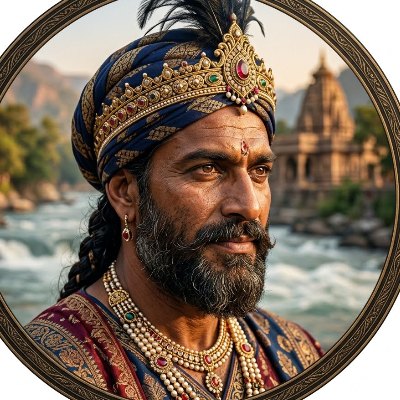
Jahnu is a sage-king of the Puru lineage within the Chandravamsha, son of Ajamidha — the great Puru king descending from Bharata Daushyanti — by his wife Kesini. He is attested across the Mahabharata (Adi Parva chapter 94 and Anushasana Parva chapter 4), the Brahma Purana (chapter 11), the Vishnu Purana (Book IV, chapter 7), the Ramayana, and the Harivamsha, and is one of the few figures of the Puru genealogical line between Bharata and Kuru to have attained a mythological profile substantially independent of the dynastic narrative. His fame rests principally on two episodes involving the river Ganga: the Brahma Purana records that during his performance of the great sacrifice Sarva Medhayaga, Ganga flooded his hall, whereupon he drank the entire river and released her through his ear after the gods propitiated him; and the more widely attested legend of Bhagiratha records that Ganga, having descended from heaven through Shiva's locks, again disrupted Jahnu's hermitage and was again absorbed and released through his ear — giving Ganga the name Jahnavi, meaning she who emerged from Jahnu. Through his descendants, Jahnu is also the progenitor of the Kushika lineage in the Mahabharata's Anushasana Parva tradition, from which the royal-sage Vishvamitra and the Saptarishi Jamadagni — father of Parashurama — both ultimately descend, though this connection belongs to a separate textual tradition from the Ramayana's account of those same figures.
✦ The Name
The name Jahnu carries no ancient gloss in the primary sources. The most commonly proposed derivation connects a root related to striking or overcoming, consistent with the figure's capacity to absorb the cosmic river by force of will. The derivative name Jahnavi — meaning she who belongs to Jahnu or daughter of Jahnu — became permanently attached to the Ganga and is used throughout the Puranic, epic, and devotional literature. The Mahabharata's Anushasana Parva chapter 4 uses this relationship in the literal genealogical sense, calling Ganga the daughter of Jahnu — the most ancient textual basis for the name Jahnavi.
✦ Lineage
- Father: Ajamidha — king of the Puru line, son of Suhotra son of Bhumanyu son of Bharata Daushyanti; described in the Anushasana Parva as the best of all virtuous men and a performer of great sacrifices; he had three wives in the principal Mahabharata tradition: Dhumini, Nili, and Kesini
- Mother: Kesini — third wife of Ajamidha; the Mahabharata Adi Parva chapter 94 names her as mother of Jahnu, Jala, and Rupina
- Brothers: Jala and Rupina — sons of Kesini by Ajamidha; no independent narrative is attested for either
- Half-brothers: Riksha — son of Ajamidha by Dhumini, progenitor of the Kuru royal line through Samvarana; Dushmanta and Parameshthin — sons of Ajamidha by Nili, progenitors of the southern Panchala tribes; Nila — son of Ajamidha by Nalini, progenitor of the northern Panchala line
- Wife: Kaveri — wife of Jahnu, named in the Harivamsha and Brahma Purana
- Son: Balakashva — the son to whom Jahnu transferred his kingdom before retiring to forest penance; the Puranic Encyclopaedia records Sindhudwipa as a further son named in the Anushasana Parva tradition; the Wikipedia article on Jahnu records Ajaka and Sunanda as further children from the Harivamsha
- Daughter (Anushasana Parva tradition): Ganga — the Mahabharata Anushasana Parva chapter 4 describes Ganga as the daughter of Jahnu in the literal genealogical sense; this is the textual basis for the epithet Jahnavi
✦ The Sarva Medhayaga and the First Drinking of Ganga
The Brahma Purana (chapter 11) records the earliest episode involving Jahnu and Ganga. Jahnu was performing a great sacrifice of long duration called Sarva Medhayaga when the goddess Ganga approached him with the desire to have him as her husband. He declined her proposal. Ganga, affronted, flooded his entire sacrificial ground. Jahnu, seeing the sacred arena of his sacrifice desecrated by the haughty river, announced that he would condense her waters throughout the three worlds and drink them entirely — and immediately did so. The gods and sages propitiated Jahnu and entreated him to release her. He relented and released Ganga from his ear, after which the tradition conferred upon Ganga the epithet Jahnavi.
✦ The Bhagiratha Episode and the Second Drinking of Ganga
The more widely attested episode belongs to the great narrative of Bhagiratha's quest to bring the Ganga down from heaven to earth so that her purifying waters could flow over the ashes of his sixty thousand ancestors — the sons of King Sagara — whose souls could not attain liberation until the sacred river touched their remains. After extraordinary penances across many generations of his solar dynasty, Bhagiratha propitiated Brahma and then Shiva, who received Ganga in his matted locks to break the force of her descent. When Shiva released the river, her waters flowed across the terrestrial plane and disrupted the hermitage of Jahnu, who was performing penance there. Jahnu again absorbed the entire river. Bhagiratha propitiated Jahnu with reverence and entreaty, and Jahnu, pleased, released Ganga once more through his ear. This second release is the event most widely referenced across the Ramayana, the Mahabharata, and the Puranas in connection with the name Jahnavi.
The Vishnu Purana (Book IV, chapter 7) gives a compressed but clear account of the same episode: Jahnu, while performing a sacrifice, saw the place overflowed by the Ganga and with eyes red with anger united the spirit of sacrifice with himself by the power of his devotion and drank up the river. The gods and sages came to him, appeased his indignation, and reobtained the Ganga from him in the capacity of his daughter — hence Jahnavi.
✦ Renunciation and the Kushika Line
Having fulfilled his royal duties, Jahnu transferred his kingdom to his son Balakashva and retired to the forest to perform penance. The Mahabharata Anushasana Parva (chapter 4) records, in the context of Bhishma's account of how Vishvamitra attained Brahmarishi status, that a descent from Jahnu eventually reaches the figures central to that story. The full sequence given is: Jahnu → Sindhudwipa → Valakashva → Vallabha → Kushika → Gadhi. Gadhi is the king of Kanyakubja whose daughter Satyavati married the sage Richika of the Bhrigu line, giving birth to Jamadagni; and whose son Vishvamitra attained the supreme Brahminical status through extraordinary penance and spiritual transformation. In the Anushasana Parva's framing Jahnu is thus the remote Puru ancestor of the entire Kushika gotra and of all the great figures associated with it.
✦ Textual Variants and Inconsistencies
The most significant variant concerns the relationship between the Anushasana Parva's genealogical tradition for Gadhi and the entirely independent tradition preserved in the Valmiki Ramayana. The Anushasana Parva places Gadhi as a descendant of Jahnu through the sequence Jahnu → Sindhudwipa → Valakashva → Vallabha → Kushika → Gadhi, making him a member of the Puru lunar line. The Valmiki Ramayana (Bala Kanda, chapter 34 and prose 51), however, gives Gadhi an entirely different and unconnected parentage: Brahma → Kusha → Kushanabha → Gadhi, making Kusha a mind-son of Brahma and Gadhi the son of Kushanabha. The Ramayana account is narrated by Vishvamitra himself to Rama, making it a statement by the figure whose own parentage is at stake. Wilson's footnotes to the Vishnu Purana (Book IV, chapter 7) record the full cross-Puranic picture: the Brahma Purana and Harivamsha make Gadhi the son of Kushika; the Vayu Purana and Bhagavata Purana make him the son of Kushanabha; and the Ramayana makes him the son of Kushanabha. The two traditions — the Anushasana Parva's lunar-Puru-Jahnu lineage for Gadhi, and the Ramayana's independent Brahma-Kusha line — are irreconcilable and both are primary texts. They are recorded here as separate traditions. For the purposes of this genealogical tree, Jahnu's line terminates with Balakashva and the Kushika gotra as a collective descendant body; the Gadhi-Vishvamitra-Jamadagni-Parashurama line is placed in the tree under its Ramayana parentage independently.
On the Ganga episodes: the Brahma Purana episode and the Bhagiratha episode represent distinct narrative occasions for the same act. In the Brahma Purana it is Ganga's unwanted matrimonial approach that provokes Jahnu; in the Bhagiratha tradition it is the disruption of his hermitage by the river's earthward descent. The Vishnu Purana account combines elements of both. Most secondary sources conflate the two episodes, but in the primary texts they are distinct occasions.
On the identity of Ganga as Jahnu's daughter: the Anushasana Parva states this literally in the genealogical sense; the Vishnu Purana uses the phrase in the capacity of his daughter to indicate that Ganga was reobtained by the gods from Jahnu in a relationship of filiation, not that she was born of him biologically. The two framings of the same epithet Jahnavi exist in tension across the primary sources.
On the intermediate generations between Jahnu and Gadhi, variant sequences exist. The Puranic Encyclopaedia gives Jahnu → Sumanta → Ajaka → Balakashva → Kushika — four generations with different intermediate names from the Anushasana Parva's five-generation sequence. The Bhagavata Purana (as cited in a secondary source) gives yet another intermediate chain. These variants are typical of multi-generational genealogical records across the Puranic corpus.
✦ Theological and Cosmological Significance
Jahnu occupies a unique position in the tradition: he is simultaneously a mortal king of the Puru genealogical line and a figure of such extraordinary tapasic power that he can absorb, contain, and release the holiest river in the Hindu cosmological order not once but twice. The episode functions as a demonstration of the power of sustained austerity and righteous anger — that a human sage, by virtue of his practice, can command forces that transcend the natural order. The name Jahnavi, permanently attached to the Ganga, ensures that the memory of this mortal figure is preserved in every devotional act, pilgrimage, and textual reference to the river across all subsequent centuries of the tradition.
✦ Connection to the Wider Genealogy
Jahnu stands in the Puru line: Bharata Daushyanti → Suhotra → Bhumanyu → Ajamidha → Jahnu (by Kesini). He is a half-brother of Riksha — from whom the Kuru royal line descends through Samvarana, Kuru, and the long sequence of Hastinapura kings to Pratipa, Shantanu, Bhishma, and all the figures of the Mahabharata's central narrative. Through his own line Jahnu is the ancestor of the Kushika gotra, one of the major Brahminical and Kshatriya lineage groupings of the Vedic tradition. The Anushasana Parva's account of this descent — Jahnu → Sindhudwipa → Valakashva → Vallabha → Kushika → Gadhi → Vishvamitra and Satyavati — connects the Puru tree in that tradition to the families of Vishvamitra, Jamadagni, and Parashurama, though this connection is not made in the Ramayana, which gives Gadhi an independent parentage under Brahma → Kusha → Kushanabha. In this genealogical tree Jahnu's line terminates at Balakashva and the collective Kushika gotra; Gadhi and his descendants are placed under the Ramayana tradition separately.
✦ References
Primary Sources
- Mahabharata, Adi Parva, chapter 94, verses 30–32 — Names Jahnu as the eldest son of Ajamidha by Kesini; states that the Kushikas are the sons of Jahnu; places him in the Puru genealogical sequence.
- Mahabharata, Anushasana Parva, chapter 4 — Bhishma's account of the Kushika lineage in the context of Vishvamitra's attainment of Brahmarishi status; names Jahnu as son of Ajamidha; states Ganga was the daughter of Jahnu; gives the full descent sequence Jahnu → Sindhudwipa → Valakashva → Vallabha → Kushika → Gadhi → Satyavati → Jamadagni and Gadhi → Vishvamitra.
- Brahma Purana, chapter 11 — The principal narrative source for the Sarva Medhayaga episode; records Ganga's approach to Jahnu, his refusal, her flooding of his sacrificial ground, his drinking of the river, and her release through his ear at the gods' entreaty; names his wife as Kaveri.
- Vishnu Purana, Book IV, chapter 7 — Records the Bhagiratha episode with Jahnu absorbing and releasing Ganga; uses the phrase in the capacity of his daughter for the origin of the name Jahnavi; Wilson's footnotes collate variant traditions for Gadhi's parentage across the Brahma Purana, Harivamsha, Vayu Purana, Bhagavata Purana, and Ramayana.
- Valmiki Ramayana, Bala Kanda, chapter 34 and prose 51 — Gives the independent tradition for Gadhi's parentage as Brahma → Kusha → Kushanabha → Gadhi, narrated by Vishvamitra himself; this tradition places Gadhi entirely outside the Jahnu-Puru line and is irreconcilable with the Anushasana Parva account.
- Harivamsha — Names Kaveri as Jahnu's wife; gives Balakashva and Ajaka as his sons; confirms the lineage toward the Kushika clan.
Secondary Sources
- Vishnu Purana, tr. H. H. Wilson (1840), Book IV, chapter 7, footnotes — The critical reference for the cross-Puranic collation of Gadhi's parentage traditions; explicitly records that the Brahma Purana and Harivamsha make Gadhi son of Kushika, the Vayu and Bhagavata make him son of Kushanabha, and the Ramayana makes him son of Kushanabha; distinguishes these from the Anushasana Parva's fuller sequence.
- Puranic Encyclopaedia, Vettam Mani, entry "Jahnu" — Records the full genealogy; gives the Kushika descent sequence as Jahnu → Sumanta → Ajaka → Balakashva → Kushika, a variant of the Anushasana Parva's five-generation chain; notes the abdication and retirement to penance.
- Wisdomlib.org, "Jahnu" definition entry — Collates references across the Mahabharata, Brahma Purana, Vishnu Purana, and Harivamsha.
- Wikipedia, "Jahnu" article — Records the Brahma Purana episode with Ganga's matrimonial approach; gives children as Balakashva, Sunanda, and Ajaka from the Harivamsha; notes the Bhagiratha episode.
- Sacred-texts.com, Mahabharata, Anushasana Parva, section IV — Full primary text of Bhishma's account beginning with Ajamidha and Jahnu; records Ganga as daughter of Jahnu and the full descent to Gadhi.