
About
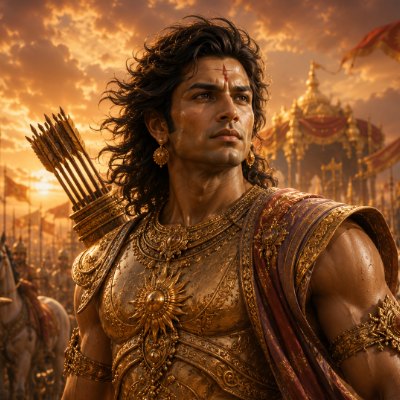
Karna — King of Anga, Son of Surya, Hero of the Mahabharata
Karna · Vasushena · Radheya · Sutaputra · Angaraja · Vrisha · Daanveer Karna · Vaikartana · Suryadatta
Karna is the most celebrated figure of the Anga dynasty and one of the central characters of the Mahabharata. Born of the princess Kunti by the sun god Surya before her marriage, he was abandoned at birth, discovered in a sealed basket on the river Ganga, and raised as the son of Adhiratha, the Suta king of Anga, and his wife Radha. His life is defined by a series of profound paradoxes: the eldest son of the Pandava mother who became the sworn ally of the Kauravas; a warrior of supreme ability who was denied recognition throughout his life on grounds of birth; a king of Anga who had no blood connection to the dynasty he ruled; and a man of inexhaustible generosity who gave away the very armour that constituted his divine protection. He is attested across the entire span of the Mahabharata from the Adi Parva through the Karna Parva, the Stri Parva, and the Shanti Parva, as well as in the Bhagavata Purana, the Harivamsha Purana, the Devibhagavata Purana, and numerous secondary texts.
✦ The Names
The name Karna derives from the Sanskrit karna, meaning ear, and was given to him on account of the natural golden earrings with which he was born — gifts from his divine father Surya. His birth name, bestowed at the naming ceremony conducted by Brahmins in Adhiratha's home, was Vasushena, meaning one whose wealth is his armour or one endowed with divine treasure — a compound of vasu (wealth, divine treasure, or a class of celestial beings) and sena (army or power). The matronymic Radheya — son of Radha — by which he is widely called throughout the epic reflects his foster mother's name and the Suta social identity she conferred upon him. Angaraja means king of Anga and was the title by which he was formally installed as ruler of that kingdom by Duryodhana. Vrisha means bull or the excellent one, a name of heroic connotation used alongside Vasushena in the Mahabharata. Vaikartana, meaning one who cut away his natural armour, is an epithet that arose from his act of severing his divine kavach and kundal as charity for Indra. Daanveer — great giver, hero of charity — is among his most enduring epithets in the tradition, reflecting the quality of limitless generosity that the texts repeatedly identify as his most defining personal characteristic alongside his martial prowess.
✦ Lineage
- Biological father: Surya, the sun god, one of the twelve Adityas, who appeared before Kunti in response to the mantra given to her by the sage Durvasa and fathered Karna upon her
- Biological mother: Kunti, born Pritha, daughter of Shurasena of the Yadava dynasty and adopted daughter of Kuntibhoja; later wife of King Pandu of Hastinapura and mother of Yudhishthira, Bhima, and Arjuna — making Karna the eldest half-brother of the three elder Pandavas
- Adoptive father: Adhiratha, Suta king of Anga, son of Satyakarma, a friend of Dhritarashtra and a charioteer; the man who found Karna in the basket, gave him his name, raised him, sent him to Hastinapura for training, and arranged his marriage
- Adoptive mother: Radha, wife of Adhiratha, whose milk and care constituted Karna's primary maternal bond; source of the matronymic Radheya
- Wives: The canonical Mahabharata (Udyoga Parva) records that Karna married wives of Adhiratha's selection, using a plural form that confirms more than one wife; the Stri Parva names one unnamed wife as the mother of Vrishasena and Sushena; the name Vrushali is attested in certain recensions and secondary traditions as his first wife, a woman of Suta birth chosen for him by Adhiratha as his childhood companion; the name Supriya appears in later secondary sources as a second wife; neither name appears in the critical edition of the Mahabharata and should be treated as recension-level or secondary attestation rather than primary canon
- Sons: Vrishasena (eldest), Chitrasena, Satyasena, Sushena, Shatrunjaya, Dvipata, Banasena, Prasena, and Vrishaketu (youngest); the Bhagavata Purana (9.23.14) names Vrishasena specifically; the fuller list of nine is given across the Drona Parva, Karna Parva, and Stri Parva of the Mahabharata; of these, all except Vrishaketu were killed in the Kurukshetra War
✦ Birth and the Kavach-Kundal
Kunti's invocation of the sun god Surya through the mantra of Durvasa, and the consequent birth of Karna, is narrated in the Adi Parva of the Mahabharata (Kundalaharana Parva and surrounding sections). Surya, appearing before the unmarried Kunti, fathered a son upon her in fulfilment of the mantra's compulsion. At Kunti's specific request, made in anticipation of what abandonment would mean for the child's safety, Surya bestowed upon the newborn a natural kavach — divine armour that grew as part of his body — and kundal — golden earrings of celestial origin — both derived from amrita, the substance of immortality. These gifts rendered Karna effectively invulnerable as long as he retained them. Terrified of social disgrace as an unmarried mother, Kunti sealed the infant in a box adorned with protective substances and set it adrift on the river Aswa. The box passed through the Charmanvati and Yamuna rivers and reached the Ganga, where Adhiratha and Radha found it near the city of Champa in Anga.
✦ Education and Training
The Mahabharata records that Karna received his initial training in arms from Drona, the royal preceptor at Hastinapura — a fact attested in the Sambhava Parva, where Karna is listed among Drona's students. When Karna sought from Drona the knowledge of the Brahmastra — the most powerful of all celestial weapons — Drona declined, reserving it for a Brahmin of faultless conduct or a Kshatriya purified by great penance. Karna thereafter went to Mount Mahendra, where Parashurama — who accepted only Brahmin students — resided. Disguising himself as a Brahmin, Karna became Parashurama's disciple and attained mastery over all weapons and astras. Parashurama declared him equal to himself in the art of archery and gifted him his personal bow, the Vijaya. The deception was discovered when Parashurama, resting his head on Karna's lap, was unaware that a bee had bored into Karna's thigh. Karna endured the pain without moving to avoid disturbing his guru, but when Parashurama awoke and saw the wound, he deduced from this superhuman tolerance of pain that his student was a Kshatriya, not a Brahmin. Feeling deceived, Parashurama cursed Karna that in the moment of his greatest need in battle, the knowledge of the most powerful weapon would fail him. The Mahabharata also records a separate curse placed upon Karna by a Brahmin whose cow he had accidentally killed — that his chariot wheel would sink into the earth at a critical moment of battle. Both curses were fulfilled at the moment of his death.
✦ The Arms Demonstration and Coronation as King of Anga
When the Kaurava and Pandava princes held a public demonstration of their martial skills at Hastinapura under Drona's supervision, Karna appeared and matched Arjuna's feats with equal brilliance. The Pandavas challenged his right to compete by questioning his lineage, asserting that only kings of noble birth were eligible to contest with princes. At this moment of humiliation, Duryodhana intervened immediately and crowned Karna King of Anga on the spot, providing him with the royal status that entitled him to compete. This act of recognition became the foundation of the bond between Karna and Duryodhana — a loyalty that Karna maintained absolutely until his death, refusing all subsequent entreaties, including those from Krishna and Kunti, to abandon Duryodhana's cause. When Adhiratha arrived at the arena upon hearing of his adopted son's coronation, Karna descended from his throne and prostrated before him, placing his crowned head at his foster father's feet in a public declaration of filial devotion.
✦ The Gift of the Kavach and Kundal to Indra
Karna was known throughout the tradition for his practice of making gifts to all who approached him during his morning worship of Surya, refusing no petitioner. Indra, the king of the gods and the father of Arjuna, knowing that Karna's natural armour made him invincible, approached him disguised as a Brahmin beggar. Surya himself appeared to Karna in a dream and warned him of Indra's plan. Karna acknowledged the warning, declared that he understood the consequences, and stated that he could not refuse a Brahmin's request without violating his own dharma. When Indra presented himself and asked for the kavach and kundal as charity, Karna severed them from his own body — they had grown as part of his flesh — and gave them over without hesitation. The wounds bled, and Karna's invincibility was permanently compromised. Indra, moved by the magnitude of the sacrifice, offered Karna a boon. Karna asked for the Vasavi Shakti, Indra's most powerful weapon, which Indra granted on the condition that it could be used only once and would then return to Indra.
✦ The Revelation of His Birth and Kunti's Appeal
Before the Kurukshetra War, both Surya and Krishna revealed to Karna the truth of his birth — that he was Kunti's firstborn and therefore the elder half-brother of the five Pandavas. Kunti herself came to him in person and acknowledged him as her son, asking him to abandon the Kaurava side and join his brothers. Karna's response, recorded in the Udyoga Parva, was to acknowledge his birth but refuse to abandon Duryodhana. He was bound by the debt of recognition and friendship that Duryodhana had given him when the entire world had rejected him. He agreed, however, to Kunti's plea that he would not seek to kill any of the five Pandavas except Arjuna, and that at the end of the war Kunti would still have five sons — for if Arjuna killed him, the number would remain five, and if he killed Arjuna, Vrishaketu would fill the gap.
✦ Role in the Kurukshetra War
Throughout the eighteen-day war, Karna fought on the Kaurava side as one of their supreme commanders. During the period when Bhishma held supreme command, Karna refrained from active participation in the war, having been insulted by Bhishma who refused to classify him at the same rank as Arjuna. After Bhishma fell on the tenth day, Karna entered the battle fully. He fought across multiple days with extraordinary valour, killing vast numbers of Pandava warriors. On the fourteenth day, during the night battle, he deployed the Vasavi Shakti — the weapon received from Indra — against Ghatotkacha, the half-Rakshasa son of Bhima, who was causing immense destruction to the Kaurava forces through his use of dark magic. Ghatotkacha was slain. Krishna, watching from Arjuna's chariot, reportedly expressed profound relief, knowing that the single-use weapon had now been spent and could no longer be directed at Arjuna. On the sixteenth and seventeenth days, recorded in the Karna Parva, Karna served as supreme commander of the Kaurava forces. During this period he witnessed the deaths of his sons in battle, including Vrishasena, who was killed by Arjuna before Karna's eyes. On the seventeenth day, in his decisive encounter with Arjuna, the wheel of his chariot sank into the earth — the fulfilment of the Brahmin's curse — and in that moment of helplessness, the knowledge of the weapon mantra that could have saved him failed him — the fulfilment of Parashurama's curse. Karna descended from his stalled chariot to free the wheel. While he was on the ground, unarmed and engaged in this task, Arjuna, at Krishna's direction, shot him with a fatal arrow. The manner of his death generated lasting debate within the epic tradition about the dharmic propriety of killing an unarmed warrior.
✦ Sons and Their Fates in the War
The Mahabharata records nine sons of Karna who participated in the war. Vrishasena, the eldest, was a formidable warrior who had successfully challenged Nakula in single combat before being killed by Arjuna. Chitrasena, Satyasena, and Sushena were killed by Nakula. Shatrunjaya and Dvipata were killed by Arjuna. Banasena was killed by Bhima. Prasena was killed by Satyaki. Vrishaketu, the youngest, was either too young to fight or survived by other circumstances and was taken under the protection of the Pandavas after the war, eventually becoming a student and companion of Arjuna. A tenth son, Sudama, is mentioned in some recensions as having been killed by Arjuna at the time of Draupadi's swayamvara when the conflict erupted, though this is not part of the critical edition of the text.
✦ Theological and Philosophical Significance
Karna's life functions in the Mahabharata as a profound examination of the conflict between social identity and innate worth, between institutionalised dharma and personal dharma, and between loyalty and justice. His repeated humiliations on grounds of birth — at the arms demonstration, at Draupadi's swayamvara, and throughout the war — are set against the consistent testimony of the text that he was arguably the greatest warrior of his generation and a man of extraordinary moral discipline. His decision to remain loyal to Duryodhana despite knowing the full truth of his own identity is presented not as moral failure but as the enactment of a form of dharma grounded in personal debt and friendship — a position that Krishna challenges but never fully dismisses. The quality of dana — charity and giving — is treated in the tradition as Karna's supreme virtue, exemplified most dramatically by the gift of the kavach and kundal. The sun god Surya's role as his divine father places him within the Suryavamsha theological framework even though his dynastic affiliation was with the Chandravamsha Anga line.
✦ Textual Variants and Inconsistencies
Several genuine inconsistencies appear across the primary sources. The question of Karna's wives is the most relevant to this genealogical record. The critical edition of the Mahabharata does not name any of his wives. The Stri Parva identifies one unnamed wife as the mother of Vrishasena and Sushena. The Udyoga Parva uses a plural form for wife, confirming more than one. The names Vrushali and Supriya appear in regional recensions and secondary tradition — Vrushali is attested in some Mahabharata manuscripts as his first wife chosen by Adhiratha; Supriya appears in later secondary accounts — but neither name is confirmed in the critical edition or in any of the principal Puranic texts. The assignment of specific sons to specific wives, as found in popular and secondary sources, has no primary textual foundation.
A second inconsistency concerns the number of sons. The core list of nine — Vrishasena, Chitrasena, Satyasena, Sushena, Shatrunjaya, Dvipata, Banasena, Prasena, and Vrishaketu — is derived from the Drona Parva and Karna Parva accounts of the war. A tenth son, Sudama, appears in some recensions but is absent from the critical edition. The Bhagavata Purana (9.23.14) names only Vrishasena specifically.
A third matter concerns Karna's training under Drona. Some popular accounts state that Drona refused to teach Karna on grounds of caste. The Sambhava Parva of the Mahabharata, however, attests that Karna was indeed Drona's student. It was specifically the Brahmastra — a weapon Drona reserved for one student alone — that was denied to Karna, as it was denied to all others except Arjuna. The blanket refusal attributed to Drona is therefore a later elaboration not supported by the primary text.
✦ Connection to the Wider Genealogy
Karna stands at the convergence of two dynastic streams. Through his adoption by Adhiratha he belongs to the Anga dynasty of the Chandravamsha — the Lunar line descending through Yayati, Anu, Titikshu, Rushadratha, Homa, Sutapa, Bali, and King Anga himself, and through the subsequent Anga kings to Adhiratha. Through his biological parentage he is the son of Surya, a solar deity, making him simultaneously of divine solar lineage — a paradox that the tradition never resolves and which contributes to the ongoing theological complexity of his position. His half-brothers by Kunti are Yudhishthira, Bhima, and Arjuna, and by extension Nakula and Sahadeva, his half-brothers through Pandu. His son Vrishaketu survived the war, continued the Anga line, accompanied Arjuna on the Ashvamedha campaigns, and was ultimately killed by Babruvahana — Arjuna's son by his Manipuri wife — though later restored to life in some accounts.
✦ References
- Mahabharata, Adi Parva, Kundalaharana Parva section: Primary source for Karna's birth, the kavach and kundal, Kunti's abandonment, and the river journey to Anga
- Mahabharata, Adi Parva, Chapters 67, 130, and 147: Records adoption by Adhiratha and Radha, the naming ceremony, the arms demonstration, and the coronation as King of Anga by Duryodhana
- Mahabharata, Sambhava Parva: Attests Karna as a student of Drona; describes his departure to Parashurama after being denied the Brahmastra
- Mahabharata, Vana Parva, Chapters 307–309: Narrates the discovery of Karna by Adhiratha and Radha; records Karna growing up in Anga and being sent to Hastinapura
- Mahabharata, Udyoga Parva: Records Surya's warning to Karna about Indra's plan; records Krishna's revelation of Karna's birth; records Kunti's appeal and Karna's response including his promise to spare the Pandavas except Arjuna; records Karna's declaration of devotion to Adhiratha and Radha
- Mahabharata, Karna Parva (Days 16–17): Primary source for Karna's role as supreme commander; the death of Vrishasena before his eyes; the sinking of the chariot wheel; the failure of the weapon mantra; and his death at Arjuna's hands while unarmed
- Mahabharata, Stri Parva, Jalapradanikaparva: Records Gandhari's lamentation; names one unnamed wife of Karna as the mother of Vrishasena and Sushena; the primary source for the canonical wife attestation
- Mahabharata, Drona Parva: Records the deployment of the Vasavi Shakti against Ghatotkacha; lists sons of Karna killed in battle; records the deaths of Chitrasena, Satyasena, Shatrunjaya, Dvipata, and Banasena
- Bhagavata Purana, Canto 9, Chapter 23, verses 13–14: Places Karna in the Anga dynastic sequence as adopted son of Adhiratha; names Vrishasena as his son; the primary Puranic source for his genealogical position
- Harivamsha Purana, Adi Parva, Chapter 32, verse 58: Confirms Adhiratha's receipt of Karna and the consequent Suta designation
- Devibhagavata Purana, Skandha 2: Provides a variant account of the discovery and naming
- Puranic Encyclopaedia (Vettam Mani), "Karna" entry: Secondary source providing the full genealogical chain from Vishnu through the Anga line to Karna; summarises the major narrative episodes
- Wisdomlib — Karna and Vrishasena definition entries: Secondary sources compiling cross-Puranic and epic attestations for Karna's sons and martial career
- Wikipedia, "Karna" and "Wives of Karna" articles: Secondary sources noting the absence of wife names in the critical edition and the recension-level attestation of Vrushali; recording the nine-son list from the Drona and Karna Parvas