
About
Vrishaketu — Youngest Son of Karna, Sole Survivor of Kurukshetra
Vrishaketu · Vrishaketu · son of Karna · son of Radheya · last of Karna's line
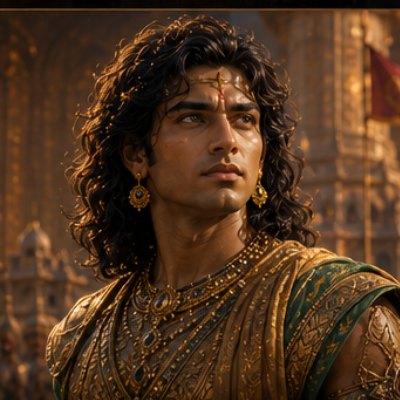
Vrishaketu is the youngest son of Karna — the great Kaurava warrior, king of Anga, and biological son of the sun god Surya and Kunti — and the only one of Karna's sons to survive the Kurukshetra War. While his eight brothers all fell in battle, Vrishaketu did not participate in the war, evidently due to his young age at the time. After the war, when the Pandavas learned that Karna had been their elder half-brother through Kunti, Vrishaketu was taken under the patronage of Arjuna — the very warrior who had killed his father and elder brothers — and subsequently trained in arms. He participated in the military campaigns associated with Yudhishthira's Ashvamedha sacrifice and eventually died in battle against Babruvahana, the son of Arjuna and the Manipuri princess Chitrangada. His stories appear primarily in the Ashvamedha Parva and in later regional adaptations of the epic, with only brief references in the main narrative of the Mahabharata itself.
✦ The Name
Vrishaketu is composed of vrisha (bull, or one who rains blessings — an epithet of Karna himself) and ketu (banner, standard, or bright sign). The name may thus be read as he whose banner is the bull, or one who bears the standard of Vrisha (Karna). As Karna's sole surviving son, the name carries an implicit resonance of carrying forward his father's lineage.
✦ Lineage
- Father: Karna (also known as Vasusena, Radheya, and Suryaputra), foremost archer of the Kaurava forces, biological son of the sun god Surya and Kunti, adoptive son of the charioteer Adhiratha, and king of Anga.
- Mother: Not named in any primary source. The canonical Mahabharata does not name Karna's wife or wives. Some popular and secondary sources identify Vrishaketu specifically as the son of Supriya (Karna's second wife in Shivaji Sawant's modern novel Mrityunjaya), while others assign him to Vrushali. Neither attribution is attested in any primary text.
- Brothers: Vrishasena (eldest), Chitrasena, Satyasena, Sushena, Shatrunjaya, Dvipata, Banasena, Prasena — all killed in the Kurukshetra War.
- Paternal half-uncles: The five Pandavas — Yudhishthira, Bhima, Arjuna, Nakula, and Sahadeva — who were, like Karna, sons of Kunti (or in the case of the twins, her co-wife Madri). The family connection was unknown during the war and revealed only after Karna's death.
- Wife: The daughter of King Yavanata, whom Vrishaketu married during the campaigns preceding the Ashvamedha sacrifice.
✦ Post-War Life and Arjuna's Patronage
After the Kurukshetra War ended and Karna's identity as the eldest son of Kunti was revealed, the Pandavas honoured their fallen half-brother by taking care of his surviving son. Vrishaketu was received under Arjuna's personal patronage. Arjuna trained him in archery and in the use of divine weapons. In some traditions, Vrishaketu is described as the last mortal to possess full knowledge of the Brahmastra, Varunastra, Agnyastra, and Vayuastra. According to this tradition, Krishna asked Vrishaketu to keep this knowledge secret and not transmit it further, so that the knowledge of these weapons of mass destruction would pass from the world. Whether Arjuna himself or Vrishaketu received these weapons directly from whom is not consistently stated across sources.
Vrishaketu participated in the military campaigns that preceded and accompanied Yudhishthira's Ashvamedha sacrifice — the great horse sacrifice performed by the Pandavas to consolidate their sovereignty after the war. During the campaigns, he married the daughter of King Yavanata. Some versions of the story also assign him the kingship of Anga, Karna's former domain, after the Pandavas recognised his lineage.
✦ Death at Babruvahana's Hands
Vrishaketu's death occurred during the Ashvamedha campaigns when he accompanied Arjuna to the kingdom of Manipura, ruled by Babruvahana, the son of Arjuna and the Manipuri princess Chitrangada. In the conflict that arose at Manipura — a battle that Ulupi, Arjuna's Naga wife, instigated in order to fulfil the Vasus' curse on Arjuna — Babruvahana fought Arjuna and Vrishaketu. He killed Vrishaketu and then killed Arjuna. Arjuna was subsequently revived through a nagamani (serpent-gem) obtained by Ulupi. In some versions of the story, Vrishaketu too is revived through Krishna's intervention or through the same nagamani; other versions record his death as final. The Jaiminibharata, a twelfth-century Sanskrit expansion of the Mahabharata's Ashvamedha Parva composed by Jaimini, gives an elaborate account of this battle, though the Vyasa text's version is considerably briefer.
✦ Textual Variants
There are notable discrepancies between the Vyasa Mahabharata and the Jaimini Ashvamedhaparva in the account of the Manipura battle. The Jaimini version significantly expands Babruvahana's role, has him defeat Bhima and slay Vrishaketu, and gives a different cause for Arjuna's death than the Vyasa version. The maternal identity of Vrishaketu is not settled in any primary source: the Mahabharata itself does not name it, and the popular attribution to Supriya (as distinct from Vrushali) appears only in modern retellings. Some sources even posit a third wife Padmavati (from the Kashidasi Mahabharata, the fifteenth-century Bengali retelling) as a mother of some of Karna's sons, but this too is regional and not Puranic.
✦ Theological and Genealogical Significance
Vrishaketu represents the continuation of Karna's line through the extraordinary irony of Pandava patronage. The son of the man whom Arjuna killed becomes, in effect, Arjuna's ward and student. This inversion — enemy becoming protégé, the killer raising the slain man's son — is one of the more theologically charged relationships in the post-war narrative of the Mahabharata. It enacts, at the level of personal relationships, the reconciliation that Krishna's revelation of Karna's true identity was meant to accomplish. The tradition that Vrishaketu possessed and was asked to withhold knowledge of the great weapons places him at a narrative juncture: the end of the epoch in which such weapons could be wielded by mortals.
✦ References
- Mahabharata, Ashvamedha Parva (Book 14): Primary reference for Vrishaketu's role in the post-war campaigns and the Manipura battle sequence involving Babruvahana.
- Jaiminibharata (Jaimini Ashvamedhaparva), 12th century: Expanded regional retelling of the Ashvamedha Parva; gives an elaborate account of the Manipura battle and Vrishaketu's role, though it diverges from the Vyasa text in significant ways.
- Mahabharata, Stri Parva (Book 11): Background; Gandhari's lament names only Vrishasena and Sushena in connection with their mother, not Vrishaketu.
- Wikipedia, "Vrishaketu": Secondary summary noting that most of his stories appear in regional adaptations rather than in the main epic text.
- Wikipedia, "Babhruvahana": Summarises both the Vyasa and Jaimini accounts of the Manipura battle and Vrishaketu's involvement.
- Wikipedia, "Wives of Karna": Establishes that the names Vrushali and Supriya originate in Shivaji Sawant's Mrityunjaya, not in any primary source, and notes scholar Pradip Bhattacharya's analysis of this literary invention.
- Kevin McGrath, The Sanskrit Hero: Karna in Epic Mahabharata (Brill, 2004): Scholarly reference on Karna's family and the treatment of his wives and sons in the primary epic.