
About
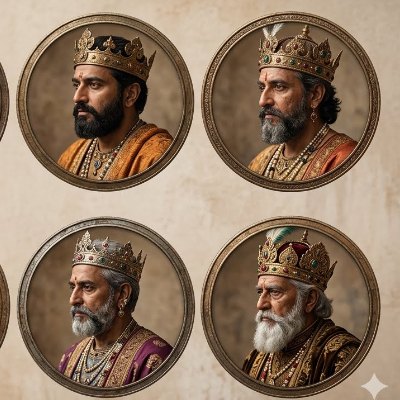
Dhritiman · Satyadhriti · Dridhanemi · Sudharma — Four Transitional Kings of the Dvimidha Line
Dhritiman · Dhritimat · Kritiman · Satyadhrti · Satyadhriti · Dridhanemi · Dridanemi · Sudharma · Sudharman · Suparshva (Vishnu Purana name for Dridhanemi's successor)
These four kings — Dhritiman, Satyadhriti, Dridhanemi, and Sudharma — form a continuous sequence of successive rulers in the Dvimidha sub-branch of the Paurava dynasty, each the son of the king before him. They occupy the four generations between Yavinara, the son of Dvimidha, and Sarvabhauma, the celebrated lord paramount of the line. No independent narrative episode is recorded for any of these four kings in any primary source. They appear exclusively within genealogical lists, each identified only by name and his place in the succession. Their primary textual sources are the Harivamsha, the Bhagavata Purana, the Vishnu Purana, and the Matsya Purana. Because no primary source attaches any narrative, epithet, title, or episode to any of these four kings individually, they are treated in a single grouped entry. The significant textual variants affecting their names and the number of generations they represent are documented in full below.
✦ The Sequence
The four kings stand in the following order of succession within the Dvimidha line, between Yavinara above and Sarvabhauma below:
- Dhritiman — son of Yavinara; father of Satyadhriti. His name is rendered Dhritimat in the Vishnu Purana, Dhritiman in the Harivamsha, and Kritiman in the Bhagavata Purana. All three forms derive from the same Sanskrit root and refer to the same individual.
- Satyadhriti — son of Dhritiman; father of Dridhanemi. His name is consistently rendered as Satyadhrti or Satyadhriti across all primary sources, with only minor orthographic variation between texts.
- Dridhanemi — son of Satyadhriti; father of Sudharma. His name is rendered Dridhanemi in the Harivamsha and Bhagavata Purana and Dridanemi in some secondary compilations. It appears in the Vishnu Purana as the same figure under the same name.
- Sudharma — son of Dridhanemi; father of Sarvabhauma. His name is rendered Sudharma or Sudharman in the Harivamsha and Brahma Purana recensions. The Vishnu Purana's main text omits this figure entirely, moving directly from Dridhanemi to the next generation, which it names Suparsva rather than Sarvabhauma. This omission is the principal source of confusion between the two textual traditions and is addressed in the Variants section below.
✦ The Names
Dhritiman / Dhritimat / Kritiman. All three forms share the Sanskrit root dhrti, meaning steadfastness, resolution, firmness of purpose, or self-possession — a quality valued in a Kshatriya king. The Bhagavata Purana's Kritiman is a distinct rendering: krti means accomplished or skilled, giving the sense of one who is accomplished, a figure of achieved excellence. It is possible that Kritiman represents an independent tradition that substituted a different name at this position, or that the Bhagavata Purana preserves a variant form which, over generations of transmission, had become differentiated from the Dhritimat of the Vishnu Purana and Harivamsha traditions. Both are used as names in the same dynasty — a king named Krita appears later in the same line — which may have contributed to the variation.
Satyadhriti. The name combines satya, meaning truth or reality, with dhrti, meaning steadfastness, yielding the sense of one who holds firmly to truth, or a king of true resolve. This is a compound name carrying strong dharmic resonance appropriate to a king in the Paurava tradition.
Dridhanemi. The name combines dridha, meaning firm, hard, or unyielding, with nemi, the iron rim of a chariot wheel, yielding the compound meaning of one whose chariot-wheel rim is firm — an image of the wheel of royal power that turns without obstruction, or a king whose authority is unyielding. Chariot imagery pervades royal nomenclature in Vedic and epic literature, and Dridhanemi sits within this broad tradition.
Sudharma / Sudharman. The name means one of good dharma or one whose duty is excellent — a name signalling upright kingship and dharmic conduct. It is found in multiple contexts across Puranic literature, most famously as the name of the divine assembly hall of the gods, taken by Krishna to Dwaraka in the Harivamsha. The royal name Sudharma in the Dvimidha genealogy is entirely separate from this divine hall. The Vishnu Purana's parallel name at this position — Suparsva, meaning one of good flanks or sides, a name connoting physical strength and balanced power — may represent an alternate transmission of the same king's name, a different recension's rendering of a name only loosely recorded, or a genuine confusion in the manuscript tradition between two similarly positioned figures.
✦ Lineage Summary
- Dhritiman: Father — Yavinara (son of Dvimidha, son of Hasti, founder of Hastinapura). Son — Satyadhriti.
- Satyadhriti: Father — Dhritiman. Son — Dridhanemi. A second Satyadhriti appears elsewhere in the Bhagavata Purana as the son of Shatananda (son of Gautama and Ahalya), father of Sharadvana and ancestor of Kripa and Kripi — an entirely different figure in a different genealogical stream, noted here solely to prevent confusion.
- Dridhanemi: Father — Satyadhriti. Son — Sudharma (in the Harivamsha and Brahma Purana recension) or Suparsva (in the Vishnu Purana main text).
- Sudharma: Father — Dridhanemi. Son — Sarvabhauma, the lord paramount of the Dvimidha line.
✦ Textual Variants and Inconsistencies
The four-generation sequence Dhritiman — Satyadhriti — Dridhanemi — Sudharma is explicitly attested in the Harivamsha Chapter 20 genealogical recitation, where the Sanskrit text gives the names in direct succession: dhrtimAn tasya putraH tu tasya satyadhrtih sutaH / jajne satyadhrterputro drdhanemir pratApavAn / drdhanemi sutaH chApi sudharmA nAma pArthivah. This passage is the most specific and self-consistent primary source for these four kings as a connected sequence.
The Bhagavata Purana Skandha 9 Chapter 22 gives the same sequence through Dridhanemi but names the next king Suparsva rather than Sudharma and omits the Sarvabhauma generation, moving from Suparsva directly to Sumati. The Vishnu Purana Book IV Chapter XIX similarly gives Suparsva after Dridhanemi and likewise omits Sarvabhauma, Mahan, and Rukmaratha. Wilson's footnote to the Vishnu Purana passage notes the inter-Puranic discrepancy explicitly, recording that between Dridhanemi and Suparsva the Vayu Purana inserts Mahat and Rukmaratha; the Matsya Purana inserts Sudhanvan, Sarvabhauma, Mahapaurava, and Rukmadhara; and the Brahma Purana inserts Sudharman, Sarvabhauma, Mahat, and Rukmaratha. The Harivamsha's expanded sequence — which includes both Sudharma and Sarvabhauma — is therefore aligned with the Brahma Purana recension in its structural logic, though not identical in all name forms.
Two explanations for this divergence are possible. The first is that the Bhagavata and Vishnu Purana traditions compressed the genealogy at this point, folding several kings into a single generation or omitting intermediate rulers who were recorded in earlier sources including the Harivamsha. The second is that the expanded recensions inserted additional kings at this position to accommodate regional traditions or to align the genealogy with other chronological frameworks. The Harivamsha's primacy as a Mahabharata supplement — itself a text of great antiquity — gives its expanded sequence significant authority, and the Brahma Purana's agreement with it strengthens the case for the fuller sequence. The Bhagavata Purana's compressed version, while widely cited, appears to reflect a later editorial tradition that condensed the middle generations of the Dvimidha line.
The name Dhritiman versus Kritiman at the first position in the sequence is a distinct variant unrelated to the Sudharma/Suparsva problem. It appears to reflect two independent manuscript traditions for Yavinara's son — the Dhrti-root tradition preserved in the Vishnu Purana and Harivamsha, and the Krti-root tradition preserved in the Bhagavata Purana — which may have arisen through scribal misreading of a single original form.
✦ Connection to the Wider Genealogy
These four kings stand between the third and seventh generations of the Dvimidha sub-branch, connecting Yavinara — the first-generation son of the branch's founder Dvimidha — to Sarvabhauma, the most distinguished ruler in the middle period of the line. Through the succession below Sarvabhauma, these four kings are the direct remote ancestors of Krita, the Sama Veda scholar, and of Ugrayudha, whose death at the hands of Bhishma is the event that connects the Dvimidha line to the main Mahabharata narrative. They are, in the broader context of the Paurava dynasty, collateral ancestors of the Pandavas and Kauravas through their common descent from Hasti and ultimately from Puru, the youngest son of Yayati of the Lunar dynasty.
✦ References
- Harivamsha, Chapter 20 (mahabharata-resources.org Sanskrit text with transliteration): The most precise primary source for the sequence; gives the four names in direct succession in the original Sanskrit, confirming Dhritiman — Satyadhriti — Dridhanemi — Sudharma as a continuous genealogical chain leading to Sarvabhauma.
- Bhagavata Purana, Skandha 9, Chapter 22 (Tagare translation; srimad-bhagavatam.github.io verse-by-verse): Gives the sequence Yavinara — Kritiman — Satyadhrti — Dridhanemi — Suparsva, confirming the first three generations under alternate name forms but omitting Sudharma and replacing Sarvabhauma with Suparsva at the next position.
- Bhagavata Purana, Skandha 9, Chapter 21, verse 27 (Tagare translation): Specifically states that the son of Dvimidha was Yavinara and his son was Kritiman, establishing the Bhagavata's name form for the first generation.
- Vishnu Purana, Book IV, Chapter XIX (H.H. Wilson translation, sacred-texts.com): Gives the sequence Dvimidha — Yavinara — Dhritimat — Satyadhriti — Dridhanemi — Suparsva, with Wilson's footnote recording the Brahma, Vayu, and Matsya Purana variants that insert Sudharma, Sarvabhauma, and additional kings between Dridhanemi and Suparsva.
- Wisdomlib, definition of Satyadhriti: Secondary compilation confirming Satyadhriti as son of Kritiman (son of Yavinara) and father of Dridhanemi, with reference to Bhagavata Purana 9.21.27, and noting the separate Satyadhriti in the Gautama-Shatananda line.
- Matsya Purana historical elements study (Wisdomlib, Chaitali Kadia): Gives the Matsya Purana's own sequence for the Dvimidha line, confirming Dhritimana — Satyadhriti — Dridhanemi as three successive kings and identifying the Matsya Purana's variant names for the kings following Dridhanemi.
- Monier-Williams Sanskrit-English Dictionary (Oxford, 1899): Provides etymological analysis of the roots dhrti, satya, dridha, nemi, and sudharma relevant to interpreting the meanings of all four kings' names.