
About
Sarvabhauma — Lord Paramount of the Dvimidha Line, Sole Sovereign of the Earth
Sarvabhauma · Sarvabhauma Paurava · Eka-rat · Prajeshvara · son of Sudharma · father of Mahan
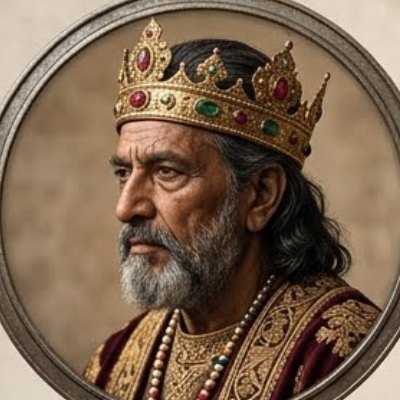
Sarvabhauma is the most distinguished ruler in the middle period of the Dvimidha sub-branch of the Paurava dynasty and the only king in this collateral line to be accorded the title of universal sovereign in the primary sources. He is the son of Sudharma — himself the son of Dridhanemi, Satyadhriti, Dhritiman, and ultimately of Yavinara and Dvimidha — and the father of Mahan, from whose line the succession continues through Rukmaratha, Suparshva, Sumati, Sannati, and Krita to Ugrayudha. His principal source is the Harivamsha, which records both his name and his imperial status in a single verse of Bhishma's genealogical recitation to Yudhishthira. He also appears in the Brahma Purana and the Matsya Purana in their expanded recensions of the Dvimidha succession. He is absent from the Bhagavata Purana and the Vishnu Purana main texts, which compress this section of the genealogy. No narrative episode beyond the statement of his imperial status is recorded for him in any primary source.
✦ The Name and Title
The name Sarvabhauma is a Sanskrit compound of sarva, meaning all or entire, and bhauma, meaning of the earth or earthly, from bhumi, the earth. Together the compound carries the meaning of one who is of the entire earth — a title denoting a king whose sovereignty extends over the whole of the earth without a rival or superior. In the political taxonomy of the Puranas and the epics, kingship was ordered in ascending grades: the samanta or tributary king at the base, then the raja, the maharaja, the chakravarti, and at the apex the sarvabhauma — a ruler of all the earth whose authority was unchallenged and whose chariot rolled across the globe without obstruction. A chakravarti's reign is itself described as sarvabhauma in the technical literature, meaning that the two terms are intimately related: sarvabhauma is the state achieved by a successful chakravarti.
The Harivamsha verse recording this king's imperial status uses two specific epithets alongside his name. The first is prajeshvara — lord of all subjects or lord of all created beings, a title marking absolute sovereign authority over the entire population of the earth. The second is eka-rat — sole sovereign or the one who shines alone, a term used in Vedic and epic literature for a king who rules without peer or co-ruler anywhere on earth. Together these epithets characterise Sarvabhauma as the paramount ruler of his age, a figure who had achieved the highest grade of kingship recognised in the Paurava political tradition. The Harivamsha's translator at mahabharata-resources.org renders the verse's meaning as: he was named Sarvabhauma because he obtained emperorship and the whole earth was under his single umbrella.
The name Sarvabhauma also functions as a common noun and title throughout Puranic literature, applied to gods, deified kings, and historical sovereigns. It is used as an epithet of Shiva in the Shiva Purana, as a designation of a manifestation of Vishnu-Hari in the Savarnasavarna epoch, and as the title of Sarvabhauma Bhattacharya — the celebrated Navadvipa logician and devotee of Chaitanya. These uses are entirely separate from the Dvimidha-line king and must not be confused with him.
✦ Lineage
- Father: Sudharma (also called Sudharman) — king of the Dvimidha sub-line, son of Dridhanemi. Sudharma's name means one of excellent dharma or one whose duty is of the highest order. He is attested in the Harivamsha and Brahma Purana recensions of the Dvimidha succession and is absent from the compressed Bhagavata and Vishnu Purana versions.
- Paternal ancestry: Dridhanemi — Satyadhriti — Dhritiman — Yavinara — Dvimidha — Hasti — Suhotra — Bhumanyu — Bharata — Dushyanta — Puru — Yayati (Lunar dynasty).
- Son: Mahan — the next king in the Dvimidha succession, described in the Harivamsha as one born in Sarvabhauma's great lineage, a joy of the Pauravas. The Harivamsha verse recording him reads: tasya anvavAye mahati mahAn paurava nandana — in his great lineage was born Mahan, the delight of the Pauravas. His son was Rukmaratha, from whom the line continued.
✦ Imperial Status in Context
The designation of Sarvabhauma as a universal sovereign is a significant claim in the Paurava genealogical tradition. The Dvimidha line is a collateral branch of the Paurava dynasty — it descends from Dvimidha, the second of Hasti's three sons, rather than from Ajamidha, whose line held the throne of Hastinapura. To have a king of this collateral branch designated as sole sovereign of the entire earth is a notable elevation of the branch's historical standing. The Harivamsha presents this claim in the context of Bhishma's response to Yudhishthira's question about Ugrayudha — who later in the same line claimed imperial ambitions of his own and was slain by Bhishma for it. The contrast is implicit: Sarvabhauma achieved legitimate universal sovereignty, while Ugrayudha's bid for power through an improper demand was punished.
The Mahabharata itself, in its Shanti Parva (XII.29), gives a list of sixteen kings — the Shodasha Rajika — who had been regarded as chakravartis or universal sovereigns before the Mahabharata war. Sarvabhauma of the Dvimidha line does not appear in that particular list, which focuses primarily on other royal lines. His imperial status as recorded in the Harivamsha is therefore specific to the Dvimidha genealogical tradition and cannot be corroborated from the Shodasha Rajika context. This does not negate the Harivamsha's attestation, but it places it within its proper scope: a tradition preserved in a Mahabharata supplement rather than in the core epic or the major Puranas.
✦ Textual Variants and Inconsistencies
The Sarvabhauma of the Dvimidha line must be carefully distinguished from three other figures of the same name in the Puranic corpus. The first is Sarvabhauma son of Viduratha — a king of the main Kuru succession recorded in the Bhagavata Purana (9.22.10) as a descendant of Jahnu son of Kuru, whose son was Jayasena; this figure belongs to the Ajamidha-Riksha-Kuru main line and is entirely separate from the Dvimidha branch. The second is Sarvabhauma son of Ahamyati — a king of the earlier Puru main succession born to Ahamyati by Bhanumat, daughter of Kritavirya, who married Sunanda daughter of the king of Kekaya; this figure is substantially older in the dynastic sequence and belongs to the pre-Bharata period of the Puru line. The third is Sarvabhauma as a manifestation of Hari in the Savarnasavarna epoch, a theological rather than genealogical figure.
The Dvimidha-line Sarvabhauma is attested only in the Harivamsha and in the Brahma Purana and Matsya Purana's expanded recensions. The Bhagavata Purana Skandha 9 Chapter 22 and the Vishnu Purana Book IV Chapter XIX both omit him entirely, moving from Dridhanemi to Suparsva without inserting Sudharma or Sarvabhauma. Wilson's footnote to the Vishnu Purana passage confirms this omission and records that the Brahma Purana inserts Sudharman, Sarvabhauma, Mahat, and Rukmaratha at precisely this position, aligning with the Harivamsha's sequence. The Matsya Purana inserts a slightly different set of names — Sudhanvan, Sarvabhauma, Mahapaurava, and Rukmadhara — showing that the expanded tradition was known across multiple Puranic recensions but preserved in varying forms.
The name of Sarvabhauma's son also shows a cross-source variant. The Harivamsha names him Mahan — meaning the great one or a man of great qualities, a straightforward Sanskrit superlative — and specifically describes him as a Paurava nandana, a joy of the Pauravas, suggesting he was a figure of distinction in his own right. The Brahma Purana names the corresponding figure Mahat, a near-synonym meaning the great, which is likely the same individual under a slightly different Sanskrit form. The Matsya Purana gives Mahapaurava — the great Paurava — which may be an epithet that became a name in transmission, referring to the same figure by his dynastic quality rather than his personal name. All three forms are treated in this profile series as variant names for the same king.
✦ Connection to the Wider Genealogy
Sarvabhauma stands seventh in direct descent from Dvimidha — the founding patriarch of his branch — and approximately nine generations below Hasti, the founder of Hastinapura. Through Hasti's brother Ajamidha and the main Kuru line, Sarvabhauma is a collateral kinsman of all subsequent Kuru kings including Riksha, Samvarana, Kuru, the long line of Hastinapura kings, and ultimately the Pandavas and Kauravas. Through his own line of descent, Sarvabhauma is the direct ancestor of Mahan, Rukmaratha, Suparshva, Sumati, Sannati, Krita — the Sama Veda compiler — and Ugrayudha, whose confrontation with Bhishma is the defining narrative event of the Dvimidha branch and the episode that prompted Bhishma's recitation of the entire lineage in which Sarvabhauma's name and title are preserved.
✦ References
- Harivamsha, Chapter 20, verse 39 (mahabharata-resources.org Sanskrit text with transliteration): The primary and most specific source; gives Sarvabhauma as the son of Sudharma in direct succession, applying the epithets prajeshvara (lord of all subjects) and eka-rat (sole sovereign) and stating that his name Sarvabhauma was earned because the whole earth came under his single sovereignty. Verse 40 names his son Mahan as born in Sarvabhauma's great lineage.
- Harivamsha, Chapter 20 (M.N. Dutt translation, Wisdomlib): Prose translation of the same passage, rendered as Bhishma's speech to Yudhishthira explaining the genealogy of Ugrayudha; confirms Sarvabhauma as a paramount ruler and Mahan as his son.
- Vishnu Purana, Book IV, Chapter XIX, footnote 39 (H.H. Wilson translation, sacred-texts.com): Wilson's critical footnote recording that between Dridhanemi and Suparsva the Brahma Purana inserts Sudharman, Sarvabhauma, Mahat, and Rukmaratha — the principal secondary evidence confirming the Sarvabhauma generation in the Brahma Purana recension.
- Wisdomlib, definition of Sarvabhauma (concept page): Secondary compilation documenting the multiple distinct figures and usages of the name Sarvabhauma across Puranic literature, distinguishing the Dvimidha-line king from the Viduratha-line king (Bhagavata Purana 9.22.10), the Ahamyati-line king, and the theological usages in the Shiva Purana and Vaishnava texts.
- Wisdomlib, definition of Chakravarti: Documents the Puranic political taxonomy distinguishing Raja, Maharaja, Chakravarti, and Sarvabhauma as ascending grades of sovereignty, confirming that a sarvabhauma's reign represents the apex of the scale and that the chakravarti concept is etymologically and functionally linked to sarvabhauma sovereignty.
- Inflibnet Political System in Puranas study: Secondary source explicitly listing the hierarchy of kingship grades — Samanta Raja, Raja, Maha Raja, Chakravarti, Sarvabhauma — and defining Sarvabhauma as a ruler of the entire earth, confirming the technical significance of the title in the Puranic framework.
- Bhagavata Purana, Skandha 9, Chapter 22, verse 10 (Tagare translation): Records a separate Sarvabhauma as son of Viduratha in the main Kuru line, establishing the need for disambiguation between this figure and the Dvimidha-line Sarvabhauma.