
About
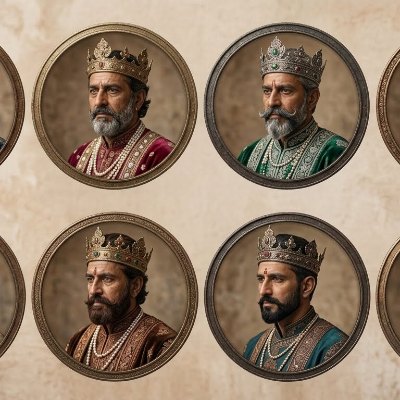
Mahan · Rukmaratha · Suparshva · Sumati · Sannati — Five Successive Kings of the Dvimidha Line
Mahan · Mahat · Rukmaratha · Suparshva · Suparsva · Sumati · Sannatiman · Sannati
Mahan, Rukmaratha, Suparshva, Sumati, and Sannati are five successive kings belonging to the Dvimidha branch of the Puru lineage within the broader Chandravamsha, the Lunar dynasty of ancient India. They form a continuous generational sequence descending from Dvimidha — himself a son of Hastin and a great-grandson of the emperor Bharata — through the intermediate rulers Yavinara, Dhritiman (Krtiman), Satyadhrti, and Dridhanemi (Drdhanemi), and continuing through these five kings down to Krita (Krti), from whom the line extends further. Their primary genealogical record is preserved in the Bhagavata Purana (Skandha 9, Adhyaya 21, verses 27–29) and in the Vishnu Purana (Book IV), with additional detail and variant sequencing found in the Vayu Purana, the Brahma Purana, and the Harivamsa.
✦ The Names
The name Mahan (also rendered Mahat in some Puranic manuscripts) carries the sense of greatness or largeness, deriving from the Sanskrit root connoting magnitude and eminence. Its appearance in this dynastic list suggests an honorific appellation rather than a descriptive personal name recorded with narrative detail. Rukmaratha is a compound of rukma (gold or golden) and ratha (chariot), meaning one who possesses or rides a golden chariot — a conventional epithet of martial distinction in the kshatriya tradition. Suparshva is a compound of su (good, auspicious) and parshva (flank or side), signifying one with fine or auspicious flanks — a term applied both to persons and to sacred mountains in the Puranic geographical tradition, though its use here is strictly as a personal name. Sumati combines su (good) with mati (mind or intellect), yielding the meaning of a person of excellent understanding or wisdom — a name shared by several figures across Puranic and epic literature, including a king of the Solar dynasty and a son in the Ikshvaku line, making contextual identification essential. Sannati (Sannatiman in the full form attested in the Bhagavata Purana) derives from sam-nati, meaning deep reverence, humility, or bowing down, with the suffix -man indicating one who embodies that quality.
✦ Lineage
- Dynasty: Chandravamsha (Lunar dynasty), Puru lineage, Dvimidha branch
- Dvimidha: Ancestor and branch-founder; son of Hastin, who founded the city of Hastinapura, and great-great-grandson of the emperor Bharata; Dvimidha is the progenitor of this entire collateral line
- Yavinara: Son of Dvimidha; first in the descending sequence leading to these five kings
- Dhritiman (Krtiman): Son of Yavinara
- Satyadhrti: Son of Dhritiman
- Dridhanemi (Drdhanemi): Son of Satyadhrti; immediate ancestor of Suparshva in the Bhagavata Purana account
- Mahan: Placed between Dridhanemi and Suparshva in the Vayu Purana tradition; preceded by Sarvabhauma and Sudharma in the Brahma Purana tradition (see Variants section)
- Rukmaratha: Son of Mahan in the traditions that include both figures
- Suparshva: Son of Rukmaratha in traditions including Mahan and Rukmaratha; son of Dridhanemi directly in the Bhagavata Purana
- Sumati: Son of Suparshva; recorded in the Bhagavata Purana (9.21.28)
- Sannati (Sannatiman): Son of Sumati; recorded in the Bhagavata Purana (9.21.28)
- Krita (Krti): Son of Sannati; the next king in the line, noted in the Bhagavata Purana as one who received mystic knowledge from Brahma and compiled six samhitas of the Pracyasama section of the Sama Veda
✦ Textual Record
These five kings belong to a portion of the Dvimidha genealogy preserved almost exclusively in the dynastic king-lists of the Puranas rather than in the narrative sections of the Mahabharata or Harivamsa. No independent episodes, wars, marriages, or personal attributes are recorded for Mahan, Rukmaratha, Suparshva, Sumati, or Sannati in any of the primary texts. Their presence in the tradition is entirely genealogical — their function is to maintain the patrilineal continuity of the Dvimidha branch across successive generations, linking the earlier rulers down from Dridhanemi to the more prominent figure of Krita, who receives individual notice for his Vedic scholarship. The Bhagavata Purana presents the sequence in a brief, tightly compressed genealogical passage (9.21.27–29) without narrative elaboration. Similarly, the Vishnu Purana and the Vayu Purana record these names in list form only, with Wilson's translation noting variant sequences across different Puranic recensions.
✦ Textual Variants and Inconsistencies
The most significant divergence among the primary sources concerns the position and presence of Mahan and Rukmaratha in the sequence. The Bhagavata Purana (9.21.27–28) gives the line from Dvimidha as: Yavinara — Krtiman — Satyadhrti — Drdhanemi — Suparshva — Sumati — Sannatiman, with no mention of Mahan or Rukmaratha. The Vayu Purana, as recorded in Wilson's footnote to the Vishnu Purana translation (Book IV, Chapter XIX, note 39), inserts Mahan (Mahat) and Rukmaratha between Drdhanemi and Suparshva. The Brahma Purana, according to the same note, gives a slightly different intermediate sequence of Sudharman, Sarvabhauma, Mahat (Mahan), and Rukmaratha before Suparshva. The Matsya Purana, also cited in the same note, provides yet another intermediate list including Sudhanwan and Sarvabhauma rather than Mahan and Rukmaratha. These discrepancies represent the standard variation in generational enumeration found across Puranic genealogical lists, where different recensions compress or expand the same lineage. No primary source contradicts the core sequence of Suparshva — Sumati — Sannatiman, which is consistent across the Bhagavata Purana and is corroborated by the Vishnu Purana tradition.
A further note concerns the Bhagavata Purana's full form of the name Sannati: it reads Sannatiman, meaning one who embodies reverence. The shorter form Sannati is used in secondary sources and some later Puranic digests. Both refer to the same figure in this genealogical position.
✦ Connection to the Wider Genealogy
The Dvimidha branch to which these five kings belong is a collateral line of the Puru dynasty that runs parallel to the main Kuru lineage. Dvimidha was a son of Hastin — the founder of Hastinapura — and a brother of Ajamidha, whose line includes the Kuru kings and ultimately the Pandavas and Kauravas. These five figures thus represent a dynastic sub-branch that continued independently through the Panchaladesa region, distinct from but descended from the same common Puru stock. The line continues after Sannati through Krita, who is the grandfather of Ugrayudha — a figure who appears in both the Harivamsa and the Mahabharata narrative, noted for his violent seizure of the Panchala kingdom before being killed by Bhishma. This connection places these five largely anonymous genealogical kings in direct ancestral relationship to one of the more turbulent episodes in the Panchala succession narrative.
✦ References
- Primary Sources:
- Bhagavata Purana, Skandha 9, Adhyaya 21, verses 27–29: The principal source for this genealogical sequence; gives the line Dvimidha — Yavinara — Krtiman — Satyadhrti — Drdhanemi — Suparshva — Sumati — Sannatiman — Krti without the intermediate figures Mahan and Rukmaratha
- Vishnu Purana, Book IV, Chapter XIX (H.H. Wilson translation, notes 39–41): Records the Dvimidha line in the main text and in critical footnotes identifies the variant sequences given by the Vayu Purana, Brahma Purana, and Matsya Purana, including the positions of Mahan (Mahat), Rukmaratha, Sarvabhauma, and Sudharman
- Vayu Purana (as cited in Vishnu Purana, Wilson note 39): Inserts Mahat (Mahan) and Rukmaratha between Drdhanemi and Suparshva
- Brahma Purana (as cited in Vishnu Purana, Wilson note 39): Gives Sudharman, Sarvabhauma, Mahat, and Rukmaratha as intermediate figures before Suparshva
- Matsya Purana (as cited in Vishnu Purana, Wilson note 39): Provides yet another variant intermediate sequence including Sudhanwan and Sarvabhauma
- Secondary Sources:
- Wisdomlib, definition entry for Suparshva: Confirms Suparshva as son of Drdhanemi and father of Sumati, citing Bhagavata Purana 9.21.27–29
- Vettam Mani, Puranic Encyclopaedia: General reference for name etymologies and cross-identification of homonymous figures named Sumati across different dynasties