
About
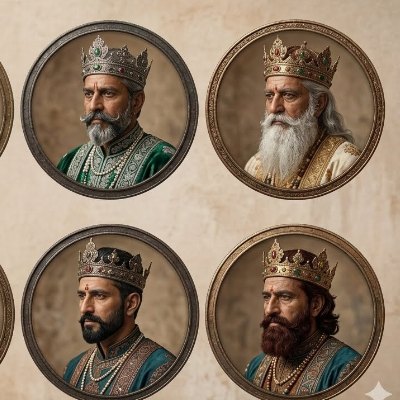
Kshemya · Suvira · Nripanjaya — Three Successive Kings of the Dvimidha Line
Kshemya · Kshema · Suvira · Sudhira · Nripanjaya · Ripunjaya
Kshemya, Suvira, and Nripanjaya are three successive kings of the Dvimidha branch of the Puru lineage within the Chandravamsha, the Lunar dynasty of ancient India. They form the penultimate generational sequence of the Dvimidha line as recorded in the primary sources, descending from Ugrayudha — the conqueror of Panchala who was slain by Bhishma — and continuing to Bahuratha, the last named king of this branch. Their record is preserved exclusively in the dynastic king-lists of the Bhagavata Purana (Skandha 9, Adhyaya 21, verse 29), the Vishnu Purana (Book IV, Chapter 19), and the Harivamsa (Adi Parva, Chapter 20, verse 46), where all three are listed consecutively without narrative elaboration. The Harivamsa explicitly designates the entire group, together with the kings who precede and follow them, as Pauravas.
✦ The Names
The name Kshemya derives from kshema, meaning safety, security, welfare, or prosperous ease — a condition of settled peace after danger has passed. It can denote both an adjective (that which brings security) and a substantive quality of one who embodies or provides such safety. The Monier-Williams Sanskrit dictionary confirms this derivation and records it as an attested name for several Puranic princes. The Vayu Purana uses the shortened form Kshema for the same figure.
The name Suvira is a compound of su (good, excellent) and vira (hero, warrior, man of valour), yielding the meaning of an excellent hero or a man of outstanding courage. It is a common honorific in the kshatriya tradition and appears as a name for several distinct figures across Puranic and epic literature, including a king born from the aspect of the asura Krodhavasha mentioned in the Udyoga Parva, and a son of king Dyutiman praised in the Anushasana Parva — neither of whom is to be confused with this Suvira of the Dvimidha line. The Vishnu Purana gives a variant name Sudhira (meaning one of firm or steadfast mind) for this figure, suggesting either a scribal variation or an alternate name preserved in a different recension.
The figure rendered as Nripanjaya in the Vishnu Purana and Harivamsa bears the name Ripunjaya in the Bhagavata Purana — and these are two etymologically distinct names, not merely variant spellings of the same word. Ripunjaya (ripu + jaya) means conqueror of enemies, while Nripanjaya (nripa + jaya) means victory among kings or one who conquers kings. Both names are attested in the primary sources for this single genealogical figure, the difference reflecting either variant traditions or a figure known by two names in different textual lineages. The user's supplied form Nripanjaya follows the Vishnu Purana and Harivamsa usage.
✦ Lineage
- Dynasty: Chandravamsha (Lunar dynasty), Puru lineage, Dvimidha branch
- Dvimidha: Remote ancestor and branch-founder; son of Hastin, who founded Hastinapura, and a great-great-grandson of the emperor Bharata
- Ugrayudha: Father of Kshemya; the most narratively prominent king of the Dvimidha line, who conquered Panchala by destroying the Nipa dynasty and was subsequently killed by Bhishma after demanding Satyavati, Shantanu's widow, as his wife
- Kshemya: Son of Ugrayudha; father of Suvira
- Suvira: Son of Kshemya; father of Nripanjaya
- Nripanjaya (Ripunjaya): Son of Suvira; father of Bahuratha, the last named king of the Dvimidha line in the Puranic record
✦ Textual Record
These three kings appear in only three primary sources, and in each case solely within compressed genealogical sequences. The Harivamsa (I.20.46–47) names all three in a single verse immediately following its account of Ugrayudha's deeds, noting that from Nripanjaya was born Vahuratha (Bahuratha) and that all these kings are called Pauravas. The Bhagavata Purana (9.21.29) lists them in a single compound sentence as son following son from Kshemya through Suvira to Ripunjaya. The Vishnu Purana (IV.19) includes them in the same unbroken sequence that closes the Dvimidha genealogical passage, giving the name Sudhira in place of Suvira as a variant. No narrative episode, personal attribute, marriage, military campaign, or individual act is recorded for any of the three figures in any primary source.
✦ Textual Variants
Two name variants are worth recording. For the first figure, the Bhagavata Purana and Vishnu Purana use Kshemya while the Vayu Purana uses Kshema — a straightforward shortening of the same root. For the second figure, the Bhagavata Purana and Harivamsa both use Suvira, while the Vishnu Purana substitutes Sudhira — a different name with a related but distinct meaning. Whether this reflects a genuine alternate name or a copyist confusion between two similar-looking Sanskrit words cannot be determined from the sources alone. For the third figure, the name divergence between Ripunjaya (Bhagavata Purana) and Nripanjaya (Vishnu Purana, Harivamsa) is the most notable, as these are semantically distinct names that nonetheless appear to designate the same genealogical position in every source.
✦ Connection to the Wider Genealogy
Kshemya, Suvira, and Nripanjaya represent the final generational stretch of the Dvimidha branch before it reaches Bahuratha, the last king in the line. They succeed directly to a throne that Ugrayudha had seized by force from the Nipa kings of Panchala and that Bhishma, in killing Ugrayudha, had effectively removed from Dvimidha control — restoring Panchala to Prishata, father of Drupada. What kingdom these three kings ruled after that dispossession, or what territory constituted their domain in the post-Ugrayudha period, is not addressed in any source. Their position in the Puru dynastic record places them as collateral kinsmen of the Kuru main line: the Dvimidha branch and the Kuru branch both descend from Hastin through his sons Dvimidha and Ajamidha respectively, making these three kings distant cousins of Bhishma himself.
✦ References
- Primary Sources:
- Bhagavata Purana, Skandha 9, Adhyaya 21, verse 29: Lists Kshemya, Suvira (as father of Ripunjaya), and Ripunjaya (as Nripanjaya's equivalent) in a single genealogical sentence within the Dvimidha sequence
- Vishnu Purana, Book IV, Chapter 19 (H.H. Wilson translation): Lists Kshemya, Suvira (rendered as Sudhira in the text), and Nripanjaya consecutively as the penultimate kings of the Dvimidha line before Bahuratha; designates all as Pauravas
- Harivamsa, Adi Parva (Harivamsa Parva), Chapter 20, verse 46: Names Kshemya, Suvira, and Nripanjaya in a single verse immediately following the Ugrayudha episode; notes that from Nripanjaya came Bahuratha, and identifies all as Pauravas
- Vayu Purana (as cited in Wisdomlib glossary entries): Uses the name Kshema in place of Kshemya for the first figure in this group
- Secondary Sources:
- Wisdomlib, definition entries for Kshemya, Suvira, and Ripunjaya: Consolidate the cross-source references for each figure, including the Vayu Purana variant Kshema and the Vishnu Purana variant Sudhira; cite Bhagavata Purana 9.21.28–30 and Vishnu Purana IV.19.55 as primary sources for each entry
- Cologne Digital Sanskrit Dictionaries, Monier-Williams entry for Kshemya: Confirms the etymology and records the Puranic attestations including Harivamsa 1084 and Vishnu Purana