
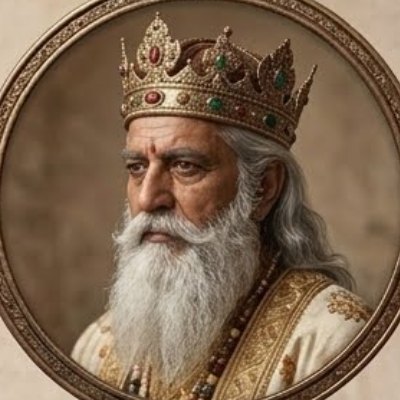
About
Vriddhakshatra — King of Sindhu, Father of Jayadratha, Author of the Protective Curse
Vriddhakshatra · Vriddhakshatra of Sindhu · father of Jayadratha · king of the Sindhus
Vriddhakshatra is the king of the Sindhu kingdom, belonging to the Puru lineage, and the father of Jayadratha — king of Sindhu and Sauvira, husband of Dussala the daughter of Dhritarashtra, and one of the principal Kaurava-side warriors of the Kurukshetra war. Vriddhakshatra is a figure of extremely limited direct narrative presence in the Mahabharata; he does not appear as an active participant in any episode but exerts a decisive influence on the war's events through two acts recorded in the primary text: the birth-prophecy he heard at Jayadratha's birth, to which he responded with a protective pronouncement functioning as a curse on any warrior who caused his son's severed head to touch the ground; and his presence at the forest of Samantapanchaka in a state of austerities at the moment of Jayadratha's death, into whose lap Arjuna's arrow carried the severed head — causing Vriddhakshatra himself to let the head fall to the earth and thereby activating his own curse, which burst his own head asunder. His entire significance in the Mahabharata is mediated through the fate of his son. He appears by name in the Drona Parva, and is attested in the Wisdomlib corpus and Vettam Mani's Puranic Encyclopaedia.
✦ The Name
The name Vriddhakshatra is formed from two Sanskrit elements: vriddha, meaning old, aged, or venerable, and kshattra or kshatriya, the warrior class or warrior principle. The compound thus carries the sense of an aged or senior warrior or one of venerable Kshatriya standing. The name is consistent with the characterisation of the figure in the primary text as a king of advanced years who had performed long austerities and who had abdicated his throne to his son before the war began. The name is spelled Vriddhakshatra in the Wisdomlib entry and Vriddhakshatra or Vridhakshatra in secondary sources; Vriddhakshatra is the preferred form.
✦ Lineage and Kingdom
- Dynasty: The Puru lineage — one of the principal branches of the lunar dynasty, descended from King Puru, son of Yayati. The Sindhu kingdom's ruling house belonged to this lineage, making Vriddhakshatra a distant kinsman of both the Kaurava and Pandava princes through the common Puru ancestry.
- Kingdom: Sindhu — the kingdom of the Sindhu river valley in the northwestern region. Vriddhakshatra ruled this kingdom before abdicating in favour of Jayadratha.
- Son: Jayadratha — king of Sindhu and Sauvira; husband of Dussala, daughter of Dhritarashtra and Gandhari; killed by Arjuna on the fourteenth day of the Kurukshetra war. Jayadratha is described in the primary text as Vriddhakshatra's only son, born after long austerities.
✦ The Birth of Jayadratha and the Protective Pronouncement
The Drona Parva (Jayadratha-vadha Parva, Adhyaya 142, Ganguli translation) records the circumstances of Jayadratha's birth and the protective pronouncement that Vriddhakshatra made at that time. The text states that it was after a long period — implying extended difficulty or austerities undertaken to obtain a son — that Vriddhakshatra finally received Jayadratha. At the birth, an incorporeal and invisible voice, deep-toned as thunder or a great drum, spoke to Vriddhakshatra. The voice proclaimed that his son would become worthy of both the Solar and Lunar lineages in blood, conduct, and restraint; that he would become one of the foremost of Kshatriyas; but that in battle, a great warrior, a bull among Kshatriyas, would cut off his head.
The Ganguli translation records that Vriddhakshatra, hearing this prophecy, reflected for a time and then made a pronouncement — framed in the text as a declaration with the force of a curse — to the effect that whoever caused Jayadratha's severed head to fall upon the ground would have his own head immediately burst into pieces. Having made this pronouncement, Vriddhakshatra installed Jayadratha on the throne of Sindhu at a young age and himself retired to the forest to continue austerities. The text records that he took up residence at the forest of Samantapanchaka, where he remained in ascetic practice throughout the years prior to and during the Kurukshetra war.
✦ Death — Day 14, Drona Parva
Vriddhakshatra's death is recorded in the same Drona Parva passage that narrates Jayadratha's death. On the fourteenth day of the Kurukshetra war, as Arjuna was about to shoot the arrow that would kill Jayadratha, Krishna — who knew of Vriddhakshatra's protective pronouncement and its condition — instructed Arjuna precisely how to aim and with what intent. Krishna told Arjuna that Vriddhakshatra was at that moment performing austerities in the forest of Samantapanchaka, and that the arrow must carry Jayadratha's severed head through the air and cause it to fall directly into Vriddhakshatra's lap. Arjuna shot the specially consecrated arrow; it decapitated Jayadratha and, following the trajectory Krishna had described, carried the head to Samantapanchaka and dropped it into Vriddhakshatra's seated lap.
Vriddhakshatra, startled out of his meditation by the impact of the severed head in his lap, rose to his feet. As he rose, the head fell from his lap to the ground. The protective pronouncement he had made at Jayadratha's birth now activated — but its terms required that the one who caused the head to touch the ground would be destroyed. Since it was Vriddhakshatra's own involuntary act of rising that caused the head to fall, the curse turned upon him. His own head burst into pieces instantly, and he died. The Drona Parva thus records that Jayadratha's death was engineered by Krishna not only to fulfil Arjuna's oath but to dispose of Vriddhakshatra's protective curse in a manner that removed both father and son simultaneously, without any Pandava warrior being destroyed by the curse's activation.
✦ Textual Variants and Inconsistencies
The Wisdomlib entry for Vriddhakshatra records three distinct figures bearing this name in the Mahabharata, and this is a critical point for the genealogical record. The first is the father of Jayadratha, king of Sindhu, described above. The second is a king of the Puru dynasty who favoured the Pandavas and was killed by Ashvatthama, attested in the Drona Parva (Chapter 200, Stanza 73). The third is a king of the Vrishni dynasty who also took the Pandava side and was killed by Bahlika, attested in the Drona Parva (Chapter 24, Stanza 49). These are three entirely separate figures who share the same name. The profile here concerns only the first — father of Jayadratha, king of Sindhu — and no detail from the second or third figure should be attributed to him.
A secondary-source tradition holds that Vriddhakshatra himself performed the penance to Shiva specifically to obtain for Jayadratha the boon of invulnerability, and that Shiva granted the protective curse on the fallen head as the result of this penance. This tradition is attested in the Puranic Encyclopaedia (Drona Parva, Chapter 146) and in several secondary accounts. However, the Ganguli translation of the Drona Parva (Adhyaya 39, sacred-texts.com/hin/m07/m07039.htm) clearly records that it was Jayadratha himself — not his father — who performed austerities to Shiva after his humiliation at the hands of Bhimasena. Shiva appeared to Jayadratha in a dream and granted him the boon of checking four Pandavas for one day. The penance in that passage is Jayadratha's own act. The Ganguli translation of Adhyaya 142, narrating the birth-prophecy and Vriddhakshatra's protective pronouncement, presents the pronouncement as Vriddhakshatra's own response to the birth-voice rather than as a boon obtained from Shiva. These two narratives are not mutually exclusive — both a paternal pronouncement and a separate Shiva boon could coexist — but the sources that attribute the head-protection specifically to a Vriddhakshatra penance are drawing on a tradition not clearly present in the Ganguli passages consulted. Both layers are noted here. The primary narrative — birth-voice, paternal pronouncement, retirement to Samantapanchaka — is the one attested in the Ganguli translation.
✦ Narrative Significance
Vriddhakshatra's significance in the Mahabharata is entirely structural and ironic. His pronouncement, made out of paternal love at his son's birth, is designed to protect Jayadratha by destroying whoever kills him. Instead, the pronouncement becomes the mechanism of his own death. Krishna, whose omniscience encompasses the terms of the curse and the location of Vriddhakshatra's austerities, turns the protective structure back upon itself: the arrow's precise trajectory ensures that the person who causes the head to fall on the ground is Vriddhakshatra himself. Father and son die as a consequence of the same act, at the same moment, separated by the distance between the battlefield and the forest. The episode is one of the Mahabharata's most precisely engineered examples of a protective measure that destroys its author — a form of narrative irony that the text uses elsewhere in the epic as well, in the fates of warriors whose boons, curses, or vows turn back against them.
✦ Connection to the Wider Genealogy
Vriddhakshatra belongs to the Puru lineage of the lunar dynasty. Through his son Jayadratha's marriage to Dussala — daughter of Dhritarashtra and Gandhari of the Kuru branch of the same Puru lineage — he is connected to the Kuru royal family as a grandfather-in-law of Dussala and a great-grandfather of Suratha. His grandson Suratha inherited the Sindhu kingdom after Jayadratha's death, and Suratha's unnamed infant son was installed by Arjuna as king of Sindhu during the Ashvamedha expedition. Vriddhakshatra himself left no other recorded descendants and his death on the fourteenth day of the war ended his direct line, with the Sindhu kingship continuing through Jayadratha and Dussala's branch alone.
✦ References
- Mahabharata, Drona Parva, Jayadratha-vadha Parva, Adhyaya 142 (Ganguli translation, Sacred Texts Archive, sacred-texts.com/hin/m07/m07142.htm): The primary source for the birth-prophecy addressed to Vriddhakshatra, his protective pronouncement concerning the fallen head, his abdication and retirement to Samantapanchaka, and the account of his death when Jayadratha's severed head fell from his lap to the ground. All key facts in the Birth and Death sections of this profile are drawn from this passage.
- Mahabharata, Drona Parva, Abhimanyu-badha Parva, Adhyaya 39 (Ganguli translation, Sacred Texts Archive, sacred-texts.com/hin/m07/m07039.htm): Records the penance performed by Jayadratha himself to Shiva after the Draupadi humiliation, and Shiva's granting of the boon to check four Pandavas for one day. This passage establishes that the Shiva penance was Jayadratha's own act, distinct from Vriddhakshatra's paternal pronouncement at birth.
- Mahabharata, Drona Parva, Chapter 146 (Ganguli translation, cited in Wisdomlib via Vettam Mani): The secondary-source citation for the tradition that Vriddhakshatra himself performed penance to Shiva to obtain the protective boon; noted in the Variants section as a tradition not clearly established in the Ganguli passages consulted.
- Wisdomlib, Vriddhakshatra: 5 definitions: Critical secondary reference for the three-Vriddhakshatra problem — establishing that three distinct figures share this name in the Mahabharata (father of Jayadratha; a Puru-dynasty king killed by Ashvatthama at Drona Parva 200.73; a Vrishni-dynasty king killed by Bahlika at Drona Parva 24.49) — and for the identification of the first as a king of the Puru lineage who was Jayadratha's father.
- Vettam Mani, Puranic Encyclopaedia (Motilal Banarsidass, 1975): Secondary reference for the narrative of Vriddhakshatra's austerities at Samantapanchaka and for the Chapter 146 citation regarding his penance tradition.