
About
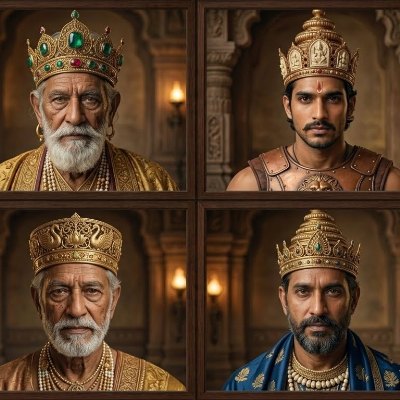
Successors of Champa — Intermediate Kings of the Anga Dynasty
Haryanga · Bhadraratha · Brihatkarman · Brihadratha · Brihadbhanu · Brihanmanas · Jayadratha · Vijaya · Dhriti · Dhritavrata · Satyakarma
Between King Champa, the founder of Champapuri, and Adhiratha, the Suta charioteer who adopted the hero Karna, the Anga dynastic succession passes through a sequence of kings whose reigns are recorded in the Puranic and epic sources primarily as genealogical continuity rather than as narrative episodes. The line bifurcates at Brihanmanas — whose two wives from different social backgrounds bore sons of different varnas — creating two distinct collateral branches: the Jayadratha line, which maintained the Kshatriya succession, and the Vijaya line, whose descendants became Sutas and from whom Adhiratha and ultimately Karna descended. These kings appear in the Vishnu Purana, the Bhagavata Purana, the Harivamsha Purana, the Matsya Purana, the Vayu Purana, and the Agni Purana, though the texts differ on the arrangement and parentage of several figures in this stretch of the line.
✦ The Kings and Their Names
Haryanga combines hari (tawny, golden, or a name of Vishnu) with anga (limb or body), suggesting one of golden limbs or one whose body reflects divine radiance — a conventional royal honorific. The Harivamsha records his birth through the blessing of the forest ascetic Purnabhadra, a semi-divine being of the Yaksha order, paralleling the pattern of sacred intercession that marks several royal births in this dynasty. Bhadraratha means one whose chariot is auspicious or noble, bhadra carrying connotations of prosperity and good fortune combined with ratha, chariot — a standard Kshatriya royal name. Brihatkarman and Brihadratha are closely related compounds: brihat means great or vast, yielding great in action and great chariot respectively — names characteristic of martial kings of the eastern Gangetic tradition. Brihadbhanu means one of great radiance or great sun-like splendour, bhanu being a standard word for the sun or luminosity. Brihanmanas means one of great mind or great intelligence, manas denoting the mind or spirit — a name reflecting the intellectual and spiritual qualities valued in a Kshatriya ruler. Jayadratha means one whose chariot is victorious, jaya meaning victory — a widely used royal name in the Puranic tradition. Vijaya likewise means victory, making Jayadratha and Vijaya near-synonymous names borne by half-brothers in the same generation. Dhriti means steadfastness or resolve. Dhritavrata means one who holds fast to his vow, vrata denoting a sacred observance or vow — a name of pronounced religious connotation. Satyakarma means one whose deeds are truthful or one whose actions are in accordance with truth — a name marking the final Kshatriya-ranked king before the line passes to Adhiratha.
✦ Lineage
- Haryanga: Son of Champa, king who founded Champapuri; born through the favour of the ascetic Purnabhadra according to the Harivamsha (31.49)
- Bhadraratha: Son of Haryanga; father of Brihatkarman and Brihadratha according to the Vishnu Purana (4.18) and Harivamsha (31.51); the Bhagavata Purana omits Haryanga and Bhadraratha entirely in its compressed account
- Brihatkarman: Elder son of Bhadraratha; his son was Brihadbhanu according to the Vishnu Purana (4.18); the Bhagavata Purana (9.23.11) gives Brihatkarman as a son of Prithulaksha directly, reflecting its compressed sequence
- Brihadratha: Second son of Bhadraratha; a distinct figure from the famous Brihadratha of Magadha who founded the Jarasandha line
- Brihadbhanu: Son of Brihatkarman; his son was Brihanmanas according to the Vishnu Purana (4.18); named in the Bhagavata Purana (9.23.11) as a son of Prithulaksha in its compressed genealogy
- Brihanmanas: Son of Brihadbhanu; married two wives — Yashodevi, a Kshatriya woman and daughter of a Chaidya king, and Satvi (also called Sambhuti in the Bhagavata Purana), a woman of Brahmin birth born of a Kshatriya father and a Brahmin mother; father of Jayadratha by Yashodevi and of Vijaya by Satvi/Sambhuti
- Jayadratha: Son of Brihanmanas by his Kshatriya wife Yashodevi; the Kshatriya-lineage branch of the family; a distinct figure from the famous Jayadratha of Sindhu who appears as an antagonist in the Mahabharata
- Vijaya: Son of Brihanmanas by his wife Satvi/Sambhuti, who was of mixed Kshatriya-Brahmin origin; because his mother's social origin placed her in the Suta varna — the caste of charioteers and bards born of Kshatriya fathers and Brahmin mothers according to Manu — Vijaya and all his descendants were of Suta status; this genealogical fact is the primary textual explanation for the designation of Karna and Adhiratha as Sutas
- Dhriti: Son of Vijaya; Suta lineage
- Dhritavrata: Son of Dhriti; Suta lineage
- Satyakarma: Son of Dhritavrata; father of Adhiratha; last in the intermediate succession before the line reaches Adhiratha, who adopted Karna
✦ The Bifurcation at Brihanmanas
The most significant event within this group of kings is not a military campaign or a founding act but a genealogical bifurcation. Brihanmanas, as recorded in the Harivamsha (31.52–56) and confirmed by the Vishnu Purana annotator, married two women of different social origins. His Kshatriya wife Yashodevi bore him Jayadratha, who continued the royal Kshatriya line of Anga. His second wife Satvi — described in the Vishnu Purana as the daughter of a Kshatriya father and a Brahmin mother, and therefore classified by the law books as belonging to the Suta varna — bore him Vijaya. Because in the Puranic and Dharmashastric framework a child inherits the varna status of the mother, Vijaya was a Suta by birth. All of Vijaya's descendants — Dhriti, Dhritavrata, Satyakarma, Adhiratha, and ultimately Karna — were therefore Sutas by lineal descent, even though they were royally descended from the Anga dynasty.
The Vishnu Purana annotator makes this point explicitly, noting that the apparently confusing application of the term Suta to Karna — who was both an Anga prince by adoption and of divine parentage as a son of Kunti by the sun god Surya — finds its genealogical explanation precisely here, in the varna of Brihanmanas's second wife. The Suta designation was not merely a social insult applied to Karna by his enemies at Kurukshetra; it reflected the actual legal-genealogical status of the collateral branch of the Anga royal house from which Adhiratha descended.
✦ Bhadraratha and Parashurama
The Mahabharata (Shanti Parva, Chapter 49; Drona Parva, Chapters 57 and 62) records a notable episode involving Brihadratha of the Anga line — described in the Agni Purana (Chapter 277) as son of Jayadratha and father of Vishvajit in an alternate genealogical sequence. According to this account, during the period when Parashurama undertook his campaign of extermination of the Kshatriya order, this Brihadratha was saved from destruction by a forest tribe called the Lamsuras, who dwelt on the mountain Gridhrakuta. This episode, if it belongs to the Anga Brihadratha rather than to the more famous Brihadratha of Magadha, provides the only narrative episode within the intermediate succession, though the identification is complicated by the number of figures sharing this name across different dynasties.
✦ Textual Variants and Inconsistencies
The primary inconsistency in this section of the Anga succession is the compression in the Bhagavata Purana (9.23.10–11) relative to the Vishnu Purana and Harivamsha. The Bhagavata omits Champa, Haryanga, and Bhadraratha entirely, placing Brihadratha, Brihatkarman, and Brihadbhanu directly as sons of Prithulaksha. The Vishnu Purana (4.18) and Harivamsha (31.51) agree that Brihatkarman and Brihadratha are sons of Bhadraratha, and that Brihadbhanu is the son of Brihatkarman. The Bhagavata's compressed sequence represents a minority reading unsupported by any other primary text for this part of the line.
A second inconsistency concerns whether Vijaya is the son of Jayadratha or his brother. The Vishnu Purana (4.18) and Bhagavata Purana (9.23.12) both make Vijaya the son of Jayadratha. The Vayu Purana, Matsya Purana, and Harivamsha (31.55–56) make Vijaya the half-brother of Jayadratha — both sons of Brihanmanas by different wives. The Vishnu Purana annotator notes this discrepancy explicitly and attributes it to a failure to distinguish the collateral lines. The Harivamsha account is the most detailed and gives the most coherent explanation of the bifurcation, and is followed here.
A third inconsistency involves the Agni Purana (Chapter 277), which gives an independent and divergent sequence for the later portion of this line, placing Brihadratha as son of Jayadratha and Vishvajit as son of Brihadratha — a sequence that does not align with the Vishnu Purana, Bhagavata Purana, or Harivamsha accounts and appears to conflate figures from different branches of the family.
✦ Connection to the Wider Genealogy
These eleven kings occupy the ninth through nineteenth positions in the Anga dynastic succession, spanning the stretch from Champa's son to Adhiratha's father. Above them the line runs: Anga → Para/Khalapana/Dadhivahana → Diviratha → Dharmaratha → Citraratha/Satyaratha → Romapada → Chaturanga → Prithulaksha → Champa → Haryanga. Below Satyakarma, the line passes to Adhiratha, who found the infant Karna in a basket on the Ganges and adopted him, and thence to Karna himself, the hero of the Mahabharata who became King of Anga, and to Karna's son Vrishasena. The entire dynasty belongs to the Chandravamsha through the Anu branch, descending through Yayati, Anu, Titikshu, Rushadratha, Homa, Sutapa, and Bali, from whose wife the sage Dirghatama fathered King Anga, the dynasty's eponymous founder.
✦ References
- Vishnu Purana, Book 4, Chapter 18, verses 17–20: Primary source for the sequence from Champa through to Vijaya and the birth of Satyakarma's line; annotator's notes explicitly explain the Suta status of Vijaya's descendants and the collateral-line confusion
- Bhagavata Purana, Canto 9, Chapter 23, verses 10–13: Gives the compressed sequence omitting Champa, Haryanga, and Bhadraratha; makes Vijaya the son rather than brother of Jayadratha; gives Sambhuti as the name of Jayadratha's wife and the mother of Vijaya
- Harivamsha Purana, Adi Parva, Chapter 31, verses 49–57: Most detailed primary source for this section; gives Haryanga's birth through Purnabhadra's favour; provides the two-wife account of Brihanmanas; explicitly names Yashodevi and Satvi as the two wives and describes the varna distinction between their sons; gives the sequence Dhriti → Dhritavrata → Satyakarma
- Matsya Purana and Vayu Purana: Corroborate the Harivamsha in making Vijaya the half-brother of Jayadratha rather than his son
- Agni Purana, Chapter 277: Gives a divergent sequence placing Brihadratha as son of Jayadratha and Vishvajit as his son; records the episode of Brihadratha being saved from Parashurama by the Lamsura tribe of Gridhrakuta
- Mahabharata, Shanti Parva Chapter 49; Drona Parva Chapters 57 and 62: Records the episode of the Anga Brihadratha's rescue from Parashurama's campaign by the Lamsuras
- Wisdomlib — Brihadratha, Brihanmanas, Jayadratha, and Prithulaksha definition entries: Secondary sources compiling cross-Puranic attestations and identifying the distinct figures sharing these names across different dynasties
- Puranic Encyclopaedia (Vettam Mani), "Anga" entry: Secondary source providing the consolidated Anga king list from the dynasty's founder through to Vrishasena