
About
Adhiratha — Suta King of Anga and Adoptive Father of Karna
Adhiratha · Suta of Anga · Foster Father of Karna · Friend of Dhritarashtra
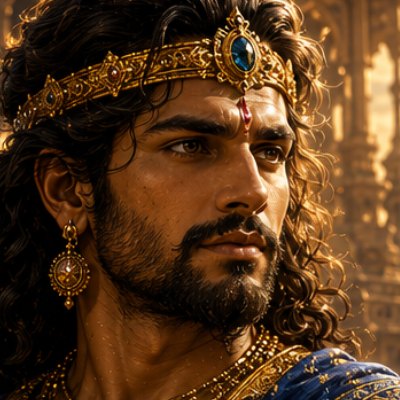
Adhiratha was a king of the Anga dynasty and a Suta by varna — a charioteer-bard of royal lineage — who is remembered in the tradition primarily for a single act of foundational significance: the discovery and adoption of the infant Karna from a box floating on the Ganga. Son of Satyakarma and husband of Radha, Adhiratha was childless when he and his wife found the radiant child furnished with natural golden armour and earrings. The boy he named Vasushena grew to become the most celebrated warrior of the Anga kingdom and one of the central figures of the Mahabharata. Adhiratha appears in the Mahabharata, the Bhagavata Purana, the Harivamsha Purana, the Devibhagavata Purana, and the Puranic Encyclopaedia of Vettam Mani.
✦ The Name
The name Adhiratha is a compound of adhi (upon, over, or chief) and ratha (chariot), meaning one who stands upon the chariot, a superior chariot-warrior, or chief of chariots. In the context of the Suta varna, whose hereditary occupation combined the roles of charioteer and court bard, the name carries both a martial and a professional resonance. Sanskrit lexicographers gloss adhiratha as one who fights from a chariot — a respected martial designation — which is also the title commonly applied to Karna himself at the highest grade of chariot-warrior. The name thus creates a nominal continuity between Adhiratha and his adopted son. His adopted son Karna is frequently designated Radheya — son of Radha — after Adhiratha's wife, the matronymic reflecting the Dharmashastric principle that in the Suta lineage the mother's name confers social identity.
✦ Lineage
- Father: Satyakarma, king of the Anga dynasty, son of Dhritavrata, son of Dhriti, son of Vijaya — himself the son of Brihanmanas by his wife Satvi, a woman of Brahmin birth from a Kshatriya father, whose varna was Suta; from Vijaya onward all descendants of this branch of the Anga line were Sutas by hereditary status
- Wife: Radha, a woman of Suta birth, described in the Mahabharata (Vana Parva, Chapter 307) as unparalleled in beauty; childless at the time of Karna's adoption; the source of the matronymic Radheya by which Karna is widely known
- Adopted son: Karna — born of Kunti by the sun god Surya, abandoned in a sealed box set adrift on the river Aswa, which carried it to the Charmanvati, thence to the Yamuna, and thence to the Ganga near the city of Champa in Anga; discovered and adopted by Adhiratha and Radha; named Vasushena at birth by the assembled twice-born priests, and later known as Karna on account of his natural golden earrings; subsequently crowned King of Anga by Duryodhana
- Biological sons: Born after the adoption of Karna; the Mahabharata (Vana Parva, Chapter 307) records explicitly that Adhiratha had other sons begotten by himself after Karna's adoption; individual names vary across recensions and secondary sources
✦ Social Position and Royal Status
Adhiratha's position represents one of the most significant social transitions in the Anga dynastic narrative. Though a direct descendant of the Anga royal house through the collateral branch of Vijaya — and therefore of impeccable Chandravamsha lineage by blood — he was a Suta by hereditary varna, the social category that combined charioteer and court-bard functions and which occupied a liminal position between the Kshatriya and Vaishya orders. The Puranic Encyclopaedia records Adhiratha as a king of Anga, and the Mahabharata's Aranyaka Parva (Chapter 309) confirms his royal status alongside his Suta designation. The Mahabharata (Vana Parva, Chapter 307) describes him as a friend of Dhritarashtra of Hastinapura — a close personal relationship that would later facilitate Karna's entry into Hastinapura and his consequential friendship with Duryodhana.
✦ The Discovery and Adoption of Karna
The Mahabharata (Vana Parva, Chapters 307–309) provides the fullest primary account of the event that defines Adhiratha's place in the tradition. Kunti, then unmarried, had tested a mantra given to her by the sage Durvasa by invoking the sun god Surya, who appeared before her and fathered a child upon her. Fearing the disgrace of unwed motherhood, Kunti sealed the infant in a box adorned with protective substances and set it afloat on the river Aswa. The box travelled from the Aswa to the Charmanvati, thence to the Yamuna, and finally into the Ganga, moving through the kingdom of Anga until it reached the vicinity of the city of Champa.
At that time Adhiratha, who had come to the Ganga accompanied by his wife Radha — a woman who had long grieved over her childlessness — saw the box drifting in the current. Radha, drawn by curiosity, had her servants retrieve it. Adhiratha opened it and beheld an infant of extraordinary radiance, furnished with a natural golden breastplate and gleaming earrings, shining like the morning sun. Declaring to Radha that the gods had sent them a child of divine birth, he took the infant to his home. The assembled Brahmins named the child Vasushena. Radha nursed and raised him as her own son. The Mahabharata notes that after this adoption, Adhiratha subsequently fathered biological sons, confirming that the finding of Karna preceded the birth of his natural children.
When Karna had grown sufficiently, Adhiratha sent him to Hastinapura to be trained in the use of arms under Drona and Kripa. It was there that Karna formed his celebrated alliance with Duryodhana — an alliance whose consequences shaped the entire course of the Kurukshetra War. The Mahabharata records Adhiratha's presence at the arms demonstration in Hastinapura where the Pandavas challenged Karna's eligibility to compete on grounds of his birth, and it was in response to this challenge that Duryodhana immediately crowned Karna King of Anga. When Adhiratha entered the arena in response to the news, Karna descended from his newly won throne and placed his crowned head at his foster father's feet — an act of filial devotion that the text records as demonstrating the depth of the bond between them.
✦ Textual Variants and Inconsistencies
The primary inconsistency across the sources concerns the precise moment of discovery. The Mahabharata's Vana Parva account (Chapter 307) states that it was Radha who first saw the box and had her servants retrieve it before informing Adhiratha. The Devibhagavata Purana (Skandha 2) gives a variant in which Kunti entrusted the box to a maid who floated it on the river, and it was Adhiratha himself who found it while bathing. The Bhagavata Purana (9.23.13) gives a compressed account stating that Adhiratha found Karna in a basket on the banks of the Ganga where he had been exposed by his mother Kunti, without specifying Radha's role. These variants reflect differences between textual traditions rather than substantive contradictions about the event itself.
A second point concerns Adhiratha's relationship to the Kuru court. The Mahabharata consistently describes him as a friend of Dhritarashtra rather than as his formally appointed charioteer. The Puranic Encyclopaedia records that Adhiratha was king of Anga and a charioteer, and that his friendship with Dhritarashtra was well established. The designation of Adhiratha as Dhritarashtra's chief charioteer, found in some secondary and popular sources, is not attested in these primary texts and should not be treated as established fact.
✦ Connection to the Wider Genealogy
Adhiratha stands as the twentieth king in the Anga dynastic succession, the last in the biological royal line before the throne passes to his adopted son. His own lineage descends through the Suta branch of the dynasty: Anga → Para/Khalapana/Dadhivahana → Diviratha → Dharmaratha → Citraratha/Satyaratha → Romapada → Chaturanga → Prithulaksha → Champa → Haryanga → Bhadraratha → Brihatkarman → Brihadbhanu → Brihanmanas → Vijaya (Suta branch) → Dhriti → Dhritavrata → Satyakarma → Adhiratha. Through his adoption of Karna and Duryodhana's subsequent coronation of Karna as King of Anga, the throne of the ancient eastern kingdom passed to the most celebrated warrior of the age — a figure of solar divine origin whose story would become inseparable from the central narrative of the Mahabharata.
✦ References
- Mahabharata, Adi Parva, Chapters 67 and 130: Records Adhiratha's discovery and adoption of Karna and the naming ceremony; primary source for the foundational adoption episode
- Mahabharata, Adi Parva, Chapter 147, verse 3: Records Adhiratha's presence at the arms demonstration and Karna's act of prostration before him after the coronation
- Mahabharata, Vana Parva, Chapters 307–309: Fullest narrative account of the discovery; describes Adhiratha as a friend of Dhritarashtra; records Radha's role in first sighting the box; confirms Adhiratha's royal and Suta status; states that biological sons were born to Adhiratha after the adoption
- Bhagavata Purana, Canto 9, Chapter 23, verses 12–13: Places Adhiratha in the dynastic sequence as son of Satyakarma; states he was sonless when he found Karna in a basket on the Ganga abandoned by his mother Kunti
- Harivamsha Purana, Adi Parva, Chapter 32, verse 58: Attests Adhiratha's role in receiving Karna and the consequent designation of Karna as Suta-born
- Devibhagavata Purana, Skandha 2: Provides a variant account of the discovery in which Adhiratha himself finds the box while bathing at the Ganga
- Puranic Encyclopaedia (Vettam Mani), "Adhiratha" entry: Secondary source providing the full genealogical descent from Vishnu through the Anga line to Adhiratha; confirms his status as king of Anga, Suta charioteer, and friend of Dhritarashtra; records the adoption and Karna's subsequent career
- Wisdomlib — Adhiratha definition entry: Secondary source compiling Sanskrit lexicographic attestations and cross-referencing the Mahabharata and Puranic sources for Adhiratha's identity and lineage