
About
Babhru — Son of Druhyu, Progenitor of the Gandhara Line
Babhru · Babhru Druhyava
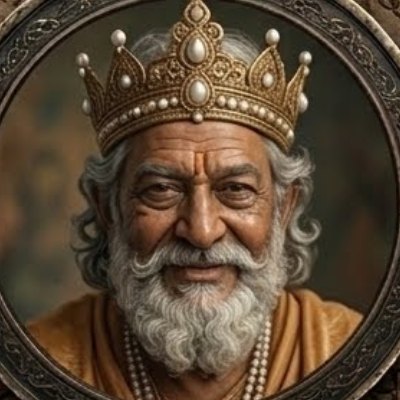
Babhru is the son of Druhyu — the third son of king Yayati and Sharmishtha, daughter of the asura king Vrshaparvan — and is the first figure in the Druhyu branch's traced descent toward the Gandhara kingdom and ultimately toward Subala and Shakuni. He appears in the Bhagavata Purana (9.23.14), the Vishnu Purana (IV.17), the Brahmanda Purana (III.74.7), and the Vayu Purana (99.7) as the direct son of Druhyu and the father of Setu in the main genealogical tradition. No narrative episode, personal attribute, or individual act is recorded for him in any primary source beyond his position in this descent. His principal significance is as the genealogical conduit through whom the Druhyu lineage passes from its progenitor toward the Gandhara kingdom. The name Babhru is shared by several entirely distinct figures in the Puranic and Mahabharata corpus, including a Satvata Yadava and a Vedic scholar, both of whom are unrelated to this Druhyu-lineage Babhru.
✦ The Name
The name Babhru derives from the Sanskrit root carrying the sense of tawny, reddish-brown, or the colour of a mongoose, and is also used as an epithet for Vishnu and Shiva in some Puranic contexts. As an adjective it denotes a rich brownish-yellow colour, and as a noun it refers to the Indian mongoose. The name appears in the Rigveda as an epithet of Agni and of various divine and heroic figures. In this dynastic context it functions solely as a personal name.
✦ Lineage
- Dynasty: Chandravamsha (Lunar dynasty), Druhyu lineage
- Grandfather: Yayati — celebrated Lunar king, son of Nahusha; father of the five sons Yadu, Turvasu, Druhyu, Anu, and Puru; cursed by Shukracharya with premature old age and ultimately bequeathed his kingdom to Puru, the youngest
- Father: Druhyu — third son of Yayati by Sharmishtha; refused to accept his father's curse of old age and was assigned lesser domains in consequence; progenitor of the Druhyu branch of the Lunar dynasty, from which the Gandhara people and kingdom ultimately descend
- Son: Setu — according to the Bhagavata Purana, Vishnu Purana, Brahmanda Purana, and Vayu Purana; see Variants section for the Harivamsa's divergent account
✦ Textual Variants
The Harivamsa presents a variant in which both Babhru and Setu are listed as sons of Druhyu rather than as father and son in sequence. Under this reading, Setu is Babhru's brother, not his son, and the line from Druhyu to Aradwat proceeds through Setu directly. The Bhagavata Purana (9.23.14), the Vishnu Purana (IV.17), the Brahmanda Purana (III.74.7), and the Vayu Purana (99.7) are in agreement that Babhru is Druhyu's son and Setu is Babhru's son — a father-son sequence of three generations from Druhyu. The Harivamsa's variant of making both contemporaneous sons of Druhyu is thus in direct disagreement with all other primary sources on this point.
✦ References
- Primary Sources:
- Bhagavata Purana, Skandha 9, Adhyaya 23, verse 14: Names Babhru as the son of Druhyu and Setu as the son of Babhru in the dynastic sequence
- Vishnu Purana, Book IV, Chapter 17 (H.H. Wilson translation): States that the son of Druhyu was Babhru and his son was Setu; is the most complete rendering of the Druhyu sequence
- Brahmanda Purana, III.74.7 (as cited in Wisdomlib): Confirms Babhru as son of Druhyu in the dynastic list; notes the variant name Ripu for Setu's son Aradwat
- Vayu Purana, 99.7 (as cited in Wisdomlib): Confirms Babhru as son of Druhyu
- Harivamsa (as cited in Monier-Williams, Wisdomlib definition of Setu): Lists Setu as a son of Druhyu and brother of Babhru — a variant that makes both contemporaneous rather than in sequence
- Secondary Sources:
- Wisdomlib, definition entry for Babhru: Distinguishes four separate figures named Babhru in the Puranic corpus and confirms this Babhru (1a) as son of Druhyu and father of Setu, citing Bhagavata 9.23.14, Brahmanda III.74.7, Vayu 99.7, and Vishnu IV.17