
About
Gandhara — Son of Aradwat, Eponymous Founder of the Gandhara Kingdom
Gandhara · Gandhara Druhyava · Gandhararaja
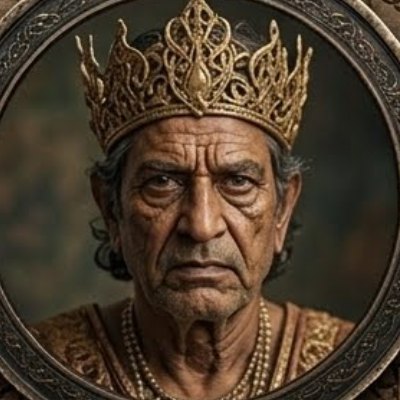
Gandhara is a king of the Druhyu lineage within the Chandravamsha, the Lunar dynasty, and the son of Aradwat (Arabdha). He is the eponymous founder of the Gandhara kingdom — the great north-western territory that gave its name to one of the most historically significant regions of ancient India, encompassing the area of present-day northern Pakistan and eastern Afghanistan. The Vayu Purana explicitly records that a large country was named after him and was celebrated for its breed of horses. He is attested in the Bhagavata Purana (9.23.15), the Vishnu Purana (IV.17), the Brahmanda Purana, the Vayu Purana, and the Matsya Purana. His son Dharma continues the line toward the Druhyu branch's terminal figure Pracetas and his hundred sons, who became the Mleccha princes of the north. The connection of the historical Gandhara kingdom and the Mahabharata's Gandhara kingdom of Subala and Shakuni to this eponymous Gandhara rests on consistent Puranic tradition, though the intermediate kings between Pracetas' sons and Subala are not named in any surviving primary source.
✦ The Name
The name Gandhara is of ancient standing, attested in the Rigveda and Atharvaveda as the name of a people and region in the north-west of the Indian subcontinent. Its etymology is debated in both ancient and modern scholarship: one tradition derives it from gandha (fragrance or smell), yielding a sense related to fragrant or aromatic land; another links it to the root gand or gantu (to go). In the Puranic tradition the name is treated as a personal name for the king after whom the territory was named, following the standard eponymous pattern of the genealogical literature. The Vayu Purana notes that the country Gandhara was named after this king and was renowned for its horses — the Gandhara horse being one of the prized breeds of the ancient north-west, frequently mentioned in the Mahabharata alongside the Kamboja and Sindhu breeds.
✦ Lineage
- Dynasty: Chandravamsha (Lunar dynasty), Druhyu lineage
- Father: Aradwat (Arabdha) — son of Setu, son of Babhru, son of Druhyu, son of Yayati and Sharmishtha
- Son: Dharma — next in the descent; his line continues through Dhrita, Duryaman, and Pracetas to the hundred Mleccha princes
✦ The Gandhara Kingdom
The territory named after Gandhara occupied the north-western portion of the Indian subcontinent, with its heartland in the valleys of the Kabul and Swat rivers and the plains around Peshawar and Taxila. The Vayu Purana records explicitly that the land was both large and famous for its horses. The Aitareya Brahmana refers to a king Naganajit of Gandhara who was a contemporary of king Janaka of Videha, indicating that the Gandhara kingdom was a recognisable political entity from the Vedic period onward. By the time of the Mahabharata, the kingdom was ruled by Subala and subsequently by Shakuni, and its capital is given as Ghandara or Pushkalavati in different traditions. The Chandogya Upanishad mentions the Gandharas as a people. The Vayu Purana also records that the Druhyus were driven out of the land of the seven rivers (the Punjab) by king Mandhatri in an earlier era, and that their king Gandhara subsequently settled in the north-western region that took his name.
✦ Textual Variant: Branch Attribution
Wilson's footnote to Vishnu Purana IV.17 records a significant variant: the Brahma Purana and the Harivamsa, in opposition to all other primary sources, make Dharma — Gandhara's son — and his successors descendants of the Anu branch rather than the Druhyu branch. Under this alternative tradition, Gandhara and the subsequent line from Dharma onward belong to a different son of Yayati entirely. The Bhagavata Purana, Vishnu Purana, Vayu Purana, Brahmanda Purana, and Matsya Purana are unanimous in placing Gandhara within the Druhyu descent. The Brahma Purana and Harivamsa represent a minority tradition on this point.
✦ References
- Primary Sources:
- Bhagavata Purana, Skandha 9, Adhyaya 23, verse 15: Names Gandhara as son of Arabdha and father of Dharma in the Druhyu sequence
- Vishnu Purana, Book IV, Chapter 17 (H.H. Wilson translation, footnotes 1–3): Names Gandhara as son of Aradwat; footnote 2 records the Vayu Purana's note that the land was named after him and was famous for horses; footnote 3 records that the Brahma Purana and Harivamsa make Dharma and successors descendants of Anu rather than Druhyu
- Vayu Purana, 99.8–9 (as cited in Wilson's footnote and secondary sources): Records that a large country was named after Gandhara and was famous for its breed of horses; notes the Druhyu expulsion from the Punjab by Mandhatri and their settlement in the north-west
- Brahmanda Purana, III.74.8 (as cited in Wisdomlib): Confirms Gandhara in the Druhyu descent
- Aitareya Brahmana (as cited in secondary sources): Refers to king Naganajit of Gandhara as a historical figure contemporary with king Janaka of Videha, confirming the antiquity of the Gandhara kingdom
- Secondary Sources:
- Booksfact.com, article on Ancient Gandhara Kingdom: Consolidates the Puranic passage confirming Gandhara as son of Aruddha (Aradwat) and founder of the territory; notes the Vayu Purana reference to the Druhyu migration
- Dharmapedia, article on Druhyus: Confirms that Puranas do not refer to Druhyus after Pracetas; notes the full chain and cites Bhagavata 9.23.15–16; Vishnu 4.17.5; Vayu 99.11–12; Brahmanda 3.74.11–12; Matsya 48.9 as the five concordant sources