
About
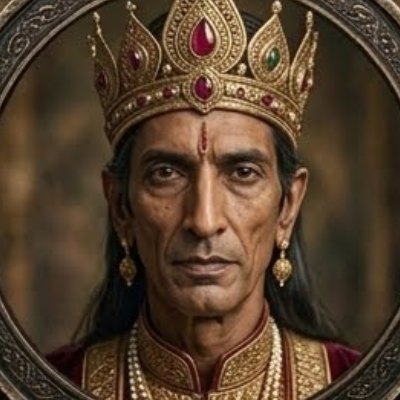
Pracetas — Son of Duryaman, Terminal Puranic King of the Druhyu Line
Pracetas · Praceta · Pracetasa
Pracetas is the last named individual king in the Puranic genealogy of the Druhyu branch, and the son of Duryaman (also rendered Durdama, Durmada, or Durmanas across the primary sources). He is attested in the Bhagavata Purana (9.23.15–16), the Vishnu Purana (IV.17), the Vayu Purana (99.11–12), the Brahmanda Purana (III.74.11–12), and the Matsya Purana (48.9) — five primary sources in complete agreement that Pracetas had a hundred sons and that those sons became the princes of the Mleccha peoples of the northern regions. Beyond this single defining fact — the fathering of the hundred sons — no individual episode, personal attribute, marriage, reign narrative, or campaign is recorded for Pracetas in any of these sources. He is the pivot at which the Druhyu dynastic line disperses from a single traceable patrilineal descent into a collective of a hundred royal lines no longer individually named in the Puranic record.
✦ The Name
The name Pracetas derives from the root cit (to perceive, to understand) with the prefix pra (forward, forth, greatly) and the suffix -as, yielding a meaning of one of great intelligence, the very wise, or the super-conscious being. In the Rigveda the word pracetas appears as an epithet of the divine — applied to Varuna in particular as the all-knowing, all-perceiving god. The Wikipedia article on Prachetas notes that the word is used in the Rigveda in the phrase pra-cetase meaning super-conscious being, and that this Druhyu-lineage Pracetas is entirely distinct from Pracetas the son of king Uttanapada mentioned in the Vishnu Purana, who is an unrelated figure of the same name.
✦ Lineage
- Dynasty: Chandravamsha (Lunar dynasty), Druhyu lineage, Gandhara branch
- Father: Duryaman (Durdama / Durmada / Durmanas across sources) — son of Dhrita, son of Dharma, son of Gandhara, son of Aradwat, son of Setu, son of Babhru, son of Druhyu, son of Yayati and Sharmishtha
- Sons: One hundred sons, collectively called the Pracetasas — their individual names are not recorded in any primary source; they collectively became the rulers of the Mleccha kingdoms of the northern regions
✦ The Hundred Sons and the Mleccha Kingdoms
The key statement about Pracetas across all five concordant primary sources is conveyed in a verse preserved consistently across the Bhagavata, Vishnu, Vayu, Brahmanda, and Matsya Puranas: the hundred sons of Pracetas — the Pracetasas — became kings of the Mleccha kingdoms, and they established themselves in the northern direction. The Sanskrit of this verse specifies that they were mleccha-rastrashipahs — lords of Mleccha territories — and that they settled in the udici (northern) direction. The scholarly analysis of Kirfel (1927), as cited in the Indus script research published on ArXiv, interprets udici here as referring not to a region beyond the Himalayas or Hindu Kush but to the region designated as Greater Gandhara in the Vedic and Paninian tradition — the north-western territories of the Indian subcontinent. The peoples later associated with these territories and designated Mleccha in the Indian tradition include the Sakas, Yavanas, Kambojas, Pahlavas, Bahlikas, Rishikas, and related groups.
The Vishnu Purana and the Bhagavata Purana both close the Druhyu genealogy at this point: after the statement about the hundred sons, the text immediately moves to other lineages. The Puranic record offers no further named individuals in the Druhyu line. This creates the documented gap between the hundred Pracetasa princes and the historical king Subala of Gandhara — father of Gandhari and Shakuni in the Mahabharata — which no surviving primary Puranic source bridges with named kings.
✦ Textual Variant: Additional Generation
The Matsya Purana, Brahma Purana, and Agni Purana insert an additional figure — Vidupa, Duduha, or Vidula (depending on the recension) — between Duryaman and Pracetas. In those traditions Pracetas is the grandson of Duryaman rather than his son. The Bhagavata, Vishnu, and Vayu Puranas make Pracetas the direct son of Duryaman without an intermediate generation.
✦ References
- Primary Sources:
- Bhagavata Purana, Skandha 9, Adhyaya 23, verses 15–16: Names Pracetas as son of Durmada (Duryaman) and states that his hundred sons became rulers of the Mleccha kingdoms in the northern region; closes the Druhyu genealogy at this point
- Vishnu Purana, Book IV, Chapter 17 (H.H. Wilson translation, footnote 6): States that Pracetas had a hundred sons who were princes of the lawless Mlecchas or barbarians of the north; footnote records Bhagavata and Matsya agreement; notes the Mahabharata's variant that Druhyu descendants were the Vaibhojas — a people who travel on rafts and have no kings
- Vayu Purana, 99.11–12; Brahmanda Purana, III.74.11–12; Matsya Purana, 48.9 (all as cited in Dharmapedia and ArXiv 1204.3800): Five-source concordance on the statement about the hundred Mleccha kings; the Sanskrit verse is quoted in Kirfel 1927 and cited consistently across these sources
- Matsya Purana, Brahma Purana, Agni Purana (as cited in Wilson's footnote 5): Insert an additional intermediate figure (Vidupa/Duduha/Vidula) before Pracetas
- Secondary Sources:
- Wikipedia, article on Prachetas: Confirms this Druhyu-lineage Pracetas as the son of Duryaman and father of the hundred Mleccha kings; notes the Vedic etymology of the name; distinguishes him from the unrelated Pracetas of the Vishnu Purana's Svayambhuva Manu lineage
- Dharmapedia, article on Druhyus: States explicitly that the Puranas do not refer to Druhyus after Pracetas, and cites all five primary sources for the hundred-sons statement