
About
The Hundred Sons of Pracetas — Mleccha Kings of the Northern Regions
Pracetasah · Pracetasas · The Hundred Princes of Pracetas
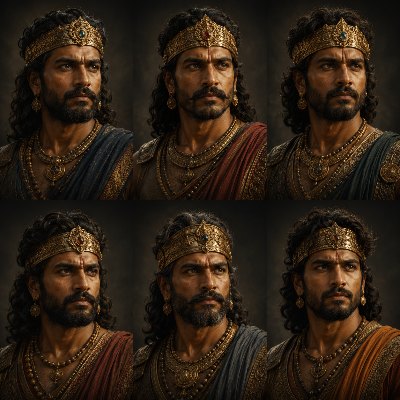
The hundred sons of Pracetas — collectively designated the Pracetasas — are the terminal figures of the Puranic Druhyu genealogy and the immediate Puranic ancestors of the Mleccha kingdoms of the north. They are the sons of Pracetas, who is the son of Duryaman, descending from Gandhara, Aradwat, Setu, Babhru, and ultimately Druhyu, the third son of Yayati. Their collective character and territorial assignment are recorded in five concordant primary Puranic sources — the Bhagavata Purana (9.23.15–16), the Vishnu Purana (IV.17), the Vayu Purana (99.11–12), the Brahmanda Purana (III.74.11–12), and the Matsya Purana (48.9) — all of which preserve a common verse establishing that the hundred sons became lords of Mleccha kingdoms and settled in the northern direction. None of these sources names any of the hundred sons individually, and the Puranic record of the Druhyu branch closes entirely at this collective statement. The subsequent history of the Gandhara kingdom — including the line of kings between the Pracetasas and the Mahabharata-era king Subala, father of Shakuni — is not recorded in any surviving primary Puranic text.
✦ Designation and Territorial Assignment
All five concordant sources use the same essential formulation: the hundred sons of Pracetas were all kings (rajanas), all lords of Mleccha territories (mleccha-rastrashipahs), and all settled in or oriented toward the northern direction (udici disham ashritah). The term Mleccha in the Puranic tradition designates peoples considered outside or on the margins of Vedic civilisation — the Sakas, Yavanas (Greeks), Kambojas, Pahlavas (Parthians), Bahlikas (Bactrians), Rishikas, and related north-western peoples are among those frequently listed as Mlecchas in the Mahabharata. The scholarly reading of Kirfel (1927) identifies the udici or northern direction as referring to the Greater Gandhara region — the north-western territories of the Indian subcontinent including modern northern Pakistan and eastern Afghanistan — rather than to regions beyond the Hindu Kush or Himalayas.
The Vishnu Purana's footnote (Wilson, note 6 to Chapter XVII) additionally records a divergent tradition from the Mahabharata itself: in the Mahabharata's account of the Druhyu descendants, they are identified not as the hundred Mleccha kings but as the Vaibhojas — a people unfamiliar with the use of cars or beasts of burden who travel on rafts and have no kings. This is a substantially different characterisation and suggests that the Mahabharata preserves a separate and irreconcilable tradition about the Druhyu lineage's end from the one found in the five concordant Puranas.
✦ Lineage
- Dynasty: Chandravamsha (Lunar dynasty), Druhyu lineage, Gandhara branch
- Father: Pracetas — son of Duryaman (Durdama), son of Dhrita, son of Dharma, son of Gandhara, son of Aradwat, son of Setu, son of Babhru, son of Druhyu, son of Yayati
- Individual names: Not recorded in any primary source
- Territories: The Mleccha kingdoms of the northern region, identified in the scholarly tradition with Greater Gandhara and the adjacent north-western territories
- Connection to Subala and Shakuni: The Puranic tradition associates the Gandhara kingdom and its rulers with the Druhyu descent through Pracetas; Subala, the king of Gandhara in the Mahabharata, and his son Shakuni are understood within this tradition as belonging to this lineage; however, no primary Puranic source names any king between the Pracetasas and Subala
✦ References
- Primary Sources:
- Bhagavata Purana, Skandha 9, Adhyaya 23, verses 15–16: States that the hundred sons of Pracetas became rulers of the Mleccha kingdoms and settled in the northern region; closes the Druhyu genealogy
- Vishnu Purana, Book IV, Chapter 17 (H.H. Wilson translation, footnote 6): Confirms the hundred Mleccha prince sons; records the divergent Mahabharata tradition identifying the Druhyu descendants as the Vaibhojas — raftsmen without kings
- Vayu Purana, 99.11–12; Brahmanda Purana, III.74.11–12; Matsya Purana, 48.9 (all as cited in concordant studies): Five-source agreement on the hundred-sons Mleccha statement; the common Sanskrit verse is preserved and cited in Kirfel 1927
- Secondary Sources:
- Dharmapedia, article on Druhyus: Quotes all five Puranic sources; confirms that the Puranic record offers nothing further after the Pracetasas
- ArXiv 1204.3800 (Indus script and Meluhha study, citing Kirfel 1927): Reproduces the Sanskrit verse common to all five Puranas and provides the geographical interpretation of udici as Greater Gandhara