
About
Lakshmana — Princess of Madra, Seventh Queen of Krishna
Lakshmana · Lakshana · Madri · Madraa · Charuhasini · Seventh of the Ashtabharya
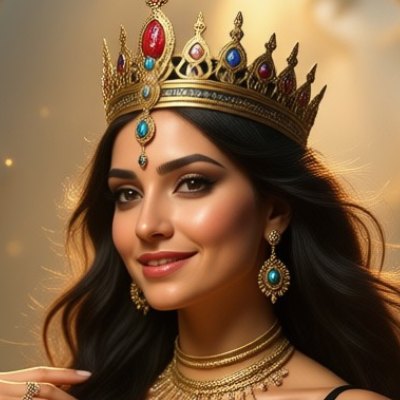
Lakshmana, also known as Lakshana, was the princess of the Madra kingdom in northwestern India and the seventh of the Ashtabharya — the eight principal queen-consorts of Krishna at Dwarka. The Bhagavata Purana describes her as endowed with excellent qualities and names her as the daughter of an unnamed king of Madra; the Padma Purana specifies her father's name as Brihatsena. She is praised across texts by the epithet Charuhasini — one with a beautiful and enchanting smile. Her marriage to Krishna is narrated in two differing accounts within the Bhagavata Purana itself: one describes an abduction from her swayamvara, the other a victory through an archery contest. She is attested in the Bhagavata Purana, the Vishnu Purana, the Harivamsha, and the Mahabharata.
✦ The Names
The name Lakshmana derives from the Sanskrit lakshman, meaning one who bears auspicious marks or signs — a name of strongly favourable connotation in both the royal and divine traditions. It is the feminine form, Lakshmanaa, that identifies this queen, distinguishing her from the famous male Lakshmana of the Ramayana. The variant form Lakshana is found across certain manuscripts and secondary sources and represents an alternate transliteration of the same name. The epithet Charuhasini — used in the Harivamsha and Vishnu Purana — is a compound of charu (beautiful, lovely) and hasini (one who smiles or laughs), yielding one with a beautiful smile or she of the lovely laugh. The geographic epithet Madri or Madraa simply means she of Madra, identifying her by her kingdom of origin. One dialogue in the Padma Purana records Lakshmana herself describing her father Brihatsena as an accomplished player of the veena, a detail that humanises and individualises him beyond his structural genealogical role.
✦ Lineage
- Father: Named in the Bhagavata Purana only as the king of Madra without a personal name; the Padma Purana specifies his name as Brihatsena, king of the Madra kingdom
- Kingdom: Madra — an ancient Indo-Aryan kingdom in the northwestern region of the Indian subcontinent, corresponding broadly to the area of modern Punjab and the Sialkot region; the Madra kingdom appears across the Mahabharata as a significant northwestern power, whose king Shalya was the maternal uncle of Nakula and Sahadeva
- Husband: Krishna, the eighth avatar of Vishnu, son of Vasudeva and Devaki, king of Dwarka
- Sons: Ten sons named in the Bhagavata Purana (10.61.15) — Praghosha, Gatravan, Simha, Bala, Prabala, Urdhaga, Mahashakti, Saha, Oja, and Aparajita
✦ The Marriage: Two Accounts in the Bhagavata Purana
The Bhagavata Purana preserves two distinct accounts of how Lakshmana came to be Krishna's wife, both within Canto 10. The first account, in Chapter 58, briefly describes Krishna as swooping into the swayamvara and taking Lakshmana onto his chariot and driving away, likening the act to the divine eagle Garuda carrying off the vessel of amrita from the gods — an image of irresistible divine appropriation that recurs across the Ashtabharya marriage narratives. In the second account, found in Chapter 83 — a passage in which the queens themselves narrate their marriages to Draupadi during a visit to Hastinapura — Lakshmana recounts that her father organised a swayamvara with an archery contest as the qualifying challenge. The assembled kings Jarasandha and Duryodhana attempted and failed the target. Arjuna, who was present and acknowledged as a supreme archer, deliberately missed his aim so that Krishna could win; Bhima declined to participate in deference to Krishna. Krishna alone succeeded in the contest and won her hand.
These two accounts — one an abduction, the other a contest won by skill — represent a genuine internal variant within the same Purana rather than a contradiction between different texts. The archery contest account is the one Lakshmana narrates in her own voice in the queens' dialogue section, and may therefore be understood as her personal account of the swayamvara's formal proceedings, while the abduction account in Chapter 58 captures the manner of her departure. The precise nature of the archery target — described in secondary sources as a fish whose eye must be struck by viewing its reflection in oil below — is not specified in these primary Bhagavata Purana passages and represents a secondary elaboration, likely influenced by the similar and better-attested challenge at Draupadi's swayamvara in the Mahabharata.
✦ Position Among the Ashtabharya
Lakshmana is counted as the seventh or eighth of the eight principal queens of Krishna depending on which text is consulted. The Bhagavata Purana (Canto 10) places her as the eighth and final queen in its enumeration of the Ashtabharya marriages in Chapter 58, while popular and secondary tradition most often describes her as the seventh. The Vishnu Purana includes her in its Ashtabharya list alongside an epithet praising her character, though it separately names a queen Madri as explicitly the princess of Madra — a detail that has led some scholars to question whether Lakshmana and Madri in the Vishnu Purana are the same individual or two distinct figures. The Harivamsha similarly calls a queen Charuhasini but names another queen Madri or Subhima as the Madra princess in a separate reference. This ambiguity is not resolved across the primary sources.
✦ Textual Variants and Inconsistencies
Three significant textual inconsistencies surround Lakshmana. First, the Vishnu Purana and Harivamsha each include both a queen identified as Lakshmana or Charuhasini and a separately named queen Madri or Subhima as the Madra princess — raising the possibility that Lakshmana and the Madra queen are distinct individuals in those texts, with the Bhagavata Purana alone explicitly combining both identities in one figure. This is an unresolved discrepancy across the three primary texts and has direct implications for her genealogical identification as a Madra princess in all traditions.
Second, as noted above, the two accounts of her marriage in BhP Chapters 58 and 83 present the swayamvara differently — as abduction in one, as archery contest victory in the other. Neither account can be dismissed as secondary, as both appear in the canonical Bhagavata Purana. The tradition has generally treated them as complementary rather than contradictory.
Third, the father's name Brihatsena is attested only in the Padma Purana. The Bhagavata Purana — the primary narrative source for the Ashtabharya — does not name him. Brihatsena should therefore be recorded as the Padma Purana's specific contribution to the profile rather than as universally attested.
✦ Connection to the Wider Genealogy
Lakshmana connects the Madra kingdom — one of the significant northwestern Kshatriya polities of the Mahabharata period, whose royal family also produced Madri, the second wife of Pandu and mother of Nakula and Sahadeva — to the Yadava dynasty of Krishna through her marriage at Dwarka. Whether the Brihatsena of the Padma Purana and the Shalya of the Mahabharata represent the same Madra royal line or different branches of the kingdom is not established in the primary sources. Her ten sons were princes of Dwarka and members of the Yadava order through their paternal lineage.
✦ References
- Bhagavata Purana, Canto 10, Chapter 58: Describes Krishna taking Lakshmana from her swayamvara onto his chariot; names her as the daughter of the king of Madra endowed with good qualities; places her as the eighth of the Ashtabharya marriages in this chapter's sequence
- Bhagavata Purana, Canto 10, Chapter 83: The queens' dialogue section in which Lakshmana narrates her own marriage to Draupadi; describes the archery contest, the failure of Jarasandha and Duryodhana, Arjuna's deliberate miss, and Krishna's success
- Bhagavata Purana, Canto 10, Chapter 61, verse 15: Names the ten sons of Lakshmana and Krishna — Praghosha, Gatravan, Simha, Bala, Prabala, Urdhaga, Mahashakti, Saha, Oja, and Aparajita
- Vishnu Purana, Book 5: Includes Lakshmana in the Ashtabharya; praises her as Charuhasini; separately names a queen Madri as the Madra princess, creating the textual ambiguity about whether the two are one figure or two
- Harivamsha: Names a queen Charuhasini among Krishna's consorts; separately records a queen Madri or Subhima as associated with Madra, corroborating the Vishnu Purana's ambiguity
- Padma Purana: Specifies the father's name as Brihatsena, king of Madra; records Lakshmana's description of him as a skilled veena player; the sole primary source for the father's personal name
- Mahabharata: References Lakshmana among Krishna's principal wives in the context of the Ashtabharya
- Wikipedia, "Lakshmana (Krishna's wife)" article: Secondary source confirming the two Bhagavata Purana accounts, the Padma Purana's naming of Brihatsena, the Vishnu Purana and Harivamsha's separate Madri reference, and the Charuhasini epithet
- Puranic Encyclopaedia (Vettam Mani), "Lakshmana" entry: Secondary source providing consolidated genealogical and narrative details across the Puranic tradition