
About
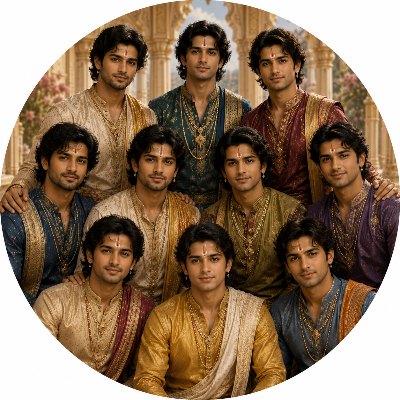
Sons of Satya and Krishna — Princes of Dwarka Born of Nagnajiti
Vira · Chandra · Ashvasena · Chitragu · Vegavan · Vrisha · Ama · Shanku · Vasu · Kunti · Sons of Satya Nagnajiti · Princes of Dwarka
The ten sons of Satya — also known as Nagnajiti, the fifth of Krishna's eight principal queen-consorts at Dwarka — are named in the Bhagavata Purana (Canto 10, Chapter 61, verse 13) as Vira, Chandra, Ashvasena, Chitragu, Vegavan, Vrisha, Ama, Shanku, Vasu, and Kunti. They were princes of Dwarka, members of the Yadava order through their father Krishna, and grandsons of King Nagnajit of Kosala through their mother. No individual narrative episodes are recorded for any of these ten sons in the Bhagavata Purana, the Vishnu Purana, the Harivamsha, or the Mahabharata. Their attestation in the primary sources is confined to the genealogical list in BhP 10.61.13. The profile is accordingly proportionate to this limited evidential base.
✦ Lineage
- Father: Krishna, the eighth avatar of Vishnu, son of Vasudeva and Devaki, king of Dwarka; of the Yadava dynasty of the Chandravamsha
- Mother: Satya (Nagnajiti), daughter of King Nagnajit of Kosala, fifth of the Ashtabharya; won by Krishna at her father's swayamvara after he tamed seven ferocious bulls simultaneously by multiplying himself into seven divine forms
- Paternal grandfather: Vasudeva, king of Mathura, son of Shurasena of the Yadava dynasty
- Maternal grandfather: Nagnajit, pious king of Kosala, described in the Bhagavata Purana as exceedingly righteous and devoted to Vedic dharma
✦ The Names
Vira means hero or brave one — a standard epithet of martial honour in Kshatriya nomenclature. The Bhagavata Purana (10.61.13) names him first in the list, and he is identified in that text as the eldest of Satya's sons. The Vishnu Purana gives a variant in which Bhadravinda is named as the eldest or most prominent son of Satya — a minor but genuine discrepancy between the two primary Puranic sources on the question of primogeniture. Chandra means moon — an ancient royal name of the Chandravamsha tradition that Satya's sons would have inherited through their father's Yadava lineage. Ashvasena combines ashva (horse) with sena (army), meaning one whose army is of horses or lord of the cavalry — a martial and royal name shared with a son of the Naga king Takshaka in other parts of the Mahabharata tradition; the two figures are distinct. Chitragu combines chitra (variegated, wonderful, bright) with go or gu (cow or senses), yielding the sense of one of wonderful cattle or one whose senses are bright and variegated — a name with both pastoral and cognitive connotations. Vegavan means one who is swift or possessed of great speed — vega being the Sanskrit word for velocity or impulse — a name of martial and heroic character. Vrisha means bull, the excellent one, or one of virtue — a name shared with Karna's eldest son Vrishasena and widely used in the Kshatriya tradition as a mark of power and righteousness. Ama derives from ama, which in Sanskrit can carry the sense of raw, powerful, or home — a brief name whose precise royal connotation in this context is not elaborated in the primary sources. Shanku means spike, javelin, or peg — carrying connotations of sharpness and precision, a conventional martial name. Vasu means wealth, a good one, or one of the Vasus — the eight elemental divine beings of the Vedic tradition; it is among the most auspicious and widely used royal names in the Puranic tradition. Kunti as a male name is unusual and distinct from the famous Kunti, the mother of the Pandavas; in this context it may derive from kunta meaning spear or lance, yielding the sense of one bearing a spear — a martial designation for a Kshatriya prince.
✦ Textual Variants and Inconsistencies
The sole variant of significance concerns the identity of the eldest son. The Bhagavata Purana (10.61.13) names Vira first in the list of ten sons, implying his primogeniture. The Vishnu Purana names Bhadravinda as the eldest or most prominent among Satya's sons — a name that does not appear in the Bhagavata Purana's list of ten at all. The Wisdomlib Purana Index entry for Nagnajiti notes that the Vishnu Purana gives only two sons specifically named for Satya, of whom Bhadravinda is one. These two accounts cannot be harmonised and represent a genuine divergence between the two principal Puranic sources on this point. Neither text records individual exploits or narrative episodes for any of the ten sons, and nothing further is known of their lives or fates from any primary source.
✦ Connection to the Wider Genealogy
The ten sons of Satya and Krishna occupy the generation of Krishna's children at Dwarka — a generation that includes the eighty sons born across all eight principal queens, of whom Pradyumna of Rukmini and Samba of Jambavati are the most narratively prominent. Through their father they belong to the Yadava dynasty of the Chandravamsha, descending through Yadu, Kroshthu, and the long Vrishni-Satvata line. Through their mother they connect to the Kosala kingdom of their grandfather Nagnajit, and through the Sri Vaishnava theological identification of their mother as an incarnation of Niladevi, they carry a divine maternal lineage alongside their royal human one.
✦ References
- Bhagavata Purana, Canto 10, Chapter 61, verse 13: The sole primary source naming all ten sons — Vira, Chandra, Ashvasena, Chitragu, Vegavan, Vrisha, Ama, Shanku, Vasu, and Kunti — with Vira listed first; the foundational genealogical attestation for this group
- Vishnu Purana, Book 5: Names Bhadravinda as the eldest or most prominent among Satya's sons; does not give a full list of ten, representing a variant account of primogeniture divergent from the Bhagavata Purana
- Wisdomlib — Nagnajiti definition entry: Secondary source citing BhP 10.61.13 and the Vishnu Purana variant; records the Bhadravinda discrepancy
- Wikipedia, "Nagnajiti" article: Secondary source confirming the ten-son list from BhP 10.61.13 and noting the Vishnu Purana variant on Bhadravinda