
About
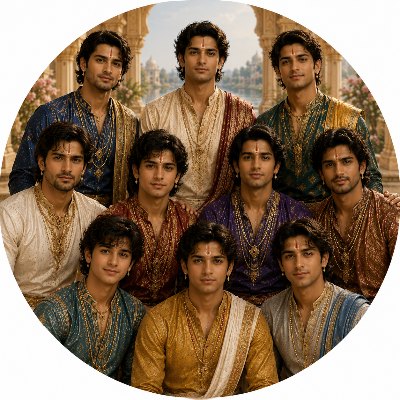
Sons of Kalindi and Krishna — Princes of Dwarka Born of the Yamuna Goddess
Shruta · Kavi · Vrisha · Vira · Subahu · Bhadra · Shanti · Darsa · Purnamasa · Somaka · Sons of Kalindi · Princes of Dwarka
The ten sons of Kalindi — the personified river goddess Yamuna, fourth of Krishna's eight principal queen-consorts at Dwarka — are named in the Bhagavata Purana (Canto 10, Chapter 61, verse 14) as Shruta, Kavi, Vrisha, Vira, Subahu, Bhadra, Shanti, Darsa, Purnamasa, and Somaka. They were princes of Dwarka, members of the Yadava dynasty through their father Krishna, and grandsons of the sun god Surya and his wife Sanjna through their mother Kalindi. The Vishnu Purana corroborates their existence and names Shruta specifically as the eldest. No individual narrative episodes are recorded for any of these ten sons in the Bhagavata Purana, the Vishnu Purana, the Harivamsha, or the Mahabharata beyond their genealogical listing. This profile is accordingly proportionate to that limited evidential base.
✦ Lineage
- Father: Krishna, the eighth avatar of Vishnu, son of Vasudeva and Devaki, king of Dwarka; of the Yadava dynasty of the Chandravamsha
- Mother: Kalindi, the personified goddess of the river Yamuna, daughter of the sun god Surya and his wife Sanjna, twin sister of Yama the god of death; who performed severe austerities in an underwater palace built by Surya, seeking Krishna as her husband, until encountered by Krishna and Arjuna on the banks of the Yamuna during a visit to the Pandavas at Indraprastha
- Paternal grandfather: Vasudeva, king of Mathura, son of Shurasena of the Yadava dynasty
- Maternal grandfather: Surya, the sun god, one of the twelve Adityas; making these ten princes the grandsons of a solar deity through their mother's divine lineage
- Maternal uncle: Yama, the god of death and dharmic judgment, twin brother of Kalindi
✦ The Names
Shruta derives from the Sanskrit root shru meaning to hear, yielding the sense of one who is learned through hearing, one renowned by fame, or one versed in sacred oral tradition — a name of intellectual and spiritual distinction. The Vishnu Purana specifically identifies Shruta as the eldest of Kalindi's sons, and the Bhagavata Purana lists him first in verse 14, implying the same primogeniture. Kavi means poet, seer, or wise one — one of the most revered designations in the Sanskrit tradition, connoting not merely literary skill but divine insight and prophetic vision; the same word is used as an epithet of Brahma and Surya in the Vedic literature, giving it additional resonance as a name for the grandson of Surya. Vrisha means bull or the virtuous one — a name of power and righteousness widely used in the Kshatriya tradition; it is shared with the eldest son of Karna, Vrishasena, and with one of the sons of Satya Nagnajiti, but those are wholly distinct individuals. Vira means hero or brave warrior — a standard Kshatriya honorific also shared with the eldest son of Satya Nagnajiti listed in the same chapter; the two are distinct princes born of different mothers. Subahu combines su (good, excellent) with bahu (arm), yielding one of excellent arms or strong-armed one — a conventional mark of martial prowess. Bhadra means auspicious, fortunate, or good — one of the most widely used auspicious names in the Sanskrit tradition, shared with one of Krishna's own principal queens; this son's name should not be confused with that queen. Shanti means peace, tranquillity, or the cessation of agitation — a name of spiritual and philosophical significance, carrying connotations of the highest virtue in both the Upanishadic and the Puranic frameworks. Darsa derives from darshana or darsha, meaning vision, sight, or one who sees — a name associated with perception, clarity, and auspicious appearance; the new moon day in the Vedic ritual calendar is also called darsha, giving the name a lunar and ritual resonance. Purnamasa means full moon — a compound of purna (full, complete) and masa (month or moon) — one of the most directly luminous names in the list, resonant with the monthly lunar cycle that governs Vedic ritual and with the completeness that the full moon symbolises in the Indian tradition. Somaka, the youngest, derives from soma — the sacred ritual drink of the Vedas, the moon, and a name of the moon god himself — combined with the suffix ka, yielding the sense of one related to or endowed with soma, the lunar and sacrificial substance; the Bhagavata Purana (10.61.14) explicitly designates Somaka as the youngest of Kalindi's sons.
✦ Divine Maternal Lineage
These ten princes occupy a unique position among Krishna's eighty sons from the Ashtabharya in that their mother is not a mortal princess but a goddess — the personified Yamuna, daughter of Surya. Through Kalindi they are the grandsons of the sun god himself, making them simultaneously descendants of the Chandravamsha through Krishna's Yadava lineage and grandsons of the solar divine order through their mother. Their maternal uncle is Yama, the lord of death and dharmic judgment, and their maternal half-aunt through Chhaya is Tapati, the river goddess who became the ancestress of the Kuru dynasty through her marriage to King Samvarana. This divine maternal genealogy gives Kalindi's sons a distinctive cosmological depth within the broader list of Krishna's children.
✦ Textual Variants and Inconsistencies
The Bhagavata Purana (10.61.14) gives the complete list of ten sons with Shruta listed first and Somaka explicitly named as the youngest. The Vishnu Purana corroborates the existence of multiple sons from Kalindi and specifically names Shruta as the eldest, without providing the complete list of ten. These two accounts are consistent on the identity of the eldest and do not present any genuine contradiction. Minor variations in the ordering or spelling of individual names appear across secondary sources and regional compilations but do not affect the primary textual canon of the list as established in BhP 10.61.14.
✦ Connection to the Wider Genealogy
The ten sons of Kalindi and Krishna belong to the generation of Krishna's children at Dwarka alongside the eighty sons of the eight principal queens. Through their father they are part of the Yadava dynasty of the Chandravamsha, connected upward through Krishna to Vasudeva, Shurasena, and the long Vrishni-Satvata line. Through their mother they connect to the solar divine order of Surya, and through her twin Yama to the realm of dharmic cosmic governance. The names of these ten sons — spanning learning, courage, strength, peace, and lunar radiance — reflect the range of royal and spiritual virtues that the Puranic tradition associated with the progeny of a divine avatar.
✦ References
- Bhagavata Purana, Canto 10, Chapter 61, verse 14: The sole primary source naming all ten sons — Shruta, Kavi, Vrisha, Vira, Subahu, Bhadra, Shanti, Darsa, Purnamasa, and Somaka — listing Shruta first and explicitly designating Somaka as the youngest; the foundational genealogical attestation for this group
- Vishnu Purana, Book 5: Corroborates Kalindi's sons and specifically names Shruta as the eldest; does not provide the complete list of ten
- Wikipedia, "Yamuna in Hinduism" article: Secondary source confirming the ten-son list from BhP 10.61.14 and the Vishnu Purana's identification of Shruta as eldest
- Puranic Encyclopaedia (Vettam Mani), "Kalindi" and "Yamuna" entries: Secondary source providing consolidated narrative and genealogical details across the Puranic tradition