
About
Sons of Lakshmana and Krishna — Princes of Dwarka Born of the Princess of Madra
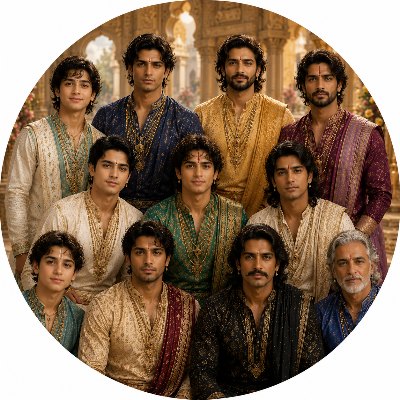
Praghosha · Gatravan · Simha · Bala · Prabala · Urdhvaga · Mahashakti · Saha · Oja · Aparajita · Sons of Lakshmana · Princes of Dwarka
The ten sons of Lakshmana — the princess of Madra and seventh of Krishna's eight principal queen-consorts at Dwarka — are named in the Bhagavata Purana (Canto 10, Chapter 61, verse 15) as Praghosha, Gatravan, Simha, Bala, Prabala, Urdhvaga, Mahashakti, Saha, Oja, and Aparajita. The Sanskrit verse itself designates them as the sons of the Madra queen — the word Madryah appearing directly in the verse — providing the primary textual basis for connecting Lakshmana's identity as Madra princess to this list of sons. They were princes of Dwarka, members of the Yadava dynasty through their father Krishna, and grandsons of Brihatsena of Madra through their mother, according to the Padma Purana's identification of their maternal grandfather. No individual narrative episodes are recorded for any of these ten sons in any primary source beyond their genealogical listing. This profile is accordingly proportionate to that limited evidential base.
✦ Lineage
- Father: Krishna, the eighth avatar of Vishnu, son of Vasudeva and Devaki, king of Dwarka; of the Yadava dynasty of the Chandravamsha
- Mother: Lakshmana, also known as Lakshana and praised by the epithet Charuhasini — one of the beautiful smile — daughter of the king of Madra; the Bhagavata Purana describes her as endowed with excellent qualities; the Padma Purana names her father as Brihatsena; she was won by Krishna at her father's swayamvara through an archery contest, and also described as carried away by Krishna from the assembly in a manner likened to Garuda seizing amrita
- Maternal grandfather: The unnamed king of Madra according to the Bhagavata Purana; identified as Brihatsena according to the Padma Purana; ruler of the Madra kingdom in northwestern India, corresponding broadly to the region of modern Punjab and the Sialkot area
- Paternal grandfather: Vasudeva, king of Mathura, son of Shurasena of the Yadava dynasty
✦ The Names
Praghosha combines pra (forth, greatly) with ghosha (sound, noise, resonance, or proclamation), yielding the sense of one who proclaims greatly, one of great resonant sound, or a mighty war-crier — a name of martial and royal dignity connoting the commanding voice of a king or warrior whose presence announces itself. It is listed first in BhP 10.61.15, implying Praghosha's primogeniture among Lakshmana's sons. Gatravan derives from gatra (limb, body, or member) combined with the possessive suffix van, yielding one who has excellent limbs or one of well-formed body — a conventional mark of physical beauty and martial capacity in Kshatriya nomenclature. Simha means lion — one of the most powerful and widely used royal epithets in the Sanskrit tradition, connoting supreme courage, majesty, and dominion; the same word forms the second element in the compound Narasimha, the man-lion avatar of Vishnu. Bala means strength or power — a brief, forceful name of straightforward martial connotation; it is among the most common names in the Puranic tradition and is shared with the elder brother of Krishna, Balarama, whose name it forms the first element of. Prabala combines pra (greatly, forth) with bala (strength), yielding the meaning greatly powerful or one of exceptional strength — a direct intensification of the preceding name Bala and a conventional superlative honorific for a Kshatriya hero. Urdhvaga combines urdhva (upward, high, elevated) with ga (one who goes), yielding one who moves upward or one who goes to the heights — a name of spiritual and cosmological elevation connoting the soul's ascent or a hero whose ambitions and achievements are directed toward the highest registers of excellence. Mahashakti combines maha (great) with shakti (power, energy, capability), yielding great power or great energy — a name of commanding spiritual and martial resonance; Shakti in the broader tradition also names the divine feminine energy, giving the name an additional theological depth. Saha means patient, enduring, or one who bears or overcomes — from the root sah meaning to endure or to be victorious; a name connoting the quality of steadfast resilience that is among the most valued of the royal virtues in the Puranic framework. Oja means vital energy, radiance, or bodily lustre — the term ojas in Ayurveda and the Upanishads denoting the finest essence of vital force that sustains life and bestows brilliance; as a personal name it carries the connotation of one who possesses this supreme vital radiance. Aparajita means the unconquered or the invincible — a compound of a (not) and parajita (conquered or defeated) — one of the most auspicious and powerful names in the Kshatriya tradition, shared with a name of the goddess Durga and used as a martial epithet for heroes of supreme capability; it completes the list as the tenth and final name.
✦ The Martial Character of the Names
The ten names of Lakshmana's sons are among the most overtly martial of the eight lists of Krishna's sons from the Ashtabharya. Simha, Bala, Prabala, Mahashakti, Saha, Oja, and Aparajita collectively constitute a sequence of names whose meanings cluster around physical strength, invincibility, endurance, and vital power — the defining qualities of a Kshatriya warrior ideal. The name Aparajita — the unconquered — as the concluding name gives the list a sense of narrative culmination in supreme martial honour. This martial concentration in the names may reflect the tradition's characterisation of the Madra kingdom as one of the great warrior peoples of northwestern India, a reputation attested in the Mahabharata's description of the Madra army and the figure of King Shalya of Madra as one of the supreme warriors of the Kurukshetra War.
✦ Textual Variants and Inconsistencies
The Bhagavata Purana (10.61.15) provides the complete list of ten sons, with the Sanskrit verse directly designating them as the children of the Madra queen. The Vishnu Purana includes Lakshmana in the Ashtabharya but separately names a queen Madri as the Madra princess, and does not provide an independent named list of sons for Lakshmana specifically. This creates the same structural ambiguity that surrounds Lakshmana's identity across the Vishnu Purana and Harivamsha — namely, whether the Madra queen of BhP 10.61.15 and the Lakshmana of BhP 10.58 are one figure whose sons are listed here, or whether the textual designation Madryah in verse 15 suggests the sons are attributed to a Madra queen who may be distinct from Lakshmana in other textual traditions. The Bhagavata Purana itself treats them as one and the same figure, and this profile follows that text's identification. Minor spelling variants — Urdhaga for Urdhvaga, and Pragosh or Praghosh for Praghosha — appear in secondary compilations but do not affect the canonical list.
✦ Connection to the Wider Genealogy
The ten sons of Lakshmana and Krishna belong to the generation of Krishna's children at Dwarka alongside the eighty sons of the eight principal queens. Through their father they are part of the Yadava dynasty of the Chandravamsha, connected upward through Krishna to Vasudeva, Shurasena, and the Vrishni-Satvata line. Through their mother they connect to the Madra kingdom — the major northwestern Kshatriya polity whose royal lineage also produced Madri, the second wife of Pandu and mother of Nakula and Sahadeva, and whose king Shalya served as charioteer to Karna and as the eighteenth-day commander of the Kaurava forces at Kurukshetra. Whether the Brihatsena of the Padma Purana and the Shalya line represent the same Madra royal house or separate branches is not established in the primary texts.
✦ References
- Bhagavata Purana, Canto 10, Chapter 61, verse 15: The primary source naming all ten sons — Praghosha, Gatravan, Simha, Bala, Prabala, Urdhvaga, Mahashakti, Saha, Oja, and Aparajita — with the Sanskrit term Madryah designating them as the sons of the Madra queen; the foundational genealogical attestation for this group
- Bhagavata Purana, Canto 10, Chapter 58: Records Lakshmana's marriage to Krishna; describes her as the daughter of the king of Madra endowed with good qualities; records both the abduction account and the archery contest account
- Padma Purana: Names Brihatsena as Lakshmana's father and records Lakshmana's own description of him as an accomplished veena player; the sole primary source for the maternal grandfather's name
- Vishnu Purana, Book 5: Includes Lakshmana in the Ashtabharya and praises her as Charuhasini; separately names a queen Madri as the Madra princess without providing an independent sons list for Lakshmana
- Wisdomlib — Bhagavata Purana Sanskrit text, verse 10.61.15: Secondary source providing Sanskrit transliteration of the verse confirming the word Madryah and the names Praghosha through Aparajita
- Wikipedia, "Lakshmana (Krishna's wife)" article: Secondary source confirming the ten sons from BhP 10.61.15 and the Vishnu Purana's ambiguity regarding the Madra identification
- Puranic Encyclopaedia (Vettam Mani), "Lakshmana" entry: Secondary source providing consolidated narrative and genealogical details