
About
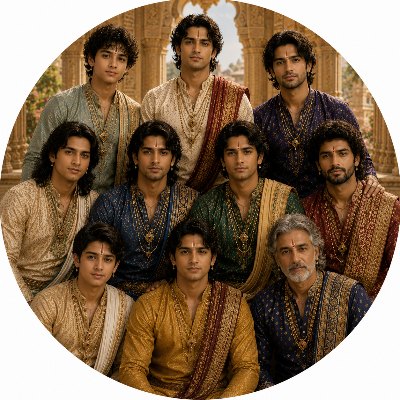
Sons of Bhadra and Krishna — Princes of Dwarka Born of the Princess of Kaikeya
Sangramajit · Brihatsena · Shura · Praharana · Arijit · Jaya · Subhadra · Vama · Ayur · Satyaka · Sons of Bhadra · Princes of Dwarka
The ten sons of Bhadra — the princess of the Kaikeya kingdom, sixth or eighth of Krishna's eight principal queen-consorts at Dwarka depending on the textual tradition consulted — are named in the Bhagavata Purana (Canto 10, Chapter 61, verse 17) as Sangramajit, Brihatsena, Shura, Praharana, Arijit, Jaya, Subhadra, Vama, Ayur, and Satyaka. They were princes of Dwarka, members of the Yadava dynasty through their father Krishna, and grandsons of King Dhrishtaketu of Kaikeya through their mother. Through their mother's maternal lineage they were also the nephews of Kunti — the mother of the Pandavas — making them first cousins of Yudhishthira, Bhima, and Arjuna. No individual narrative episodes are recorded for any of these ten sons in the primary sources beyond their genealogical listing. This profile is proportionate to that evidential base.
✦ Lineage
- Father: Krishna, the eighth avatar of Vishnu, son of Vasudeva and Devaki, king of Dwarka; of the Yadava dynasty of the Chandravamsha
- Mother: Bhadra, also known by the epithet Kaikeyi — princess of the Kaikeya kingdom — daughter of King Dhrishtaketu of Kaikeya and his wife Shrutakirti; Shrutakirti was the sister of Kunti, making Bhadra the first cousin of the Pandavas and the first cousin once removed of Krishna through Vasudeva's kinship network; her five brothers headed by the eldest Santardana arranged her marriage to Krishna
- Paternal grandfather: Vasudeva, king of Mathura, son of Shurasena of the Yadava dynasty
- Maternal grandfather: Dhrishtaketu, king of Kaikeya — not to be confused with the Dhrishtaketu of Chedi who fought on the Pandava side at Kurukshetra; the Kaikeya Dhrishtaketu was the ruler of the northwestern Kaikeya kingdom, whose region corresponded broadly to parts of modern Punjab and the western Himalayan foothills
- Maternal grandmother: Shrutakirti, sister of Kunti; her relationship to Kunti made Bhadra the maternal niece of the Pandava mother and her sons the first cousins of Yudhishthira, Bhima, Arjuna, Nakula, and Sahadeva
- Maternal uncles: Santardana and four other unnamed princes of Kaikeya who personally arranged Bhadra's marriage to Krishna
✦ The Names
Sangramajit combines sangrama (battle, conflict, war) with ajit (unconquered, or one who conquers), yielding the victor in battle or one who conquers in war — a supremely martial name of direct Kshatriya connotation. Secondary sources consistently identify Sangramajit as the eldest of Bhadra's ten sons, and his name heading the list in the Bhagavata Purana supports this identification. Brihatsena combines brihat (great, vast, mighty) with sena (army), yielding one who commands a great army — a standard royal name for a king or commander of vast forces; it is shared with Bhadra's maternal grandfather, who is named Brihatsena in the Padma Purana's account of the Madra lineage, though these are distinct individuals. Shura means brave, heroic, or valiant — one of the most direct and unadorned martial names in the Sanskrit tradition; it is also the name of Krishna's own grandfather Shurasena, lending it additional ancestral resonance within the Yadava dynasty. Praharana derives from prahara (strike, blow, or assault) combined with the nominal suffix, yielding one who strikes or the attacker — a name of aggressive martial energy connoting offensive capability and battlefield initiative. Arijit combines ari (enemy, foe) with jit (conqueror), yielding the conqueror of enemies — a direct and powerful Kshatriya honorific widely used across the epic and Puranic traditions as a mark of martial supremacy. Jaya means victory — one of the most widely used auspicious and martial names in the Sanskrit tradition, borne by a great many figures across the Puranas and epics; its simplicity and directness made it among the most popular royal names. Subhadra combines su (well, greatly) with bhadra (auspicious, fortunate), yielding the greatly auspicious one — sharing the name with the celebrated Subhadra, Krishna's sister and Arjuna's wife, though this prince is a wholly distinct individual; the name carries strong associations of divine favour and prosperity. Vama means beautiful, pleasant, or left — the last sense connecting it to the Vama tradition within Shaivite and Tantric thought connoting the left-hand or counter-conventional path; as a royal name in this context it likely carries the sense of beautiful or agreeable rather than the ritual connotation. Ayur derives from ayus meaning life, lifespan, or vitality — one of the most fundamentally auspicious names in the Sanskrit tradition, invoking long life, health, and the sustaining force of existence; it is a name of profound benedictory power in the context of royal naming. Satyaka derives from satya (truth) with the diminutive or affectionate suffix ka, yielding the truthful one or the little truthful one — a name of moral and dharmic connotation shared with the celebrated Satyaki (Yuyudhana), the Yadava warrior and disciple of Arjuna who fought at Kurukshetra; this son of Bhadra is a distinct individual. Secondary sources consistently identify Satyaka as the youngest of Bhadra's ten sons.
✦ Kinship with the Pandavas
The ten sons of Bhadra and Krishna occupy a distinctive genealogical position among Krishna's children at Dwarka in that their maternal lineage connects them directly to the Pandava family. Their mother Bhadra was the first cousin of Yudhishthira, Bhima, Arjuna, Nakula, and Sahadeva through the sisterhood of Shrutakirti and Kunti. This kinship placed the sons of Bhadra in a close cousinhood with the Pandavas — the same generation of heroes whose war with the Kauravas forms the central narrative of the Mahabharata. Their father Krishna was himself the first cousin of the Pandavas through Vasudeva's relationship to Kunti, making the sons of Bhadra simultaneously the children of Krishna and the double-cousins of the Pandava line.
✦ Textual Variants and Inconsistencies
The most significant inconsistency surrounding Bhadra's sons is not about the sons themselves but about their mother's place in the Ashtabharya. The Bhagavata Purana (10.58 and 10.61) names Bhadra as the eighth principal queen and lists her sons in verse 17. The Vishnu Purana and Harivamsha do not include Bhadra by name in their Ashtabharya lists at all, referring only to a daughter of Dhrishtaketu or princess of Kekeya as one of Krishna's consorts — an identification that scholars agree refers to the same figure. This means that BhP 10.61.17 is the sole primary source that both names Bhadra explicitly and lists her sons, and the son list cannot be independently cross-checked against a second named primary source.
A minor ordering variant exists in secondary sources: the Mythoworld compilation lists the sons in the order Sangramajit, Shura, Arijit, Jaya, Subhadra, Vama, Ayur, Brihatsena, Praharana, Satyaka — placing Brihatsena and Praharana near the end rather than second and fourth as in the Wikipedia-sourced list. This reflects different manuscript traditions or editorial choices in secondary compilations and does not affect the identity of the ten sons, all of whom are consistently named across these sources.
✦ Connection to the Wider Genealogy
The ten sons of Bhadra and Krishna belong to the generation of Krishna's children at Dwarka alongside the eighty sons of the eight principal queens. Through their father they are part of the Yadava dynasty of the Chandravamsha, connected upward through Krishna to Vasudeva, Shurasena, and the Vrishni-Satvata line. Through their mother they connect to the Kaikeya kingdom — one of the important northwestern Kshatriya polities of the Mahabharata period — and through their maternal grandmother Shrutakirti's sisterhood with Kunti, to the Pandu-Kuru dynastic network at the heart of the Mahabharata's central conflict.
✦ References
- Bhagavata Purana, Canto 10, Chapter 61, verse 17: The primary source naming all ten sons — Sangramajit, Brihatsena, Shura, Praharana, Arijit, Jaya, Subhadra, Vama, Ayur, and Satyaka — with Sangramajit listed first and Satyaka identified as youngest; the foundational genealogical attestation for this group
- Bhagavata Purana, Canto 10, Chapter 58: Records Bhadra's marriage to Krishna; identifies her as the princess of Kaikeya with the epithet Kaikeyi; records that her five brothers headed by Santardana arranged the marriage
- Vishnu Purana, Book 5 and Harivamsha: Refer to a daughter of Dhrishtaketu or princess of Kekeya among Krishna's consorts without naming her Bhadra; do not provide an independent sons list
- Mahabharata, Mausala Parva: Records Bhadra among the queens who performed sati on Krishna's funeral pyre at the end of the Dvapara Yuga
- Wikipedia, "Bhadra (Krishna's wife)" article: Secondary source confirming parentage, the Kaikeya identification, the Shrutakirti-Kunti sisterhood, the ten sons from BhP 10.61.17, and the Vishnu Purana and Harivamsha's omission of Bhadra by name
- Puranic Encyclopaedia (Vettam Mani), "Bhadra" entry: Secondary source providing consolidated narrative and genealogical details across the Puranic tradition