
About
Vasuruchi — Gandharva, Milker of the Viraj
Vasuruchi · Vāsuruchi · son of Suryavarchas · brother of Chitraratha
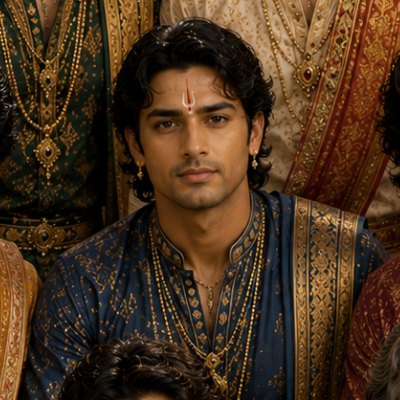
Vasuruchi is a Gandharva — a member of the class of celestial beings associated with music, the divine arts, and the intermediate realms between earth and heaven — whose sole attested appearance in the primary Sanskrit corpus is in the Atharvaveda, Book Eight, Hymn Ten, verse twenty-seven. In that passage he is named alongside his brother Chitraratha, the celebrated king of the Gandharvas, in the context of the cosmic milking of the Viraj — the primordial divine entity conceived in the Atharvaveda as a luminous cosmic cow whose milk sustains every class of existence. The two brothers are identified there as sons of Suryavarchas. Beyond this single Vedic attestation, Vasuruchi does not appear independently in any surviving Puranic genealogical list, epic narrative, or other primary text examined. His profile is accordingly brief, proportional to the textual evidence.
✦ The Name
The name Vasuruchi is a Sanskrit compound of vasu, meaning wealth, goodness, or a class of divine beings associated with beneficence, and ruchi, meaning brightness, radiance, taste, or delight. The compound thus conveys something on the order of one who delights in goodness, one of bright virtue, or one whose radiance is divine — a name consistent with the celestial standing of a Gandharva. No epithets or alternative names for Vasuruchi are preserved in the surviving sources.
✦ Lineage
- Father (Atharvaveda): Suryavarchas — a Gandharva whose name means one whose brilliance equals the Sun. He is named in the Atharvaveda as the father of both Vasuruchi and Chitraratha. Suryavarchas also appears independently in the Mahabharata's Sabha Parva list of Gandharva chiefs attending Kubera's court, confirming him as a figure of standing within the celestial musician order, though his own parentage is not recorded in any primary source.
- Brother: Chitraratha — the foremost of the Gandharvas, identified as such by Krishna in the Bhagavad Gita (10.26) and by the gods in the Shiva Purana. Chitraratha is extensively narrated in the Mahabharata, where his encounter with the Pandava prince Arjuna on the banks of the Ganga, his defeat, and his subsequent friendship with Arjuna constitute the central episode of the Chaitraratha Parva of the Adi Parva. The Mahabharata separately identifies Chitraratha as a son of the sage Kashyapa by his wife Muni, a parentage that diverges from the Atharvaveda's Suryavarchas attribution and is addressed below.
✦ The Cosmic Milking of the Viraj
The entire textual record for Vasuruchi derives from Atharvaveda 8.10.27, a hymn dedicated to the glorification of the Viraj — the primordial luminous being conceived in the Atharvavedic cosmological framework as the divine cosmic cow whose milk nourishes each class of existence according to its nature. The hymn describes how various classes of beings — gods, sages, men, demons, and celestial orders — each approach the Viraj and extract from her the particular sustenance appropriate to their kind.
In the passage concerning the Gandharvas and Apsaras, Chitraratha son of Suryavarchas acts as the calf — the inducer of milk secretion — while Vasuruchi, also a son of Suryavarchas, acts as the milker. The vessel into which the milk is drawn is described as a lotus-petal pail. From this milking emerges the most delightful fragrance — the punyagandha, the holy scent — which is the sustenance upon which the Gandharvas and Apsaras subsist. The two brothers thus perform complementary ritual functions in a cosmological act of nourishment: Chitraratha drawing forth the divine essence, Vasuruchi receiving and extracting it.
This pairing of the calf and milker is not unique to Vasuruchi and Chitraratha within the Vedic and Puranic tradition. A structurally identical episode — the Gandharvas milking the earth during the reign of the emperor Prithu — appears in the Harivamsha, Chapter Six, and the Bhagavata Purana, where Vishvavasu, the eldest and most venerable of the Gandharvas in the Vedic corpus, plays the calf's role. The Atharvaveda's assignment of Chitraratha to the calf's role and Vasuruchi to the milker's role is therefore consistent with a broader ritual template in which the foremost or most potent member of a class acts as calf while another acts as the extracting agent.
✦ Parentage — The Suryavarchas Question and Tree Placement
As noted, the Atharvaveda names Suryavarchas as the father of both Vasuruchi and Chitraratha. For Chitraratha, the Mahabharata provides an independent and divergent parentage — Kashyapa by his wife Muni — and the fuller genealogical tradition of the Mahabharata and Puranas generally situates the Gandharvas born of Kashyapa and Muni as a distinct cohort from those born of Kashyapa and Arishta. Since no primary text assigns Vasuruchi independently to any other line, his parentage rests entirely on the Atharvaveda passage that identifies him as a brother of Chitraratha.
In the genealogical tree of this reference system, Vasuruchi is placed under Kashyapa and Muni — the line to which the Mahabharata assigns his brother Chitraratha — on the editorial principle that the brotherhood attested in the Atharvaveda and the Mahabharata's maternal-line assignment for Chitraratha together yield the most structurally coherent placement for both brothers. Suryavarchas is documented in the Mahabharata as a Gandharva chief in his own right and appears in the Sabha Parva list of Kubera's court, but his own parentage is unattested, leaving him without a reliable upward connection in the broader tree. The Atharvaveda's designation of him as their father is recorded here as the primary source statement; the tree placement under Kashyapa and Muni represents the editorial reconciliation of the two accounts rather than the suppression of either.
✦ References
Primary Sources
- Atharvaveda, Book 8, Hymn 10, verse 27: The sole primary source for Vasuruchi; names him as a son of Suryavarchas and brother of Chitraratha; describes his role as the milker in the cosmic milking of the Viraj by the Gandharvas and Apsaras, with Chitraratha acting as calf and the yield being the fragrant divine sustenance of the celestial musicians.
- Mahabharata, Adi Parva, Chapter 65, verse 43: Does not name Vasuruchi directly but identifies his brother Chitraratha as a Devagandharva born of Kashyapa and Muni; the basis for the editorial decision to place both brothers under Kashyapa and Muni in the genealogical tree.
- Mahabharata, Sabha Parva, Chapter 10: Lists Suryavarchas among the Gandharva chiefs attending Kubera's celestial court, confirming Suryavarchas as an independently attested Gandharva figure whose identity is not reducible to Kashyapa.
Secondary Sources
- Wikipedia, Chitraratha article: Documents the Atharvaveda passage with the Suryavarchas parentage and names Vasuruchi as Chitraratha's brother and co-participant in the Viraj milking; consulted for confirmation of the fraternal relationship and the verse reference.