
About
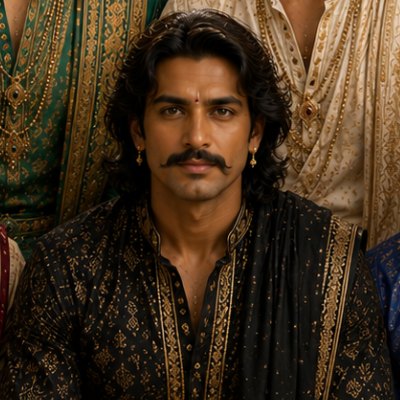
Abhimanyu (Ayan Ghosh) — Social Husband of Radha
Abhimanyu · Ayan Ghosh
Abhimanyu, known in the Bengali vernacular devotional tradition by the name Ayan Ghosh, is identified in Rupa Goswami's sixteenth-century Gaudiya Vaishnava genealogical compendium, the Shri Radha-Krishna-Ganoddesha-Dipika, as the cowherd to whom Radha, the eternal consort of Krishna, is socially wedded within the structure of the cowherd community of Vraja. He is the elder son of Vrika, a cowherd elder of the village of Javat, and his wife Jatila, and the elder brother of Durmada, to whom Radha's younger sister Ananga Manjari is wedded, and of Kutila, who together with Jatila forms part of the watchful household into which Radha married. Within Gaudiya Vaishnava theology, the marriage of Abhimanyu to Radha occupies a position of considerable theological importance despite — or rather because of — its status: the tradition holds this marriage to be a social designation belonging to the level of worldly appearance, termed Maya, which does not touch the deeper spiritual reality of Radha's eternal relationship with Krishna, and which instead serves as the structural condition that gives rise to the mood of parakiya rasa, the paramour love regarded in Gaudiya aesthetics as the highest form of conjugal devotion.
✦ The Two Names: Abhimanyu and Ayan Ghosh
The name Abhimanyu is a Sanskrit compound of abhi, an intensifying prefix meaning toward or upon, and manyu, meaning spirit, passion, anger, or wrath, together suggesting a figure of intense or assertive temperament — a meaning consonant with the protective and proprietary disposition attributed to him within the Vraja narrative tradition as the husband whose household watches over Radha. This name is the form used in the Sanskrit textual tradition represented by Rupa Goswami's Shri Radha-Krishna-Ganoddesha-Dipika.
Ayan Ghosh is the form of his name used in the Bengali vernacular devotional tradition, particularly within the padavali literature — the body of Bengali devotional poetry composed by poets such as Chandidas in the tradition of Krishna-Radha love poetry — and within Vaishnava-Sahajiya devotional circles of Bengal. The surname Ghosh is a name conventionally associated in Bengal with the Goala or Abhira cowherd caste, the community from which the Vraja cowherds of the Krishna narrative tradition are understood to derive, and its use here situates Abhimanyu's identity within a specifically Bengali social and linguistic frame. The two names, Abhimanyu and Ayan Ghosh, are understood within this profile to refer to the same figure as he appears across two distinct linguistic and regional strands of the same devotional tradition — the Sanskrit strand associated with the Goswamis of Vrindavana, and the Bengali vernacular strand associated with the padavali poets and Vaishnava-Sahajiya circles.
✦ Lineage
- Father: Vrika (also Vrika Gopa) — cowherd elder of Javat and head of the household into which Radha and Ananga Manjari were given in marriage. Vrika's textual presence is confined to his position as patriarch of the household, with no independent episode attributed to him.
- Mother: Jatila — recorded in Rupa Goswami's Vidagdha Madhava as a figure of habitual suspicion and vigilance toward Radha's conduct, whose authority within the household is depicted as subordinate to that of Mukhara Devi, Radha's maternal grandmother.
- Younger brother: Durmada — identified in the Shri Radha-Krishna-Ganoddesha-Dipika as the cowherd to whom Ananga Manjari, Radha's younger sister, is socially wedded. Durmada is described as proud, haughty, and protective in temperament.
- Sister: Kutila — recorded in the Vraja dramatic tradition alongside her mother Jatila as a watchful and suspicious figure within the household, alert to any irregularity in Radha's conduct.
- Social wife: Radha — daughter of Vrishabhanu, the cowherd chieftain of Vraja, and his wife Kirtida Devi. Radha is venerated across the Brahma Vaivarta Purana, the Padma Purana's Uttara Khanda, the Garga Samhita, and the wider Gaudiya Vaishnava tradition as the foremost of the gopis of Vraja and as the eternal consort of Krishna, identified theologically as his Hladini Shakti, the personification of Krishna's own potency of divine bliss. Her marriage to Abhimanyu is understood within Gaudiya theology to be a social designation that does not reflect this deeper spiritual identity.
- Sister-in-law: Ananga Manjari — younger sister of Radha and daughter of Vrishabhanu and Kirtida Devi, wedded to Abhimanyu's brother Durmada, and recorded as a close attendant and confidante within Radha's intimate circle.
✦ The Doctrine of Maya and the False Conception of Marriage
The Gaudiya Vaishnava theological tradition addresses the social fact of Radha's marriage to Abhimanyu through the doctrine of Maya, the worldly or illusory level of appearance that operates according to ordinary social and biological conventions but does not constrain or define the eternal spiritual realities that operate at a higher level. Within this framework, Abhimanyu is described as possessing what is termed a false conception, or in some formulations a Maya-induced belief, that he is Radha's husband in the full and exclusive sense that the term implies in ordinary worldly life. This conception is described as false not in the sense that the social marriage did not occur, but in the sense that it does not correspond to or constrain the eternal relationship between Radha and Krishna, which the tradition holds to be prior to, independent of, and unaffected by any social arrangement undertaken within the world of Vraja.
This doctrine allows the Gaudiya tradition to affirm, without contradiction in its own theological terms, both that Radha was socially married to Abhimanyu within the cowherd community of Vraja, and that her heart, devotion, and eternal identity belong entirely and exclusively to Krishna. Abhimanyu's role within this framework is thus not that of a rival or an obstacle to be overcome in the manner of an antagonist, but that of a structural feature of the social world of Vraja whose very existence — and whose belief in the legitimacy of his marriage — is what generates the condition of parakiya rasa, the paramour love whose intensity arises precisely from its being unsanctioned and concealed.
✦ Parakiya Rasa and the Aesthetics of Concealment
In the aesthetic theology developed by the Goswamis of Vrindavana, including Rupa Goswami, devotional relationships with Krishna are classified according to categories drawn from classical Sanskrit poetics, among which the conjugal mood, or madhurya-rasa, is held to be the most intimate. Within madhurya-rasa, a further distinction is drawn between svakiya, the love of a wedded wife for her husband, and parakiya, the love of a woman for a man who is not her socially sanctioned husband — a love that, precisely because it is unsanctioned, carries an element of risk, secrecy, and longing that the tradition regards as intensifying devotional sentiment beyond what svakiya love can offer. Radha's social marriage to Abhimanyu places her relationship with Krishna firmly within the parakiya category, and Abhimanyu's existence as her socially recognised husband is therefore not incidental to this theological framework but constitutive of it: without a socially sanctioned husband, Radha's love for Krishna could not occupy the parakiya category that the tradition holds in such high regard.
✦ Connection to the Wider Genealogy
Abhimanyu, as the elder son of Vrika and Jatila and the social husband of Radha, occupies a position at the centre of the social architecture of Vraja as understood in the Gaudiya Vaishnava tradition. Through his marriage to Radha, his household is connected, at the level of social appearance, to the central relationship of Gaudiya Vaishnava theology — that of Radha and Krishna as the Hladini Shakti and its possessor — while the tradition maintains that this connection operates entirely within the doctrine of Maya and does not touch the deeper spiritual reality of that relationship. Through his brother Durmada's marriage to Ananga Manjari, Abhimanyu's household is doubly linked to the family of Vrishabhanu and Kirtida Devi, two sisters of that family having married two brothers of his own.
✦ References
- Primary Sources
- Shri Radha-Krishna-Ganoddesha-Dipika of Rupa Goswami — Primary source for Abhimanyu's identification as the son of Vrika and Jatila, the elder brother of Durmada and Kutila, and the cowherd to whom Radha is socially wedded.
- Vidagdha Madhava of Rupa Goswami — Primary dramatic source for the household at Javat into which Radha married, and for the social and narrative context of Abhimanyu's marriage.
- Bengali padavali literature (Vaishnava devotional poetry tradition, including the works associated with the poet Chandidas) — Primary vernacular source for the name Ayan Ghosh as applied to Radha's social husband within the Bengali devotional tradition.
- Secondary Sources
- The Harmonist, "Ananga Manjari: A Historical and Theological Perspective" — Secondary source for the theological framing of Abhimanyu's marriage to Radha within the doctrine of Maya and the parakiya rasa framework.
- Isvara.org Archive, "Radha-Krishna-Ganoddesa-Dipika English Edition: Srimati Radharani and Her Friends" — Secondary translation consolidating the Ganoddesha-Dipika's account of Abhimanyu's identity and his household.
- Wikipedia, entry on Radha — Secondary reference for the variant tradition of Radha's social husband under the name Ayan Ghosh within the Bengali devotional context.