
About
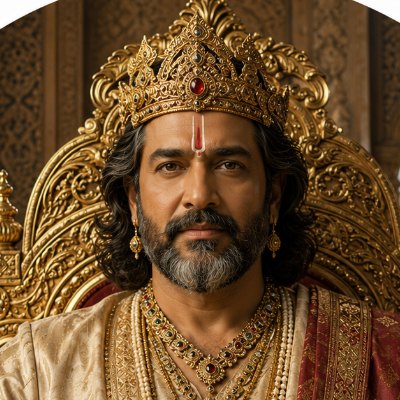
Dhanvantari — Divine Physician, Lord of Ayurveda, Avatar of Vishnu
Dhanvantari · Dhanvantara · Sudha-pani · Amritapani · Abja-ja · Jaladhi-ja · Kashiraja · Divodasa · Lord of Varanasi
Dhanvantari is one of the most revered figures in the Hindu Puranic tradition, honoured simultaneously as a cosmic deity, an avatar of Vishnu, the presiding lord of Ayurveda, and a historical king of Varanasi. He appears across a wide range of primary sources — the Bhagavata Purana, the Vishnu Purana, the Agni Purana, the Mahabharata, the Harivamsha, the Garuda Purana, and various Ayurvedic treatises — in two distinct but related registers. In the cosmic register he is the divine being who emerged bearing the vessel of Amrita from the churning of the milk ocean during the Samudramanthana. In the human register he is a king of the Kashi lineage who took birth in the world specifically to transmit the science of Ayurveda to humanity. The Bhagavata Purana identifies him explicitly as a partial manifestation of Vishnu, the preserver deity, who took this form in response to a boon he had requested in a prior existence. He is worshipped across the Hindu tradition as the deity of medicine and the remover of disease, and his festival Dhanteras — observed two days before Diwali — is one of the most widely observed devotional occasions associated with him.
✦ The Name
The name Dhanvantari is generally analysed as a compound of dhanvan or dhanvana — connected in Sanskrit to the bow, to speed, and to the concept of moving swiftly — and antari, from the root connected to the interior, the between-space, or that which moves within. One traditional interpretation reads the name as "he who moves swiftly through the sky" or "he who traverses the inner spaces," connecting him to the celestial origins of medical knowledge. A second interpretation connects dhanvan to dhanvana in the sense of a desert or open plain, giving the compound the sense of "he who pervades open space," reinforcing his cosmic identity. The epithet Sudha-pani means "he who holds nectar in his hand," referring to the vessel of Amrita he bore at his emergence from the ocean. Amritapani carries the same meaning. Abja-ja and Jaladhi-ja both mean "born from the waters" — the former from abja (water-born) and the latter from jaladhi (ocean), both referring to his emergence from the milk ocean during the churning. The epithet Kashiraja, "king of Kashi," refers to his human incarnation as a king of Varanasi. Divodasa is a distinct figure in the Kashi royal lineage tradition who is closely associated with Dhanvantari, and the Puranas handle the relationship between the two names differently across recensions — a matter addressed in the variants section below.
✦ Lineage
- Divine origin: Vishnu — the preserver deity of the Hindu trimurti, sustainer of the cosmos, who manifests in multiple avatars or incarnations for the purpose of maintaining cosmic order; Dhanvantari is described in the Bhagavata Purana as an amsha (partial manifestation or portion) of Vishnu rather than a complete avatar in the manner of Rama or Krishna.
- Emergence: Born from the cosmic milk ocean — the Kshirasagara — during the Samudramanthana, the churning of the ocean by the Devas and the Asuras; he emerged bearing the white vessel of Amrita, the nectar of immortality.
- Human-lineage father (in the Kashi tradition): Dhanva — a king of the Kashi lineage, identified in some Puranic genealogical lists as the immediate ancestor from whom Dhanvantari's human birth descends; the name Dhanvantari itself has been read as a patronymic meaning "descendant of Dhanva" in this genealogical register.
- Wife: Samudri — daughter of Vela (who was herself a daughter of Meru, the cosmic mountain, and his consort Dharini) and of Sagara (identified in different recensions as the ocean personified or as the Ikshvaku solar king Sagara); Samudri's name, derived from samudra (ocean), reflects her parentage within the oceanic or coastal lineage.
- Disciples: Sushruta — the great surgeon of the ancient Indian medical tradition, author of the Sushruta Samhita, one of the foundational texts of Ayurveda; he is identified across the Ayurvedic tradition as Dhanvantari's foremost disciple and the transmitter of the surgical branch of Ayurveda to humanity. Several other sages are listed as disciples in different textual traditions.
✦ The Samudramanthana — Emergence from the Ocean
The most celebrated episode associated with Dhanvantari is his emergence from the cosmic milk ocean during the Samudramanthana — the churning undertaken jointly by the Devas and the Asuras to produce Amrita, the nectar of immortality. This event is narrated in the Bhagavata Purana's eighth skandha, in the Vishnu Purana's first book, and in the Adiparva of the Mahabharata, among other sources.
After the Devas were weakened and displaced from their dominions by the Asuras following the curse of the hot-tempered sage Durvasa upon Indra — the king of the gods and lord of the heavens — they sought counsel from Brahma, the four-faced creator born from Vishnu's lotus navel, and then from Vishnu himself, the preserver deity. Vishnu advised the Devas to form a temporary alliance with the Asuras for the purpose of churning the cosmic ocean, with the promise that the Amrita produced would restore their strength and immortality. The great mountain Mandara — a son of Meru, the world-axis, and his consort Dharini — was uprooted and used as the churning rod, while the serpent king Vasuki was wound around it as the rope. The divine tortoise Kurma, an avatar of Vishnu, descended beneath the ocean to serve as the foundation upon which Mandara rested during the churning.
As the churning proceeded, a sequence of divine gifts emerged from the ocean. Among the most significant were: the goddess Lakshmi, the deity of fortune and prosperity, who chose Vishnu as her consort; the divine horse Ucchaishravas; the jewel Kaustubha; the wish-granting tree Parijata; the celestial elephant Airavata; the apsaras or celestial nymphs; and the terrible poison Halahala, which threatened to annihilate all creation before Shiva, the destroyer deity, contained it in his throat. The Bhagavata Purana and the Vishnu Purana both record that toward the culmination of the churning, Dhanvantari emerged from the ocean bearing a white conch and a vessel of Amrita — the nectar of immortality. His appearance was majestic, dressed in yellow, adorned with jewels and garlands, his body radiant and powerful. The emergence of Dhanvantari with the Amrita was greeted with great joy by the Devas.
The Asuras immediately attempted to seize the vessel of Amrita. To prevent this, Vishnu assumed the form of Mohini — an enchanting female form — and through this deception retrieved the nectar from the Asuras and distributed it to the Devas, restoring their strength and ultimately their dominion. Dhanvantari's role in this episode is thus that of the divine bearer of the nectar, the agent through whom the gift of immortality entered the cosmic realm.
✦ The Boon and the Human Incarnation
The Bhagavata Purana provides a specific account of why Dhanvantari took a human birth. At the time of his emergence from the ocean, Dhanvantari requested a share of the Amrita for himself. Vishnu responded that in his current emergence he could not claim a share, as the divine dispensation was already determined, but granted him the boon that in a subsequent human birth he would be honoured as the deity of Ayurveda, that he would receive a share of Vedic sacrificial offerings, and that he would transmit the complete knowledge of medicine to humanity for their benefit. This boon forms the narrative basis for his human birth in the Kashi lineage.
In fulfilment of this boon, Dhanvantari took birth as a king of Varanasi — the sacred city also known as Kashi or Benares, located on the banks of the river Ganga in the Indian subcontinent. In this human existence he ruled as a righteous king, practised and propagated the Ayurvedic sciences, and took the sage Sushruta and several other sages as his disciples, transmitting to them the full body of medical knowledge. The Sushruta Samhita, the foundational text of classical Indian surgery and one of the two principal texts of Ayurveda alongside the Charaka Samhita, presents itself as a record of the teachings that Dhanvantari, in his identity as the Kashi king, delivered to Sushruta and his fellow students.
✦ Textual Variants and Inconsistencies
The principal textual inconsistency surrounding Dhanvantari concerns the relationship between his cosmic identity and the figure of Divodasa, a king of Varanasi who appears in the Mahabharata and in the Kashi dynastic traditions. In some Puranic recensions — particularly those of the Agni Purana and certain passages of the Bhagavata Purana — Dhanvantari and Divodasa are treated as separate consecutive kings of the Kashi lineage, with Divodasa being a descendant of or successor to Dhanvantari. In other recensions the two names are treated as epithets of the same figure, with Dhanvantari's human incarnation being the king known as Divodasa. The Mahabharata references Divodasa of Kashi as a historically significant king without explicitly equating him with the divine Dhanvantari. The Sushruta Samhita itself names the teacher as Dhanvantari while providing him with the patronymic or epithet of Divodasa in some manuscript traditions. This ambiguity has not been resolved across the primary corpus and reflects the general Puranic tendency to collapse multiple historical figures into a single divine identity over time.
A secondary variant concerns the precise sequence of objects emerging from the ocean during the Samudramanthana. The Bhagavata Purana and the Vishnu Purana agree that Dhanvantari emerged bearing the Amrita, but differ on whether he was among the earlier or later emergences. The Mahabharata's version of the churning episode in the Adiparva lists the emergences in a somewhat different order and with varying emphasis on individual figures. All three sources agree on Dhanvantari's fundamental role as the bearer of the nectar.
The question of Dhanvantari's precise status — full avatar or partial manifestation — also varies. The Bhagavata Purana places him in its list of Vishnu's avatars but qualifies him as an amsha manifestation rather than a purna (complete) avatar. The Agni Purana and the Garuda Purana, which contain extended treatments of Ayurvedic knowledge attributed to Dhanvantari, do not always engage with the avatar theology and present him more directly as a divine teacher.
✦ Theological and Philosophical Significance
Dhanvantari occupies a theologically distinctive position in the Vaishnava and broader Hindu tradition. As the bearer of Amrita, he is conceptually linked to the conquest of death and disease, the two primary forms of mortal vulnerability. His identification as an avatar of Vishnu situates the entire science of Ayurveda within the framework of divine grace: medicine is not a human invention but a gift of the preserver deity, transmitted through his chosen form for the relief of suffering beings. This theological framing has consistently informed the self-understanding of the Ayurvedic tradition, which opens many of its classical texts with invocations to Dhanvantari as the source of medical knowledge.
The narrative of his boon and subsequent human birth encodes a specific understanding of divine compassion: even a deity who emerges at a moment of cosmic transformation is shown requesting something further, and the response he receives — not immediate fulfilment but a deferred gift to be used for humanity's benefit — reflects the Puranic understanding that divine boons are instruments of larger purposes. Dhanvantari's re-emergence as a human king rather than remaining in a purely cosmic form reinforces the Puranic principle that sacred knowledge requires embodied transmission through a teacher who can be approached by students.
✦ Iconography and Worship
Dhanvantari is conventionally depicted in Puranic and classical iconographic tradition with four arms, dressed in yellow garments, and bearing specific attributes: a conch (shankha) in one hand, the vessel of Amrita (amrita kalasha) — typically a pot made of gold or white clay — in another, a set of leeches (jalaukha) used in Ayurvedic bloodletting therapy in a third, and medicinal herbs or a book of medical knowledge in the fourth. Some traditions substitute the Sudarshana chakra (the spinning discus associated with Vishnu) for one of these attributes, emphasising his identity as an avatar. His complexion is described in different sources as dark blue or golden. He is typically shown standing or seated, with an expression of calm benevolence.
The festival of Dhanteras, observed on the thirteenth lunar day of the dark fortnight of the month of Kartika — two days before Diwali, the festival of lights — is the principal occasion of his worship across most Hindu communities. On this day Dhanvantari is worshipped for health, the removal of disease, and longevity. Ayurvedic practitioners traditionally regard this day as the most auspicious for beginning new medical studies or treatments. Temples dedicated to Dhanvantari exist in several parts of India, and he is invoked at the opening of many traditional Ayurvedic medical consultations and educational sessions.
✦ Connection to the Wider Genealogy
Through his wife Samudri, Dhanvantari is connected to the mountain lineage of Meru, the cosmic world-axis. Samudri is the daughter of Vela — herself a daughter of Meru and his consort Dharini — and of Sagara. Through this marriage the divine physician born of the cosmic ocean weds the daughter of the ocean and the granddaughter of the world-mountain, a union that draws together the principal elemental forces of Puranic cosmography: the great mountain, the primordial ocean, and the shoreline between them. Through his identity as an avatar of Vishnu, Dhanvantari participates in the broader Vaishnava genealogical and theological framework in which Vishnu's partial and complete manifestations sustain and protect the cosmos across successive ages. Through his disciple Sushruta and the lineage of teachers that followed, he stands at the head of the human transmission chain of Ayurvedic medical knowledge.
✦ References
- Bhagavata Purana, Skandha 8, Chapters 5–12: Primary source for the Samudramanthana narrative; describes Dhanvantari's emergence bearing the Amrita vessel, his request for a share, and Vishnu's grant of a boon promising his future human birth as the lord of Ayurveda; identifies him explicitly as an amsha of Vishnu.
- Bhagavata Purana, Skandha 9, dynastic genealogies: Contains genealogical material related to the Kashi royal lineage within which Dhanvantari's human incarnation is situated.
- Vishnu Purana, Book 1, Chapter 9: Independent account of the Samudramanthana confirming Dhanvantari's emergence and his identity as a divine being associated with Vishnu; one of the principal sources for his cosmic identity.
- Agni Purana, medical and genealogical sections: Contains extended Ayurvedic material attributed to Dhanvantari's teaching authority and engages with his identity as the Kashi king; addresses the Dhanvantari-Divodasa relationship.
- Garuda Purana, medical sections: Invokes Dhanvantari as the divine source of Ayurvedic knowledge and attributes portions of its medical teaching to him.
- Mahabharata, Adiparva, Chapters 15–17: Contains the epic's version of the Samudramanthana and references Dhanvantari's emergence; also contains independent references to Divodasa of Kashi in the dynastic material.
- Harivamsha, appendix to the Mahabharata: Provides additional genealogical and narrative material relating to Dhanvantari's identity and his place in the Vaishnava theological framework.
- Sushruta Samhita, Sutrasthana, opening chapters: The foundational text of classical Indian surgery presents itself as the teaching of Dhanvantari to Sushruta and fellow disciples; provides the Ayurvedic tradition's own account of how medical knowledge was transmitted from the divine teacher to human practitioners.
- Vettam Mani, Puranic Encyclopaedia (1975): Secondary reference consolidating Dhanvantari's appearances across the Puranic corpus, his various names and epithets, the Divodasa relationship, and his place in the avatar lists.
- H. H. Wilson, translation of the Vishnu Purana (1840): Secondary reference providing the translated text and notes relevant to Dhanvantari's emergence in the Samudramanthana account.