
About
Nabhanedishtha — Truthful Son of Manu, Who Won the Forfeited Wealth of the Angirasas from Rudra
Nabhanedishtha · Nabhagarishtha · Nabhaga
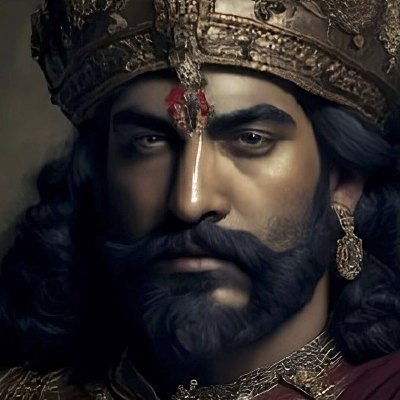
Nabhanedishtha is the son of Vaivasvata Manu whose story is told in the Aitareya Brahmana as an illustration of the rewards of truthfulness: left without a share of his father's property because he had devoted himself to religious study while his brothers divided the family estate, he was directed by them to claim, as his sole portion, the wealth left behind by a company of sages called the Angirasas after they had completed a great sacrifice and departed. When the god Rudra appeared and claimed that same wealth as his own, Nabhanedishtha, rather than contest the claim, surrendered it to him without argument, and Rudra, satisfied by his truthful conduct, granted the wealth back to him as a gift. The episode is recorded in the Aitareya Brahmana, the Taittiriya Samhita, the Kaushitaki Brahmana, and the Panchavimsha Brahmana, and his place among the sons of Manu is preserved in the later Harivamsha and Puranic genealogical lists, generally under the name Nabhagarishtha.
✦ The Name
The name is a compound built from two elements found separately elsewhere in this same family's tradition: Nabhaga, understood by commentators to mean without a share or without a portion, a name fittingly connected to the very legend of dispossession told of him, and nedishtha, a superlative form meaning nearest or closest. The compound Nabhanedishtha thus carries a sense along the lines of nearest to having no share, apt for a figure whose defining episode is his exclusion from, and subsequent recovery of, an inheritance. The variant Nabhagarishtha, used in the Harivamsha and reflected in later Puranic king-lists, instead combines Nabhaga with arishtha or rishtha, a name that also appears independently elsewhere in the tradition as a name in its own right; the exact relationship between the Vedic compound Nabhanedishtha and the Puranic compound Nabhagarishtha is treated inconsistently across sources, as discussed below.
✦ Lineage
- Father: Vaivasvata Manu — also called Shraddhadeva or Satyavrata, the progenitor of humankind in the current cosmic age, son of the sun-god Vivasvat.
- Mother: Shraddha — wife of Vaivasvata Manu.
- Brothers: Ikshvaku, founder of the Solar dynasty; Nabhaga; Dhrishta; Sharyati; Narishyanta; Pramshu; Karusha; and Prishadhra, with the exact number and division of names varying between texts, as detailed below.
✦ Dispossession by His Brothers
The Aitareya Brahmana narrates that while Nabhanedishtha was engaged in his period of religious studentship, living in the household of his teacher, his brothers divided their father's property among themselves without setting aside any portion for him. On his return, he asked his brothers for his rightful share. Rather than granting him land, cattle, or wealth from the estate already divided, his brothers directed him instead toward the encampment of a company of sages known as the Angirasas, who were at that time engaged in performing a great sacrificial session, a sattra, and told him that whatever wealth those sages might leave behind at its conclusion would be his to claim as his portion.
✦ The Wealth of the Angirasas and the Claim of Rudra
Nabhanedishtha went to the Angirasas as his brothers had directed. The sages, having completed their long sacrificial session, departed, leaving behind a store of wealth that was, by the custom surrounding such rites, considered forfeit or otherwise unclaimed, since it was thought inauspicious for a living person to take up wealth left in the wake of a sacrifice of this kind. Despite this reputation, Nabhanedishtha, following his brothers' word, took up the wealth as his own. The god Rudra then appeared and claimed that same wealth for himself, asserting that whatever is left over or forfeited from such rites belongs by right to him. Nabhanedishtha, without protest or attempt to retain what he had claimed, surrendered the wealth to Rudra immediately upon the god's assertion of ownership. Rudra, pleased by this unhesitating honesty, thereupon presented the wealth back to Nabhanedishtha as a gift and departed, leaving him in secure possession of it.
✦ Textual Variants and Inconsistencies
The relationship between this Vedic figure, Nabhanedishtha, and the Puranic figure most often equated with him, Nabhagarishtha, is not handled consistently across the tradition. Some Puranic king-lists of Manu's sons preserve the compound name intact, in the form Nabhagarishtha, treating him as a single son occupying one position in the list, generally the seventh. Other Puranic sources, including the Vishnu Purana's own list of Manu's ten sons, instead separate the compound into two distinct brothers, Nabhaga and Nedishtha, each given his own independent line of descendants; in the Vishnu Purana's continuation of these lines, Nedishtha is said to have had a son also named Nabhaga, who became a Vaishya and founded his own lineage through Bhalandana and Vatsapri, a lineage entirely distinct from the Vedic Nabhanedishtha of the Aitareya Brahmana. Because of this split, some Puranic genealogies effectively contain three figures bearing some form of the name Nabhaga: the direct son of Manu called simply Nabhaga in the ten-son lists, the direct son of Manu called Nedishtha whose own son is also named Nabhaga, and the Vedic Nabhanedishtha of the truth-and-wealth legend, whom the Harivamsha's Nabhagarishtha is generally taken to represent. The primary sources consulted do not offer a single reconciled account of how many distinct figures these names properly represent, and this profile follows the reading, supported by the Harivamsha and by modern Vedic scholarship, that Nabhanedishtha and Nabhagarishtha denote the same son of Manu, distinct from the separately listed Nabhaga and Nedishtha of the Puranic ten-son enumeration.
✦ Theological and Ritual Significance
The legend of Nabhanedishtha is preserved within the Aitareya Brahmana as part of its explanatory material on Vedic sacrificial practice, and functions there as an origin narrative illustrating the principle that wealth left over from or forfeited within the context of sacrifice belongs by right to Rudra, and that only through truthful and unresisting conduct toward such a claim can a person come to hold that wealth securely and without misfortune. The story is thus invoked in the Vedic tradition less as an isolated tale of one prince's misfortune and eventual reward than as a precedent explaining ritual practice surrounding sacrificial leftovers and the propitiation of Rudra in connection with them.
✦ Connection to the Wider Genealogy
Nabhanedishtha is a direct son of Vaivasvata Manu, making him a brother of Ikshvaku, founder of the Solar dynasty of Kosala from which Rama and his line descend, and of Sharyati, whose own descendants include Anarta and, through further generations, a marriage connection to the Yadava house of Balarama and Krishna. As a son of Manu, he belongs to the founding generation from which all subsequent royal lineages of the Solar and Lunar dynasties trace their descent, though unlike several of his brothers he is not himself credited in the primary sources with founding an enduring royal line of his own.
✦ References
- Aitareya Brahmana, 5.2.4 (also cited as 6.5.31): the principal primary source, narrating Nabhanedishtha's exclusion from his father's estate by his brothers, his claim upon the wealth left behind by the Angirasas, and Rudra's claim upon and subsequent gift of that wealth to him.
- Taittiriya Samhita, III.1.9.4–6: preserves a version of the same legend within the Yajurveda tradition.
- Kaushitaki Brahmana, XXVIII.4 and XXX.4; Panchavimsha Brahmana, XX.9.4: further Vedic attestations of the Nabhanedishtha legend, confirming its currency across multiple Brahmana traditions.
- Harivamsha, Adi Parva, Chapter 10: lists Nabhagarishtha as the seventh son of Vaivasvata Manu, the form under which this figure is generally carried into the Puranic genealogical tradition.
- Vishnu Purana, Book IV, Chapter I (trans. H. H. Wilson): gives an alternative ten-son list in which Nabhaga and Nedishtha appear as two separate sons of Manu, with Nedishtha's own son also named Nabhaga, contributing to the textual variation discussed above.
- A Concise Encyclopaedia of Hinduism / secondary Vedic reference works: consulted for cross-referencing the Aitareya Brahmana's account against the later Puranic name-forms Nabhagarishtha and Nabhaga-Nedishtha.