
About
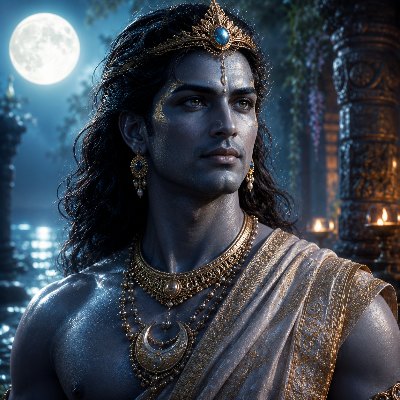
Varchas — Son of the Vasu Soma, Personification of Radiance
Varchas · Varchasa
Varchas is recorded in the Mahabharata as the son of Soma, one of the eight Vasus, the class of deities descended from Prajapati whose members personify various cosmic and elemental forces. He appears in the genealogical account of the Vasus given in the Adi Parva, where he is described as resplendent, in keeping with the meaning of his name, and is named as the husband of Manohara and father of three sons, Sishira, Prana, and Ramana. Beyond this brief genealogical notice, no independent narrative episode concerning Varchas is preserved in the primary sources consulted, and the Harivamsha's parallel account of the same family gives a differing record of his marriage and offspring, discussed below.
✦ The Name
Varchas is a Sanskrit noun meaning lustre, splendour, or vital radiance, used in the Vedic and later tradition to denote a luminous or vitalising energy associated with health, spiritual power, and physical brilliance. The same term forms the second element of the compound Brahmavarchas, the radiance or lustre of sacred and priestly knowledge, a quality frequently invoked in Vedic prayer as a boon to be sought for oneself or one's offspring. As the name of a son of Soma, the Vasu associated with the moon and with the sacred draught of the same name, Varchas is fittingly descriptive, since Soma's own essential quality in the Vedic tradition is a luminous, invigorating radiance of exactly this kind, passed here to his son as a personal name.
✦ Lineage
- Father: Soma — one of the eight Vasus, deities descended from Prajapati, associated with the moon and with the sacred Soma draught of Vedic ritual.
- Wife: Manohara — according to the Mahabharata's account, the mother of Varchas's three sons; the Harivamsha, however, does not name a wife for Varchas, attributing Manohara's marriage instead to a different figure, as discussed below.
- Sons: according to the Mahabharata, Sishira, Prana, and Ramana; according to the Harivamsha, a single son named Varchasvi.
✦ Textual Variants and Inconsistencies
The Mahabharata's Adi Parva states that Soma's son Varchas begot upon his wife Manohara three sons, Sishira, Prana, and Ramana. The Harivamsha's own account of the same family of Vasus, by contrast, states that Soma's son Varchas begot a son named Varchasvi, without naming any wife for him, and separately records that Manohara was instead married to Dravina, son of the Vasu Dhara, a different one of the eight Vasus, and that it was Dravina, not Varchas, who fathered Sishira, Prana, and Ramana upon her. The two texts thus disagree both on the name of Varchas's offspring and on the identity of his wife, with the Mahabharata attributing to him a wife, Manohara, and three named sons, and the Harivamsha instead giving him a single son, Varchasvi, of unnamed mother, while placing Manohara and her three sons in a different branch of the Vasu family entirely. This profile presents both accounts, as the primary sources themselves offer no means of reconciling them.
✦ Connection to the Wider Genealogy
Varchas belongs to the second generation of the divine family of the eight Vasus, standing as the son of Soma alongside such cousins as Kala, son of the Vasu Dhruva, and Vishvakarman, the celebrated architect and craftsman of the gods, born to the eighth Vasu, Prabhasa, through his wife, the sister of Brihaspati. The eight Vasus themselves, Dhara, Dhruva, Soma, Aha, Anila, Anala, Pratyusha, and Prabhasa, are described in the Mahabharata as sons of Prajapati, situating Varchas within the wider cosmology of deities descended from that patriarch alongside the other classes of gods, sages, and ancestral figures traced to the same source.
✦ References
- Mahabharata, Adi Parva, Sambhava Parva, Section 66: the principal primary source, naming Varchas as the son of Soma and recording his marriage to Manohara and the birth of their three sons, Sishira, Prana, and Ramana.
- Harivamsha, "An Account of Various Families," Chapter 3 (trans. M. N. Dutt): gives a differing account of the same family, recording Varchas's son as Varchasvi without naming a wife, and attributing Manohara's marriage instead to Dravina, son of the Vasu Dhara.
- Monier-Williams Sanskrit-English Dictionary: consulted for the etymology and range of meaning of the term varchas as lustre, vital energy, and radiance, and its use in the compound Brahmavarchas.