
About
Gaya — Son of Sudyumna, King of the Region of Gaya
Gaya
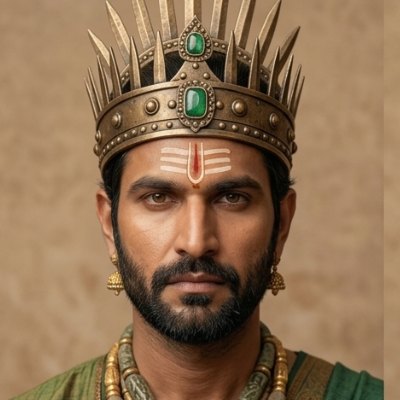
Gaya is one of the three sons born to Sudyumna, son of Vaivasvata Manu, in his periods of male existence, alongside his brothers Utkala and Vinata. He is recorded in the Vishnu Purana, the Bhagavata Purana, and other Puranic sources as having been assigned rule over the region and city of Gaya, in present-day Bihar, a city of exceptional sanctity in the Hindu tradition as a site for the performance of ancestral rites. Beyond this territorial assignment, no independent narrative episode concerning this Gaya is preserved in the primary sources consulted, and the sanctity of the city that bears his name is attributed by the wider tradition principally to an entirely different figure, the demon Gayasura, as discussed below.
✦ The Name
The Puranic genealogical lists present the name Gaya as directly eponymous with the city and region he was given to rule, stating that the city of Gaya was named after him. This eponymous account exists in the tradition alongside, and in tension with, a far more widely known and more fully developed account of the city's name and sanctity, centred not on this king but on the demon Gayasura, whose body is said to have become the very ground of the sacred city; this competing tradition is addressed in full below.
✦ Lineage
- Father: Sudyumna — son of Vaivasvata Manu, who in his periods of male existence ruled as king of Pratishthana and fathered three sons; the same being, in periods of female existence as Ila, was the wife of Budha and mother of Pururavas, first king of the Chandravamsha.
- Brothers: Utkala, who was given rule over the eastern territory that bears his name, and Vinata, also called Vinatashva, who was given rule over a western territory.
- Half-brother (through Sudyumna's female phase as Ila, by her husband Budha): Pururavas — the first king of the Lunar dynasty, who inherited the city of Pratishthana from Sudyumna and became the ancestor of the Mahabharata's royal lines.
✦ The Division of Sudyumna's Kingdom
The Vishnu Purana, the Linga Purana, and other Puranic sources record that when the domain of Vaivasvata Manu was divided among his descendants, Gaya received the eastern region and city that bears his name, generally listed alongside the parallel grants of Utkala's eastern territory and Vinata's western territory. The Linga Purana adds that the gods and the ancestral spirits, the Pitris, are said to reside always at Gaya, marking the region as one of especial sanctity even within this brief genealogical notice. The Bhagavata Purana, by contrast, describes Gaya and his two brothers collectively as rulers of the Dakshinapatha, the southern country, rather than assigning each a distinct individual direction, a variation discussed further below.
✦ Textual Variants and a Necessary Disambiguation
As with his brothers, the sources disagree on the overall geographic scheme by which the three sons' territories are described: most Puranas assign each brother a distinct direction, with Gaya receiving the eastern region, while the Bhagavata Purana instead groups all three together as rulers of the Dakshinapatha, the southern country.
Far more significant is the existence of an entirely separate and much more extensively narrated tradition explaining the sanctity and name of the city of Gaya, centred on the demon Gayasura rather than on this son of Sudyumna. According to the Vayu Purana and the Garuda Purana, Gayasura was a demon of immense size and power who undertook severe penance and was granted, or in some versions seized, such purity or sanctity that his very body was sought by the gods for the performance of a great sacrifice; in the course of this sacrifice, or in a separate account in which he offended the god Shiva through a sacrilegious act, Gayasura was struck down and his body became fixed in the earth at the site of the city, with Vishnu thereafter said to abide upon his remains, granting salvation to pilgrims who visit. This Gayasura narrative is by far the more prominent and more fully developed tradition explaining the origin, name, and sanctity of the city of Gaya within the wider Puranic corpus, appearing with considerable elaboration in the Vayu Purana, the Garuda Purana, and other sources, and it should not be conflated with the brief genealogical notice of Gaya, son of Sudyumna, whose own connection to the city consists only in the terse statement that the region was named for him. The primary sources consulted do not attempt to reconcile these two entirely distinct explanations of the same place-name, and this profile treats them as separate traditions accordingly, describing here only the genealogical figure who is the son of Sudyumna.
Further figures bearing the name Gaya also appear elsewhere in the tradition and should not be confused with this son of Sudyumna: a Rajarshi, described as the son of Amurtarayas and celebrated for performing many sacrifices, is referenced in the Mahabharata and other sources, and a composer of certain Rigvedic hymns also bears this name. These figures are unrelated to the son of Sudyumna and are noted here solely to distinguish them.
✦ Connection to the Wider Genealogy
Gaya is a grandson of Vaivasvata Manu, the progenitor of the current human race, through his father Sudyumna, and stands as a nephew, through Sudyumna's brother Ikshvaku, to the founding line of the Solar dynasty from which Rama of Ayodhya descends. Through his half-brother Pururavas, born to Sudyumna in his female phase as Ila, Gaya is connected to the entire Lunar dynasty of the Mahabharata's world, though his own line, ruling the eastern region of Gaya, remained a separate regional kingdom rather than part of the main dynastic succession carried forward through Pururavas at Pratishthana.
✦ References
- Vishnu Purana, Book IV, Chapter I (trans. H. H. Wilson): the primary source recording Gaya as one of Sudyumna's three sons and identifying Gaya as named for the eastern city and region he was given to rule.
- Bhagavata Purana, Canto IX, Chapter 1: presents Gaya and his brothers as rulers of the Dakshinapatha collectively, differing from the Vishnu Purana's individual directional assignments.
- Linga Purana (Rudra-sahasranama section): records the territorial assignment of Gaya alongside his brothers and notes the special residence of the gods and ancestral spirits at Gaya.
- Vayu Purana and Garuda Purana: the principal primary sources for the entirely separate demon Gayasura, whose body is said to have become the sacred ground of the city of Gaya, cited here to establish the necessary disambiguation from the son of Sudyumna of the same name.
- Mahabharata, Vana Parva and Shanti Parva: references the performance of sacrifices at Gaya by the unrelated Rajarshi Gaya, son of Amurtarayas, cited solely for further disambiguation.
- Wisdomlib, entries on "Gaya" and "Gayasura": consulted for cross-referencing the several distinct figures bearing this name across the Puranic and epic corpus.