
About
Keshi — Demon Who Abducted Urvashi, Defeated by Pururavas in Kalidasa's Vikramorvashiyam
Keshi · Kesha · Kesin
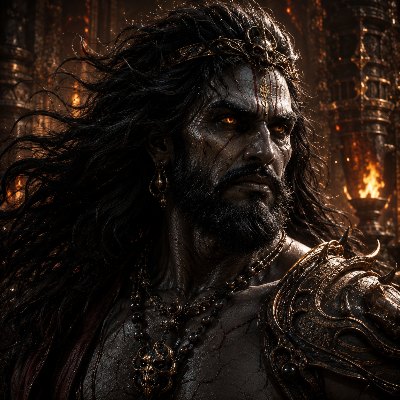
Keshi is the demon who, in the opening episode of Kalidasa's Sanskrit drama Vikramorvashiyam, abducts the celestial nymph Urvashi and her companion Chitralekha as they travel through the sky, and who is overcome in battle by King Pururavas, the earthly king of the Lunar dynasty, resulting in Urvashi's rescue and the first meeting of the two lovers whose story the play unfolds. This figure and episode belong specifically to Kalidasa's dramatic elaboration of the Pururavas-Urvashi legend, composed in Sanskrit in approximately the fourth or fifth century of the common era, and are not found in the earlier Vedic and Puranic sources that record the same love story, namely the dialogue hymn of the Rigveda, the Shatapatha Brahmana, the Mahabharata, the Vishnu Purana, and the Bhagavata Purana, none of which include an abduction or a demon of this name in their telling.
✦ The Name
Keshi, also transliterated Kesin or rendered informally as Kesha, is a Sanskrit name derived from kesha, meaning hair or mane, and denotes one possessed of hair, or the long-haired one, a name applied in the tradition to more than one figure of demonic or monstrous character whose defining trait is an unusually long or wild mane. This shared name is the source of a significant point of potential confusion within the wider Hindu narrative tradition, addressed directly below.
✦ The Abduction of Urvashi and Defeat by Pururavas
In the first act of Vikramorvashiyam, the nymph Urvashi and her companion Chitralekha are traveling through the sky when they are seized by the demon Keshi. Their cries, along with those of the other apsaras accompanying them, are heard by King Pururavas, who is passing nearby in his chariot. Pururavas confronts and overcomes Keshi in battle, securing Urvashi's release. The play itself, in the surviving translations consulted, opens with Pururavas already returning in his chariot with the rescued Urvashi, the confrontation with Keshi having taken place before the action shown on stage begins; as a result, the drama does not depict the encounter directly but establishes it through the characters' own account of what has just occurred. Whether Keshi is killed outright in this encounter or merely defeated and driven off is not stated with full clarity across the translations and summaries of the play consulted, though many modern retellings describe the outcome as Keshi's death; the play's own text, as reflected in available translations, confirms Pururavas's victory and Urvashi's rescue without dwelling on the demon's precise fate. It is this rescue, and the brief physical contact it occasions between the mortal king and the celestial nymph, that first draws Pururavas and Urvashi together and sets the play's central love story in motion.
✦ Textual Variants and a Critical Disambiguation
The name Keshi, or Kesin, belongs to an entirely separate and far more prominent figure elsewhere in the Puranic and epic tradition: the horse-demon sent by the tyrant Kamsa to kill the child Krishna at Gokula, as narrated in the Vishnu Purana, the Harivamsha, and the Bhagavata Purana. That Keshi takes the form of an enormous horse who terrorises the region with his speed and his neighing, and is slain by Krishna, who thrusts his arm into the demon's mouth until Keshi chokes and dies, an episode from which Krishna derives the epithet Keshava, slayer of Keshi. This horse-demon Keshi is a figure of major theological importance within Vaishnava tradition and is entirely distinct from the demon of Kalidasa's Vikramorvashiyam who abducts Urvashi; the two share only a name, and the primary sources give no indication that they were ever considered to be the same figure. This profile concerns solely the demon of the Pururavas-Urvashi drama, and readers of the wider genealogical database should take care not to conflate the two when cross-referencing entries under the name Keshi.
It should also be noted that the abduction-and-rescue episode itself is understood by scholars of the play to be Kalidasa's own dramatic invention, absent from earlier tellings of the Pururavas-Urvashi story such as those found in the Matsya Purana and in earlier narrative compilations upon which Kalidasa is understood to have drawn. The earlier Vedic and Puranic versions of the love story instead begin with Pururavas and Urvashi meeting and falling in love without any demon-abduction episode as its catalyst, making Keshi a figure specific to the dramatic literary tradition surrounding this legend rather than to its older Vedic or Puranic core.
✦ Connection to the Wider Genealogy
Keshi's sole significance within the wider genealogical tradition lies in his narrative function as the antagonist whose act of abduction brings King Pururavas, founder and first ruler of the Chandravamsha at Pratishthana and son of Budha and Ila, into contact with Urvashi, the celestial nymph of Indra's court who becomes Pururavas's beloved and the mother of his son Ayu, from whom the entire later royal line of the Lunar dynasty, including Nahusha, Yayati, and, through Yayati's descendants, the Pandavas and Kauravas of the Mahabharata, ultimately traces its descent. Keshi himself has no lineage, descendants, or independent narrative role recorded beyond this single episode.
✦ References
- Kalidasa, Vikramorvashiyam, Act I: the sole primary source for this figure, narrating the abduction of Urvashi and Chitralekha by the demon Keshi and their rescue by King Pururavas, which sets in motion the play's central romance.
- Sri Aurobindo (trans.), Vikramorvasie, or The Hero and the Nymph: an English translation of the play consulted for the opening scene's presentation of Pururavas's rescue of Urvashi following the encounter with Keshi.
- Vishnu Purana, Book V; Harivamsha, "The Destruction of Keshi"; Bhagavata Purana, Book X: primary sources for the entirely separate horse-demon Keshi slain by Krishna, cited here solely to establish the necessary disambiguation between the two distinct figures sharing this name.
- D. D. Kosambi, Myth and Reality: Studies in the Formation of Indian Culture (1962), "Urvashi and Pururavas": scholarly analysis of Kalidasa's play and its relationship to the earlier Rigvedic and Puranic versions of the Pururavas-Urvashi legend, establishing the abduction-by-Keshi episode as Kalidasa's own dramatic addition to the older tradition.