
About
Jaya — Gatekeeper of Vaikuntha, Cursed by the Four Kumaras to Three Mortal Births
Jaya · Dvarapala
Jaya is, together with his companion Vijaya, one of the two principal gatekeepers, or dvarapalas, who guard the entrance to Vaikuntha, the transcendent abode of the god Vishnu, in the Vaishnava Puranic tradition. His central narrative role is recorded in the third book of the Bhagavata Purana, where he and Vijaya turn away the Four Kumaras, the ageless mind-born sons of Brahma, mistaking their perpetually youthful appearance for that of ordinary children unfit to enter the sacred precinct. Offended by this refusal, the Kumaras curse both gatekeepers to descend to the mortal world, a curse that Vishnu himself confirms cannot be reversed but can be shaped in its terms, and Jaya and Vijaya subsequently take three successive births on earth as powerful adversaries of Vishnu before being slain by his own avatars and restored to their post. Jaya's parentage prior to his position at Vaikuntha's gate is recorded differently across the Puranic sources, as detailed below.
✦ The Name
Jaya is a Sanskrit word meaning victory or triumph, a name shared with his companion Vijaya, meaning great victory or complete victory, the two names together forming a fitting pair for the twin guardians of the threshold of Vishnu's own abode. The title dvarapala, by which both figures are generally known in their gatekeeping capacity, means guardian of the door or gate-protector, a term used broadly in the Hindu temple and iconographic tradition for guardian figures stationed at sacred entrances.
✦ Lineage
- Companion in office: Vijaya — the second of the two gatekeepers of Vaikuntha, who shares Jaya's role, his curse, and each of his three mortal births.
The Bhagavata Purana, which is the primary source for Jaya's role as gatekeeper and for the episode of his curse by the Four Kumaras, does not state any parentage for him at that point in the narrative, presenting him simply as an eternal personal attendant of Vishnu at Vaikuntha. Two later and differing traditions do supply a parentage, and these are given in full below, since they are not consistent with one another.
✦ The Encounter with the Four Kumaras and the Curse
According to the Bhagavata Purana, the Four Kumaras, Sanaka, Sanandana, Sanatana, and Sanatkumara, mind-born sons of Brahma who had chosen perpetual celibacy and asceticism over procreation, retained through their austerities the perpetual appearance of five-year-old children despite their great age. When the Kumaras arrived at the gate of Vaikuntha wishing to see Vishnu, Jaya and Vijaya, taking them for ordinary children, refused them entry, informing them that Vishnu was resting and could not be seen. The Kumaras, recognising in this refusal a fault requiring correction, cursed the two gatekeepers to be stripped of their divine standing and to be born as mortals on earth. When Vishnu himself emerged and interceded on behalf of his distressed attendants, he confirmed that the Kumaras' curse could not be undone but offered Jaya and Vijaya a choice in how it would be fulfilled: seven births on earth as devotees of Vishnu, or three births as his powerful enemies, each ended by death at Vishnu's own hands, after which they would return permanently to their post at Vaikuntha. Jaya and Vijaya chose the shorter path of three births as adversaries, preferring a swifter, if harsher, return to their lord's presence.
✦ The Three Mortal Births
In fulfilment of the curse, Jaya and Vijaya took birth three times as demons and enemies of Vishnu, each pair of births ended by one of Vishnu's avatars. In the first birth, in the Satya Yuga, Jaya became Hiranyakashipu, the tyrant king ultimately slain by Vishnu's man-lion avatar Narasimha, while Vijaya became his brother Hiranyaksha, slain earlier by Vishnu's boar avatar Varaha. In the second birth, in the Treta Yuga, Jaya became Ravana, the ten-headed king of Lanka slain by Vishnu's avatar Rama, while Vijaya became his brother Kumbhakarna, also slain by Rama. In the third birth, in the Dvapara Yuga, Jaya became Shishupala, the king of Chedi, and Vijaya became Dantavakra, both ultimately slain by Vishnu's avatar Krishna. With the completion of this third and final death, the curse was exhausted, and Jaya was restored to his eternal position as gatekeeper of Vaikuntha alongside Vijaya.
✦ Textual Variants and Inconsistencies
Two distinct and mutually inconsistent traditions supply a parentage for Jaya prior to his appointment as gatekeeper, neither of which is drawn from the Bhagavata Purana's own account of the curse episode itself.
The Brahmanda Purana states that Jaya, together with Vijaya, was the son of a figure named Kali, himself one of the sons of the god Varuna, the Vedic deity of the ocean and cosmic waters, by his wife Stuta. Kali's brother, and thus Jaya's uncle in this tradition, is named Vaidya. This Kali, father of Jaya and Vijaya, is a distinct figure from the Asura Kali who personifies the current Kali Yuga and from the goddess Kali, and should not be confused with either.
The Padma Purana instead states that Jaya and Vijaya were the sons of the sage Kardama, one of the Prajapatis, the patriarchal progenitors born from Brahma, and his wife Devahuti, the daughter of the first Manu, Svayambhuva. In this tradition, it was their profound devotion to Vishnu that earned Jaya and Vijaya their permanent appointment as his gatekeepers at Vaikuntha.
These two parentages, the Brahmanda Purana's descent from Varuna through Kali, and the Padma Purana's descent from Kardama and Devahuti, are not reconciled in the primary sources consulted, and each belongs to a different textual tradition's account of how Jaya came to his position at Vaikuntha's gate.
✦ Iconography
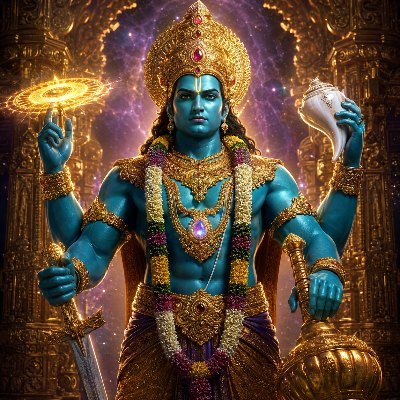
Jaya is depicted iconographically as a four-armed figure bearing the same principal attributes as Vishnu himself: a chakra, or discus, held in the upper left hand, a shankha, or conch, in the upper right hand, and a mace in the lower left hand, with a sword in the lower right hand replacing the lotus that Vishnu holds in his own fourth hand. Statues of Jaya, generally paired with Vijaya, flank the entrances to the sanctum sanctorum in many Vishnu temples across the subcontinent, continuing in temple architecture the gatekeeping role the pair perform in the Puranic narrative.
✦ Connection to the Wider Genealogy
Through his three mortal births, Jaya is genealogically identified in turn with Hiranyakashipu, son of the sage Kashyapa and the goddess Diti, and father of the great devotee Prahlada; with Ravana, son of the sage Vishrava and the rakshasi Kaikasi, king of Lanka and antagonist of the Ramayana; and with Shishupala, son of King Damaghosha of Chedi and Shrutashrava, sister of Vasudeva and thus first cousin of Krishna. These mortal genealogies belong to Jaya only for the duration of each cursed lifetime and are distinct from whichever divine parentage, that of the Brahmanda Purana or that of the Padma Purana, is understood to be his own prior to and beyond those births.
✦ References
- Bhagavata Purana, Canto III, Chapter 15–16: the principal primary source, narrating Jaya and Vijaya's refusal of entry to the Four Kumaras, the curse pronounced upon them, and Vishnu's mitigation of that curse into three mortal births as his enemies.
- Brahmanda Purana (trans. G. V. Tagare, Part 3): the source for the tradition identifying Jaya as the son of Kali, son of Varuna and Stuta, with Vaidya as his paternal uncle.
- Padma Purana: the source for the alternate tradition identifying Jaya as the son of the sage Kardama and Devahuti, daughter of Svayambhuva Manu.
- Vishnu Purana, Ramayana, and Mahabharata: the primary sources for Jaya's successive mortal identities as Hiranyakashipu, Ravana, and Shishupala, and for the parentage and fate of each of those births.