
About
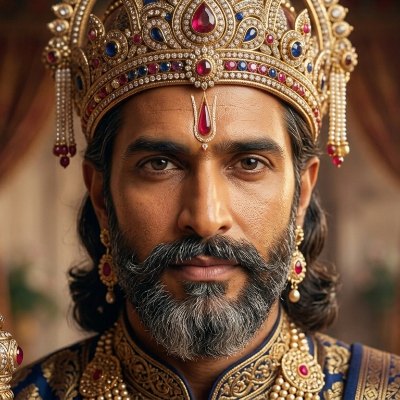
Nala — King of Nishadha, Husband of Damayanti, Hero of the Nalopakhyana
Nala · Naishadha · Bahuka
Nala is the king of the Nishadha kingdom whose story, known as the Nalopakhyana, is narrated by the sage Brihadashva to Yudhishthira during the Pandavas' forest exile in the Vana Parva of the Mahabharata, offered as consolation by showing that even a virtuous king could fall into ruin through no fault but a single ritual lapse and rise again through steadfastness. Renowned for his beauty, his mastery of horsemanship, and his skill in the science of cookery, Nala wins the hand of Damayanti, princess of Vidarbha, in a contest in which she chooses him even over four disguised gods, only to lose his kingdom to his brother Pushkara at dice under the malign possession of the being Kali, and to spend years in disguise as the charioteer Bahuka before reclaiming both his wife and his throne. The Nalopakhyana is regarded as one of the most celebrated and widely retold episodes of the entire epic.
✦ The Name
Naishadha, a patronymic-style adjective meaning of or belonging to Nishadha, is used throughout the Mahabharata as a formal title for Nala, identifying him by his kingdom in the manner common to epic address of kings. Bahuka is the name Nala adopts during his years of exile and disguise, after the bite of the serpent Karkotaka transforms his appearance into that of a short, dark, and misshapen man; the name itself is not explained in the primary text as having a particular etymological significance beyond serving as a plain alias. A separate and unrelated figure of the same name, Nala, appears in the Ramayana as one of the monkey architects, said to be a son of the divine craftsman Vishvakarma, who designs and builds the bridge to Lanka; this Nala of the Ramayana is entirely distinct from Nala of Nishadha and shares only the name.
✦ Lineage
- Father: Virasena — king of the Nishadha kingdom, whose realm Nala inherits.
- Brother: Pushkara — who, resentful of Nala, wins his brother's entire kingdom from him in a game of dice while Nala is under the possession of Kali, and who is himself later defeated by Nala in a rematch after Nala's return.
- Wife: Damayanti — princess of Vidarbha, daughter of King Bhima, celebrated as the most beautiful woman of her time, who chooses Nala at her own swayamvara even over the gods Indra, Agni, Varuna, and Yama.
- Children: Indrasena, a son, and Indrasena, a daughter, called by the feminine form Indrasenā to distinguish her from her brother; several retellings describe the two as born together.
✦ The Swan's Message and the Swayamvara
According to the Nalopakhyana, Nala and Damayanti fell in love before ever meeting, through the agency of a golden swan that carried word of each to the other. When Bhima held a swayamvara for his daughter, the gods Indra, Agni, Varuna, and Yama, having heard of Damayanti's beauty, resolved to attend as suitors themselves, and encountering Nala on his way to the assembly, prevailed upon him, against his own wishes, to serve as their messenger and to plead their respective causes with Damayanti. Damayanti, however, declared her resolve to choose Nala alone, and at the assembly the four gods took on Nala's own form and appearance in order to test her discernment, seating themselves among a row of identical Nalas. Damayanti identified the true Nala by observing that the gods among the row did not blink, cast no shadow, did not perspire, wore garlands that did not fade, and did not touch the ground with their feet, while Nala alone showed all these mortal signs, and she placed her wedding garland upon him accordingly. Pleased rather than offended by her choice, the four gods each bestowed two boons upon Nala: Indra granted him the ability to behold him bodily at sacrifices and the gait of a god, along with passage to a blessed region after death; Agni granted him fire at will and a bright abode; Yama granted him supreme skill in the art of cookery and pre-eminence in virtue; and Varuna granted him water at will and a garland of unfading celestial fragrance.
✦ The Possession by Kali and the Loss of the Kingdom
As the gods departed the swayamvara, they encountered the malevolent being Kali, along with Dvapara, arriving too late to compete for Damayanti's hand; learning that Nala had already been chosen over the gods themselves, Kali was enraged and vowed to destroy the couple's happiness by possessing Nala and driving him to ruin. Kali waited twelve years for an opportunity, entering Nala's body at last through a minor lapse in ritual purity, said to concern Nala's failure to wash his feet properly before his evening prayers. Once inside him, Kali incited Nala to a game of dice against his brother Pushkara, in which Dvapara took the form of the dice themselves. Despite Damayanti's pleading and the entreaties of his subjects, the possessed Nala continued to play until he had lost his entire kingdom, his wealth, and his royal position, at which point he and Damayanti were compelled into exile in the forest, accompanied at first only by a single garment between them.
✦ The Separation, Karkotaka, and the Transformation into Bahuka
In the depths of the forest, still under Kali's influence and in mental anguish, Nala abandoned Damayanti while she slept, reasoning, in his distress, that she might fare better without him to share her hardship. Wandering alone, Nala came upon the serpent king Karkotaka trapped within a ring of forest fire and rescued him. In gratitude, Karkotaka bit Nala, not to harm him but to work a transformation: the venom disfigured Nala into a short, dark, and misshapen man, unrecognisable to all who had known him, a change Karkotaka explained would protect Nala from discovery while causing continuous torment to Kali, who remained lodged within him. Karkotaka further instructed Nala to seek service with King Rituparna of Ayodhya and gave him two magical garments, to be used when the time came for him to reclaim his true form. Under the name Bahuka, Nala entered Rituparna's court as charioteer and cook, and in time exchanged his own unmatched knowledge of horses for Rituparna's mastery of Aksha-hridaya, the science of dice, receiving this knowledge to such powerful effect that Kali, unable to withstand it, departed from his body at last, in some tellings of the episode retching out the poison of Karkotaka as he fled and receiving Nala's forgiveness before departing.
✦ Reunion and Restoration
Damayanti, meanwhile, had returned to her father's court and, suspecting that the mysterious and skilled charioteer serving at Ayodhya might be her lost husband, devised a test: she arranged word of a second swayamvara of her own, to be held with impossibly little notice, reasoning that only a charioteer of Nala's peerless skill could cover the distance from Ayodhya to Vidarbha within a single day. Bahuka, driving for Rituparna, made the journey in the required time, and Damayanti, further testing him by having a servant, Keshini, bring her a sample of food he had cooked, recognised in its taste the unmistakable culinary signature of her husband. Confronted, Bahuka confirmed his identity, and putting on the garments given him by Karkotaka, was restored at once to his true form and beauty. Nala then challenged Pushkara to a second game of dice, this time free of Kali's influence and armed with the science he had learned from Rituparna, and won back his entire kingdom, wealth, and position, after which he ruled Nishadha justly for the remainder of his reign.
✦ The Attributed Culinary Treatise Pakadarpana
Separately from the Mahabharata itself, a later Sanskrit treatise on cookery titled the Pakadarpana, meaning mirror of cooking, is traditionally attributed to Nala, comprising some seven hundred and fifty verses across eleven chapters on the qualities of an ideal cook, the preparation of the kitchen and cooking grounds, and recipes for a wide range of dishes framed as a dialogue between Nala, under the name Bahuka, and King Rituparna. This text is a distinct later composition, of uncertain but considerable antiquity, that draws on Nala's established reputation for culinary mastery within the epic rather than forming part of the Nalopakhyana narrative itself; it is the basis for the continued use of the term Nalapaka in India to denote food of exceptional quality.
✦ Theological and Narrative Significance
Within the frame narrative of the Mahabharata, the Nalopakhyana is offered to Yudhishthira specifically as a story of a king who, like Yudhishthira himself, loses his kingdom through gambling and is reduced to exile, intended to console him by demonstrating that such reversal of fortune is not unique to him and that steadfastness, patience, and eventual restoration are possible even after total loss. The tale is further distinguished within the tradition by its unusual explanation of misfortune as originating not in any moral failing of Nala's own character, since he is consistently described as virtuous, truthful, and beloved, but in the external possession of his body by Kali, exploiting a single minor ritual lapse, offering a model in which suffering is disentangled from personal culpability while still requiring personal endurance to overcome.
✦ Connection to the Wider Genealogy
Nala is connected through his marriage to Damayanti to the royal house of Vidarbha, ruled by her father, King Bhima, and stands as brother-in-law to whichever siblings of Damayanti are recorded within that line. His story is narrated within the Mahabharata by the sage Brihadashva specifically for the benefit of the Pandava king Yudhishthira, situating Nala's tale as a moral exemplar embedded within, though not genealogically connected to, the central dynastic narrative of the Kuru line that dominates the wider epic.
✦ References
- Mahabharata, Vana Parva, Nalopakhyana (Sections 52–79 in the critical numbering; trans. Kisari Mohan Ganguli): the sole primary source for Nala's story, narrating his lineage, his courtship of Damayanti, the boons of the four gods, his possession by Kali, the loss of his kingdom, his exile, transformation into Bahuka, and eventual reunion and restoration.
- Nalapakadarpana (Pakadarpana of Nala): a later Sanskrit culinary treatise traditionally attributed to Nala, cited here to establish the separate textual basis for his reputation in the culinary arts beyond the Mahabharata's own narrative.
- Ramayana: cited solely to establish the necessary disambiguation between Nala of Nishadha and the unrelated vanara architect Nala, son of Vishvakarma, who builds the bridge to Lanka.