
About
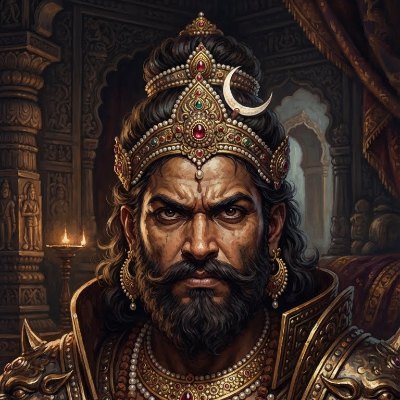
Jalandhara — Asura Emperor Born of Shiva's Wrath, Husband of Vrinda
Jalandhara · Jalandhar · Jalamdhara · Chalantarana · Shivansha · Samudraputra
Jalandhara is an Asura emperor whose origin, conquest of the three worlds, and destruction constitute one of the major war narratives in the Shaiva Puranic tradition. His story is narrated at length in the Shiva Purana (Rudra Samhita, Yuddha Khanda, chapters 13–25 and 41) and is also preserved in the Padma Purana (Uttara Khanda, chapters 3–18) and the Skanda Purana. He is unusual among the great Asuras in that he is not born of the conventional Daitya or Danava lineage but originates directly from the cosmic fire released by Shiva's third eye, making him in a theological sense a fragment of Shiva himself. He marries Vrinda, the daughter of the Asura Kalanemi, and it is her absolute conjugal fidelity that renders him invincible on the battlefield. His story is inseparable from the origin of the Tulsi plant and the Shalagrama stone, two of the most significant objects in Vaishnava devotional practice.
✦ The Names
The name Jalandhara is a Sanskrit compound formed from jala, meaning water, and dhara, meaning bearer, holder, or one who holds, yielding the sense "he who holds water" or "bearer of water." The Shiva Purana (Yuddha Khanda 14.24) specifies the occasion of this naming precisely: when the infant gripped Brahma's neck, tears were caused to flow from Brahma's eyes, and Brahma therefore named him for the water he had produced. A second name, Chalantarana, meaning "he who walks and swims," appears in the lexical tradition as an alternate designation. The epithets Shivansha, meaning "fragment of Shiva," and Samudraputra, meaning "son of the ocean," reflect the two dimensions of his origin — divine fire and the watery element into which it was cast.
✦ Lineage
- Origin: The fire released from Shiva's third eye, cast into the ocean — not born of a mother and father in the conventional sense. The Shiva Purana's Sanskrit text (Yuddha Khanda 14) uses the word kshiptam, meaning thrown away or discarded, emphasising that the energy was redirected rather than deliberately bestowed.
- Foster father (primary): Samudra, the ocean deity, who receives the infant and raises him as his own son.
- Foster father (secondary): Shukracharya — the preceptor of the Asuras, who performs Jalandhara's birth rites at Brahma's direction and later crowns him as king of the Asuras.
- Naming figure: Brahma — the creator god, who descends upon hearing the infant's cries, names him Jalandhara, and pronounces the boon that he will be invincible to all except Shiva.
- Wife: Vrinda — daughter of Kalanemi, an Asura of the Daitya line who is the son of Virochana and the grandson of Prahlada. Vrinda is described as exceptionally righteous and as a devoted worshipper of Vishnu. Her conjugal fidelity constitutes a spiritual armour around Jalandhara that no weapon can penetrate while she maintains it.
✦ Birth from Shiva's Third Eye
The Shiva Purana narrates that Indra and Brihaspati, the preceptor of the gods, journeyed to Kailasha. Shiva, wishing to test them, assumed the form of a naked ascetic with matted hair and obstructed their path. When Indra demanded to know who the ascetic was and received only silence, he raised his thunderbolt to strike. Shiva simultaneously immobilised Indra's arm and opened his third eye, releasing a fire capable of consuming the cosmos. Brihaspati recognised Shiva and prostrated himself in prayer, persuading Shiva to withhold his full wrath. Shiva, unable to withdraw the fire entirely, redirected it into the salt ocean. Upon striking the waters, the fire instantly became a radiant and crying infant at the confluence of the Ganga and the sea. The child's cries shook the heavens and compelled Brahma to descend. When Brahma attempted to hold the child, the infant gripped his neck with such force that tears welled in Brahma's eyes, and it was this act that gave the child his name.
Brahma pronounced at that moment the defining boon of the narrative: that the child would grow into an invincible ruler of the Asuras, capable of being slain only by Shiva himself. Brahma then directed Shukracharya to perform the child's birth rites, and Samudra took him as a foster son. Jalandhara was married in due course to Vrinda, the daughter of Kalanemi, in the Brahma rite, as recorded in Yuddha Khanda 14.35. Shukracharya subsequently crowned him as emperor of the Asuras.
✦ Conquest of the Three Worlds
Jalandhara's motivation for war against the Devas is rooted in the Samudra Manthana, the churning of the ocean. He learned from Shukracharya of how the gods and Asuras had churned the ocean — his foster father — for its treasures, and of how Rahu had been beheaded by Vishnu during the distribution of the nectar of immortality. Enraged by what he understood as an exploitation of the ocean and an injustice against the Asura lineage, Jalandhara launched a war against the heavens. He attacked the Devas, drove Indra from his celestial realm, and placed the three worlds under his control, ruling them according to the Shiva Purana as a formidable and in some respects orderly ruler.
The Devas, unable to defeat him, took refuge with Vishnu. A great battle was fought between Jalandhara and Vishnu. The Shiva Purana states that because Jalandhara was a portion of Shiva himself, Vishnu was unable to overcome him. Vishnu was moved by his valour and offered him a boon. Jalandhara asked that Vishnu take up residence in the ocean together with Lakshmi. Vishnu agreed, and this is offered in the Padma Purana as the mythological origin of Vishnu's abode in the cosmic ocean. The Padma Purana also records a tradition in which Lakshmi herself identified Jalandhara as her brother, on the grounds that both she and he had emerged from the ocean, and that Jalandhara accepted this kinship and refrained from attacking Vaikuntha on that account.
✦ The Demand for Parvati and the War with Shiva
The Shiva Purana narrates that Narada, acting as the agent who sets the catastrophic sequence in motion, came to Jalandhara and described the beauty of Parvati in terms that inflamed the Asura's desire. Jalandhara sent a messenger to Kailasha demanding that Shiva surrender Parvati to him, arguing that an ascetic had no rightful claim to the most beautiful woman in creation. Shiva refused with contempt, and war broke out between the armies of Shiva and the Asura host. Despite the ferocity of the battle and the power of Shiva's retinue, Jalandhara could not be defeated — Vrinda's pativrata, her complete fidelity, functioned as an impenetrable protection around him.
During the war, Jalandhara himself attempted to deceive Parvati by assuming Shiva's form and approaching her. Parvati recognised the impersonation immediately, was enraged, and withdrew. She then sought Vishnu and demanded that he deceive Vrinda in the same manner, as Jalandhara had tried to deceive her — a direct inversion of the deception that had just been attempted. The Shiva Purana (chapter 52, verses 50–51) records Parvati's reasoning that since the Asura had shown the path of deception, that same path must be employed against him; Jalandhara could not be killed in any other way. Vishnu agreed.
✦ The Deception of Vrinda and the Death of Jalandhara
The Shiva Purana describes Vishnu approaching Vrinda in disguise while she was engaged in devotions during the battle. In some versions of the episode within the textual tradition, Vishnu first caused Vrinda to experience a dream in which Jalandhara was slain, causing her concentration to break, and then appeared before her in the form of her husband. In the Skanda Purana version, Vishnu assumed Jalandhara's form directly. Vrinda, believing her husband had returned safely from battle, approached him, and in doing so her vow of conjugal fidelity was broken. The moment Vrinda's protection was withdrawn, Jalandhara's invincibility failed. Shiva, now able to act effectively on the battlefield, deployed a discus against Jalandhara and severed his head, ending the war. Various Puranic accounts differ on the precise nature of the weapon and the manner of the killing; the Shiva Purana identifies the weapon as a chakra. A tradition preserved in Tamil Shaiva sources and referenced in the Shaivam.org account describes a variant episode in which Shiva, disguised as an old man, tricked Jalandhara into attempting to lift a chakra from the ground, whereupon it decapitated him.
✦ The Aftermath: Vrinda's Curses and the Birth of Tulsi
When Vrinda discovered that the figure she had embraced was Vishnu in disguise and not her husband, she was seized with grief and fury. Before immolating herself on Jalandhara's funeral pyre, she pronounced curses upon Vishnu. The Shiva Purana (Yuddha Khanda 41.33–35) records her cursing Vishnu in terms equating his stone-heartedness with actual stone, declaring that he would become a lifeless black stone — the origin of the Shalagrama, a naturally formed stone found in the Gandaki River which is one of the most sacred objects in Vaishnava worship. In some versions of the curse, including those reflected in secondary Puranic traditions, Vrinda also cursed Vishnu that in a future incarnation his own wife would be separated from him by deception — a curse understood as a foreshadowing of Sita's abduction in the Ramayana. The Shiva Purana then records Shiva blessing the Tulsi plant as the most important among the substances offered in divine worship, ensuring that Vrinda's devotion was perpetuated in a sacred form.
✦ Textual Variants and Inconsistencies
The Shiva Purana and the Padma Purana both narrate the Jalandhara cycle but with differences in the mechanics of the deception episode and its immediate trigger. In the Shiva Purana, it is Parvati's anger at Jalandhara's attempted deception of herself that directly motivates the command to Vishnu to deceive Vrinda in retaliation. In the Padma Purana version, the structure is slightly different in emphasis, with the gods more collectively implicated in seeking the strategy. The Skanda Purana also contains the narrative and in some manuscript readings presents the sequence of events in a different order.
The nature of Vishnu's deception of Vrinda also varies across versions. The Shiva Purana includes a dream episode in which Vrinda first witnesses a vision of her husband's death before Vishnu approaches her; the Padma Purana and Skanda Purana versions emphasise the direct impersonation. The Tulasi in Hinduism article in the Wikipedia tradition, drawing on the Padma Purana, records that Vrinda sported with the disguised Vishnu for some days before recognising the deception, while the Shiva Purana implies a briefer encounter.
The destination of Jalandhara's soul after death is mentioned in some secondary accounts as having been absorbed back into Shiva, consistent with the theology of the Shiva Purana that identifies Jalandhara as a portion of Shiva from the outset.
✦ Theological Significance
The Jalandhara narrative operates on several theological registers simultaneously. At the most immediate level it is a war narrative that demonstrates Shiva's supremacy as the one deity capable of destroying what no other god can overcome. The theological complexity lies in the fact that Jalandhara is himself a portion of Shiva — cast off, discarded, but not alien — and his destruction is therefore a reabsorption rather than a simple conquest of an external enemy. This internal dimension is reinforced by the detail that Vishnu, despite his cosmic power, cannot overcome Jalandhara precisely because Jalandhara partakes of Shiva's essence.
The narrative also constitutes the foundational myth for two of the most important objects in Vaishnava devotional practice: the Tulsi plant, identified with Vrinda and prescribed as an obligatory accompaniment to Vishnu's worship, and the Shalagrama stone, which embodies Vrinda's curse in material form. The story thus anchors Vaishnava ritual obligation in a narrative of divine deception and its consequences, making the sacred objects themselves the residues of a morally complex transaction among the gods. The pativrata ideal — conjugal fidelity as a spiritual force capable of withstanding divine armies — is central to the narrative's ethical structure, and its violation is presented as the necessary and troubling price of cosmic order.
✦ References
Primary Sources
- Shiva Purana, Rudra Samhita, Yuddha Khanda, chapters 13–25: The principal narrative source for the entire Jalandhara cycle — his birth, naming, marriage to Vrinda, conquest of the three worlds, the war with Shiva, and his death; chapter 14 contains the birth and naming episode and the marriage to Vrinda.
- Shiva Purana, Rudra Samhita, Yuddha Khanda, chapter 41: The Tulasi chapter; records Vrinda's discovery of the deception, her curse of Vishnu at verses 33–35, the origin of the Shalagrama, and Shiva's blessing of the Tulsi plant as the foremost object of divine worship at verse 45.
- Shiva Purana, Rudra Samhita, Yuddha Khanda, chapter 52, verses 50–51: Records Parvati's command to Vishnu to violate Vrinda's chastity, with the explicit justification that Jalandhara had himself shown the path of deception by attempting to deceive her.
- Padma Purana, Uttara Khanda, chapters 3–18: The second major source for the Jalandhara narrative; preserves the Lakshmi-sibling tradition and a version of the deception episode with different emphases from the Shiva Purana account.
- Skanda Purana: A third primary source that contains the Vrinda-Tulsi narrative; cited alongside the Shiva Purana and Padma Purana in the Tulasi in Hinduism article as a source for the complete cycle.
Secondary and Reference Works
- Wisdomlib — "Jalandhara: 35 definitions": Compiles Sanskrit dictionary entries, Puranic glossary entries, and source references; confirms the Shiva Purana chapter and section references and notes the Padma Purana parallel.
- Wisdomlib — "The fight between the gods and Jalandhara" (Shiva Purana, chapter 15 translation): Source for the Shiva Purana's account of the war between Jalandhara and the Devas and the encounter with Vishnu.
- Greenmesg.org — "Slaying of Jalandhara" (Shiva Purana, Yuddha Khanda summary): Provides a detailed section-by-section account of the Yuddha Khanda narrative; source for specific episode details including Brahma's birth rites direction and the Kalanemi marriage.
- Wikipedia — "Jalandhara": Provides the Sanskrit of Shiva Purana chapter 52 verses 50–51 on Parvati's command and the detail of Jalandhara's attempted deception of Parvati as the trigger for the counter-deception.
- Wikipedia — "Tulasi in Hinduism": Source for the cross-Puranic account of Vrinda's story across the Shiva Purana, Padma Purana, and Skanda Purana; confirms Vrinda's parentage as daughter of Kalanemi.
- Wikipedia — "Kalanemi": Confirms Kalanemi's genealogy as son of Virochana and grandson of Prahlada, and names Vrinda as his daughter.
- Svastika.in — "Jalandhara: Not Shiva's Son, Born of His Third Eye": Provides close reading of the Shiva Purana Sanskrit at Yuddha Khanda chapter 14, confirming the word kshiptam (thrown/discarded) and the precise chapter references for the birth, naming, and marriage episodes.
- Shaivam.org — "Chalandharari (The Enemy of Jalandhara)": Source for the Tamil Shaiva tradition's variant account of Jalandhara's death by the chakra-on-the-ground episode; associated with the Thiruvirkudi temple tradition.