
About
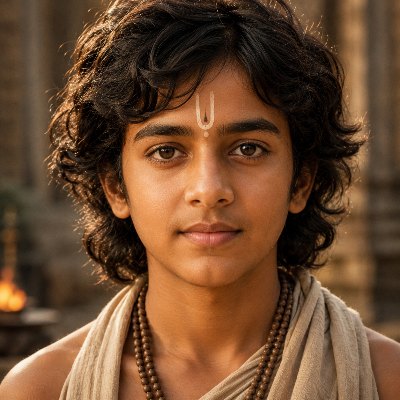
Nachiketa — Boy Sage Who Questioned Death
Nachiketa · Nachiketas
Nachiketa was a young boy of exceptional truthfulness and spiritual insight, whose father sent him to Yama, the god of death, in a moment of anger during a sacrificial rite. Rather than resisting his father's word, Nachiketa journeyed to Yama's abode and, after being kept waiting three days without hospitality, received boons from a remorseful Yama that led to a celebrated dialogue on the nature of the soul, death, and liberation. This dialogue forms the core of the Katha Upanishad, one of the principal Upanishads, and Nachiketa's name and story also appear in the Taittiriya Brahmana, the Mahabharata, and the Varaha Purana, the last of which develops the episode into a fuller narrative involving a physical tour of the realms of the dead.
✦ The Name
The name Nachiketa derives from the Sanskrit "na" (not) combined with "chiketa," a perfect-tense form of the verbal root "chit" (to perceive or know), and is generally understood to mean "the one who does not perceive" or "the unperceived one." Commentators have read this as a deliberate paradox: a boy named for a lack of perception becomes, through the story, the one who attains the deepest perception of all, the knowledge of the Self. Separately, the Taittiriya Brahmana records "Nachiketa" as the name given to one of five traditional sacrificial fire arrangements, alongside the Savitra, Chaturhotra, Vaishvasrja, and Aruna fires, reflecting the story's early integration into Vedic ritual tradition.
✦ Lineage
- Father: named in the Katha Upanishad as Vajashravasa, a sage who performed the Vishvajit sacrifice; some textual traditions instead identify Nachiketa's father with Uddalaka, son of Aruna.
✦ The Vishvajit Sacrifice and the Wrathful Gift
Nachiketa's father undertook the Vishvajit ("all-conquering") sacrifice, a rite requiring the donation of all of one's possessions in order to secure its spiritual reward. Nachiketa observed that the cows being given away were old, barren, and worn out, of no further use to their recipients, and understood that such insincere charity would bring his father spiritual demerit rather than merit. Wishing to correct his father, the boy repeatedly asked, "Father, to whom will you give me?" Provoked by the boy's persistence, his father answered in anger, "I give you unto Death (Yama)." Holding his father's word as binding truth, Nachiketa immediately set out for Yama's abode.
✦ The Three Nights at Yama's Gate
Arriving at Yama's house, Nachiketa found the god of death absent, and waited at the threshold for three days and nights without food, water, or welcome. On his return, Yama, informed that a Brahmin guest had gone unattended in his home for three nights, a grave breach of hospitality, offered Nachiketa three boons, one for each night of neglect, to atone for the lapse.
✦ The Three Boons
For his first boon, Nachiketa asked that his father's anger be appeased and that he be received again with love upon his return. For his second, he asked to be taught the sacred fire ritual that leads to heaven, which Yama duly explained, and which came to be known thereafter as the Nachiketa fire. For his third and final boon, Nachiketa asked Yama to resolve the great uncertainty of what becomes of a person after death. Yama initially attempted to dissuade him, offering instead vast wealth, kingdoms, long life, and every worldly pleasure, but Nachiketa refused all substitutes, observing that such things are fleeting and cannot satisfy the desire for the imperishable. Impressed by his resolve, Yama proceeded to teach him the knowledge of the Atman (Self) and its identity with Brahman, the highest reality, constituting the philosophical core of the Katha Upanishad.
✦ The Varaha Purana's Tour of Hell
The Varaha Purana expands the episode considerably, describing how Nachiketa, in addition to his dialogue with Yama, was given a tour of Yamapuri, the vast, fortified golden city of the god of death, and of the various hells (Narakas) in which sinners undergo punishment corresponding to their deeds. He observed the fates allotted to liars, killers of Brahmins, the ungrateful, those who abandon faithful spouses or aged parents, those who defame the Vedas or their teachers, and other classes of wrongdoers, as adjudicated according to the records kept by Chitragupta. Uniquely among mortals, Nachiketa was then permitted to return to his physical body on earth. On his return, his father received him with great joy, and word of the miracle spread swiftly: numerous sages and ascetics gathered at the hermitage to question Nachiketa directly about the workings of Yamapuri, the nature of judgment after death, and the mechanics of karma, which he related to them in detail.
✦ Textual Variants and Inconsistencies
Sources differ on the name and identity of Nachiketa's father: the Katha Upanishad itself refers to him as Vajashravasa, while some later retellings and translations identify this figure with Uddalaka, son of Aruna, treating the two names as belonging to the same person or as father and son in a short intervening generation; the sources consulted do not agree on which reading is correct. The Katha Upanishad and Taittiriya Brahmana confine the story to the dialogue with Yama concerning the Self and its liberation, with no mention of a physical tour of hell or a return to the mortal body; the Varaha Purana's account, by contrast, adds this tour and Nachiketa's subsequent return and testimony to the assembled sages as its central narrative content, reflecting the Puranic tradition's characteristic emphasis on cosmography and the mechanics of karma over the purely metaphysical concerns of the earlier Upanishadic text.
✦ Theological and Philosophical Significance
In the Katha Upanishad, Nachiketa stands as the exemplary spiritual seeker, distinguished by his refusal to accept worldly reward as a substitute for ultimate truth. His dialogue with Yama establishes foundational Upanishadic teachings on the distinction between the preferable (shreyas) and the pleasant (preyas), the immortality of the Atman, and its identity with Brahman, and it remains one of the most widely studied philosophical texts in the Vedantic tradition. In the Puranic elaboration, Nachiketa additionally functions as a witness and expositor of cosmic justice, lending direct, eyewitness authority to the Puranas' teachings on karma, sin, and the structure of the afterlife.
✦ References
- Katha Upanishad (Adhyaya 1–2): primary source for Nachiketa's dispatch to Yama, the three nights of waiting, the three boons, and the dialogue on the Self and Brahman.
- Taittiriya Brahmana (3.1.8): earliest textual reference to the Nachiketa episode outside the Upanishads, and source for the "Nachiketa fire" among the five traditional fire arrangements.
- Varaha Purana (chapters describing Nachiketa's journey, numbered variously across editions): primary source for the expanded narrative of Nachiketa's tour of Yamapuri and the hells, his return to his body, and his account to the assembled sages.
- Mahabharata (Sabha Parva and Anushasana Parva): secondary primary-text references listing Nachiketa among sages present at royal assemblies.
- Monier-Williams Sanskrit-English Dictionary, entry "Naciketas": secondary source for the standard etymology of the name from "na" and the verbal root "chit."
- Wikipedia, "Nachiketa" and "Katha Upanishad": secondary summaries noting the variant identification of Nachiketa's father and the Taittiriya Brahmana's listing of the Nachiketa fire.