
About
Madhu and Kaitabha — Twin Asuras Born of Vishnu's Ear-Wax
Madhu · Kaitabha · Madhu-Kaitabha (as a joint pair)
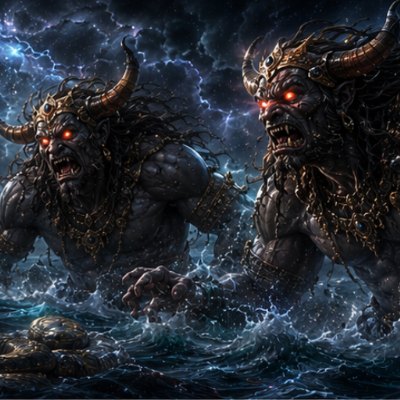
Madhu and Kaitabha were a pair of powerful asuras who arose at the very beginning of a cosmic cycle, born from the wax of Vishnu's ears while he lay in yogic slumber (Yoganidra) upon the primordial ocean during the period of universal dissolution. Rising in strength and arrogance, they threatened Brahma, who was seated on the lotus growing from Vishnu's navel, and in some accounts stole the Vedas from him. Their story is recounted with variations across the Mahabharata, the Vishnu Purana, the Devi Mahatmya of the Markandeya Purana, and the Devi Bhagavata Purana, and culminates in their destruction by Vishnu, an episode regarded as marking the start of creation proper after the deluge.
✦ The Names
In the Mahabharata's account, Madhu is said to have been born from a dewdrop as sweet as honey (madhu), giving him his name and associating him with the quality of tamas (inertia, darkness). Kaitabha was born from a second, hard dewdrop, and is associated with the quality of rajas (activity, passion). In the Devi Mahatmya and Devi Bhagavata Purana tradition, both names are instead explained simply as those given to the two demons born together from Vishnu's ear-wax, without the honey-dewdrop etymology.
✦ Origin and Birth
At the close of a kalpa, the universe lay submerged beneath a single ocean, upon which Vishnu rested asleep on the coils of the serpent Shesha (Ananta), with Brahma seated in meditation upon the lotus rising from Vishnu's navel. From the wax of Vishnu's ears, two asuras, Madhu and Kaitabha, sprang into being. Endowed with great strength and pride, they rose up and attempted to seize or slay Brahma. In the Devi Mahatmya's account, Brahma, terrified, invoked the goddess Yoganidra, who was at that time abiding within Vishnu as his sleep, asking her to withdraw from Vishnu so that he might awaken and confront the demons.
✦ The Battle and the Boon
Once roused, Vishnu engaged Madhu and Kaitabha in combat upon the cosmic ocean, and the fight is said to have continued for five thousand years without resolution. The goddess then deluded the two asuras with her power of illusion, so that in their arrogance they offered Vishnu a boon of his choosing. Vishnu asked only that he be permitted to slay them. Surveying the boundless waters on every side, the demons believed no place could be found without water, and so stipulated that they be killed only in a place devoid of it. Vishnu thereupon drew them onto his own thighs, which the water did not cover, and beheaded both with his discus, the Sudarshana Chakra.
✦ Theft of the Vedas
In the Devi Bhagavata Purana's fuller telling, Madhu and Kaitabha are described as first performing long tapas directed toward the goddess Mahadevi using the Vagbija mantra, receiving from her the boon that they could be slain only with their own consent, before turning to attack Brahma and seizing the Vedas from him, concealing them in the netherworld Patala. This theft compelled Brahma to appeal to Vishnu for aid, setting the subsequent battle in motion.
✦ Textual Variants and Inconsistencies
The Shanti Parva of the Mahabharata gives the earliest surviving account, in which Madhu and Kaitabha are born not from Vishnu's ear-wax but from two dewdrops of water formed on the lotus growing from his navel, one honey-sweet and one hard, explaining their names through this origin. The Devi Mahatmya of the Markandeya Purana and the later Devi Bhagavata Purana instead attribute their birth to the dirt or wax of Vishnu's ears, and additionally credit the goddess, rather than Vishnu alone, with a central role in the demons' defeat, either by withdrawing as his sleep to allow him to awaken or by directly deluding the asuras into offering the fatal boon. A further variant, found in some Vaishnava devotional literature, holds that it was specifically Vishnu's horse-headed incarnation Hayagriva, rather than Vishnu in his usual form, who slew Madhu and recovered the stolen Vedas.
✦ Theological and Philosophical Significance
The destruction of Madhu and Kaitabha is treated across these traditions as the event that clears the way for creation to proceed following the dissolution of the previous universe, with the demons themselves often read as personifications of tamas and rajas, the two lower qualities (gunas) that must be overcome before ordered creation, presided over by Brahma, can begin. In Vaishnava tradition the episode is one of the sources of Krishna's epithet Madhusudana ("slayer of Madhu"), linking Krishna's identity to this primordial act of Vishnu. In Shakta tradition, particularly through the Devi Mahatmya, the episode instead establishes the goddess as the power without whose intervention even Vishnu could not have acted, and it forms the first of the three great victories of the goddess narrated in that text.
✦ References
- Mahabharata, Shanti Parva (chapter 348): earliest primary account, giving the dewdrop origin of Madhu and Kaitabha and their tamas/rajas symbolism.
- Devi Mahatmya (Markandeya Purana, chapter 1): primary account of the ear-wax origin, the goddess's role as Yoganidra, and the boon that leads to the demons' death on Vishnu's thighs.
- Devi Bhagavata Purana (Book 1, chapters 6–10): primary account elaborating the demons' tapas toward the goddess, the theft of the Vedas, and their concealment in Patala.
- Wikipedia, "Madhu-Kaitabha": secondary summary comparing the Mahabharata and Devi Bhagavata Purana versions of the birth narrative.
- Wisdomlib, "Madhu and Kaitabha": secondary compilation of textual references to the pair across Puranic and epic literature.
- Back to Godhead, "The Madhusudana Mystery": secondary Vaishnava discussion of the Hayagriva variant tradition and its connection to Krishna's epithet Madhusudana.