
About
Dhundhu — Asura Slain by King Kuvalashva
Dhundhu · Dhundu
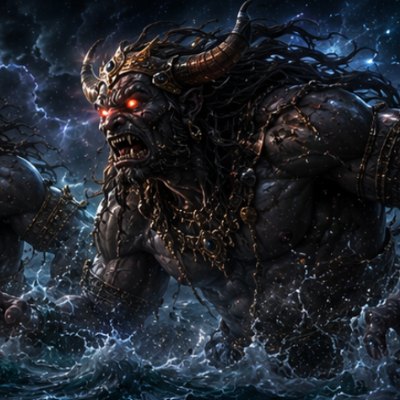
Dhundhu was a powerful asura who, having obtained near-invincibility through a boon from Brahma, concealed himself beneath the sands of the desert of Ujjalaka in the region of Marudhanva, from where his fiery breath brought earthquakes and darkness upon the surrounding land. He is chiefly known through the Mahabharata, which identifies him as the son of the primordial demons Madhu and Kaitabha, and through his eventual destruction at the hands of King Kuvalashva of the Ikshvaku dynasty, who earned the epithet Dhundhumara ("slayer of Dhundhu") for the deed. The episode also appears, with variation, in the Vishnu Purana, the Bhagavata Purana, and the Harivamsha.
✦ The Name
The name Dhundhu is associated with the deep, rumbling sound of his breathing beneath the sand, which the Mahabharata describes as producing tremors felt for miles around. His slayer, King Kuvalashva, took the epithet Dhundhumara directly from this name, meaning "the one who crushed or destroyed Dhundhu."
✦ Lineage
- Father: Madhu, one of the twin primordial asuras born from the wax of Vishnu's ears, slain by Vishnu at the dawn of creation.
- Father: Kaitabha, the second of the twin primordial asuras, likewise slain by Vishnu at the dawn of creation.
✦ The Boon from Brahma
Angered by the death of his parents at Vishnu's hands, Dhundhu performed fierce ascetic austerities aimed at Brahma with the intention of eventually overthrowing Vishnu and destroying the three worlds. Pleased by this penance, Brahma granted him a boon that he could not be slain by gods, danavas, gandharvas, rakshasas, yakshas, or serpents (uragas). No protection was granted against mortal men, a condition that would ultimately prove his undoing. Having received the boon, Dhundhu withdrew beneath the sands of the desert of Ujjalaka, in the barren region known as Marudhanva.
✦ The Torment of Uttanka's Hermitage
The sage Uttanka had established his hermitage near the sands beneath which Dhundhu lay hidden. Each time the asura exhaled in his subterranean sleep, the ground shook, dust rose into the sky and obscured the sun for days at a time, and flames and sparks burst forth from the earth, making the hermitage uninhabitable. Uttanka undertook deep penance and thereby caused Vishnu to appear before him. Vishnu told the sage that a king named Kuvalashva, born in the line of Ikshvaku, would be the one to kill Dhundhu, and then vanished.
✦ The Slaying of Dhundhu
Uttanka carried Vishnu's word to King Kuvalashva, son of Brihadashva of the solar (Suryavamsha) dynasty descending from Ikshvaku. Kuvalashva set out for Ujjalaka accompanied by his twenty-one thousand sons and, at Uttanka's request, was infused with Vishnu's own divine energy before the encounter. Kuvalashva's sons dug into the sands for seven days before uncovering Dhundhu's hiding place. In the battle that followed, the fire issuing from Dhundhu's breath consumed almost all of Kuvalashva's sons, sparing only three — Dridhashva, Kapilashva, and Bhadrashva — before Kuvalashva himself succeeded in slaying the asura. For this feat Kuvalashva became renowned by the name Dhundhumara.
✦ Textual Variants and Inconsistencies
The Mahabharata's Vana Parva is the primary source that explicitly identifies Dhundhu as the son of Madhu and Kaitabha, framing his hostility toward Vishnu as an act of filial vengeance. The Vishnu Purana and the Bhagavata Purana's ninth canto recount the same slaying of Dhundhu by Kuvalashva and the near-total destruction of his sons, situating the episode within the Ikshvaku genealogy, but do not repeat the claim of his descent from Madhu and Kaitabha, treating him simply as a formidable Daitya or Asura of the desert without specifying his parentage.
✦ Connection to the Wider Genealogy
Through his parentage as recorded in the Mahabharata, Dhundhu is directly linked to Madhu and Kaitabha, the twin asuras born from Vishnu's ear-wax at the beginning of creation and destroyed by Vishnu upon his thighs. Through the family of his slayer, Dhundhu's death is woven into the Ikshvaku solar dynasty: Kuvalashva was the son of Brihadashva, and Kuvalashva's surviving sons Dridhashva, Kapilashva, and Bhadrashva continued the line that several generations later produced the celebrated universal monarch Mandhata.
✦ References
- Mahabharata, Vana Parva (Markandeya-Samasya Parva, chapters 201–203): primary account of Dhundhu's parentage from Madhu and Kaitabha, the boon from Brahma, the torment of Uttanka, and the slaying by Kuvalashva.
- Vishnu Purana (Book IV, chapter 2): parallel primary account of Kuvalashva's slaying of Dhundhu and the deaths of his sons, situated within the Ikshvaku genealogy.
- Bhagavata Purana (Canto 9, chapter 6): parallel primary account of the episode and the genealogy of Kuvalashva's surviving sons.
- Harivamsha (chapter 11): supporting primary account of Uttanka's description of Dhundhu's disturbances.
- Wisdomlib, Puranic Encyclopaedia entry "Dhundhu": secondary summary consolidating the Mahabharata narrative.
- Wisdomlib, "Kuvalayashva" entry: secondary genealogical reference confirming Kuvalashva's parentage and the names of his three surviving sons.