
About
Yoganidra — Goddess of Vishnu's Cosmic Slumber, Awakener of the Preserver Against Madhu and Kaitabha
Yoganidra · Yoga Nidra · Nidra Devi · Mahakali (in the Devi Mahatmya's identification)
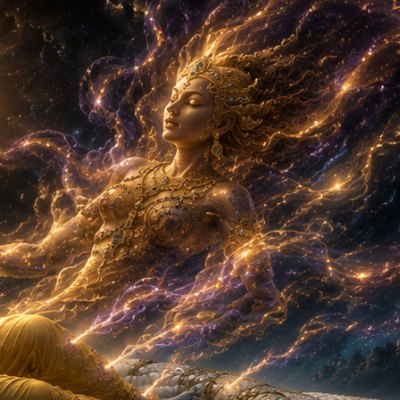
Yoganidra is the goddess who personifies the mystic slumber, or yogic sleep, in which the god Vishnu rests upon the great serpent Shesha in the primeval cosmic ocean during the period between the dissolution of one universe and the emergence of the next. Her central narrative appears in the Devi Mahatmya, the celebrated seven-hundred-verse hymn to the Goddess embedded within the Markandeya Purana, where she pervades Vishnu's body so completely that Brahma, threatened by the demons Madhu and Kaitabha, cannot rouse him, and where she withdraws from Vishnu only upon Brahma's fervent praise, allowing him to wake and destroy the demons. In this episode she is identified by the text itself with the fierce goddess Mahakali, one of the principal forms under which the Devi Mahatmya presents the one Great Goddess, Mahamaya, across its three constituent narratives.
✦ The Name
Yoganidra is a Sanskrit compound formed from yoga, here carrying the sense of a profound, unified, or mystic state of contemplative absorption, and nidra, sleep, together denoting the mystic or yogic sleep itself, personified as a goddess. The name thus describes not an ordinary slumber but the special, cosmically significant state of withdrawal and stillness in which Vishnu rests between cycles of creation, a state the goddess herself is understood both to induce and to embody. In the opening invocatory verse of the Devi Mahatmya's first chapter, she is addressed and meditated upon under the name Mahakali, described there as three-eyed, of the brilliance of a blue jewel, adorned with ornaments, possessing ten faces and ten legs, and bearing in her many hands a sword, a discus, a mace, a bow and arrows, a club, a severed human head, and a conch, indicating that Yoganidra is understood within this text as one name or aspect under which the goddess Mahakali is invoked in this particular episode.
✦ The Slaying of Madhu and Kaitabha
The Devi Mahatmya narrates that at a time of cosmic dissolution, when only the primeval ocean existed, Vishnu lay resting upon the serpent Shesha, floating upon the waters in the profound sleep of Yoganidra. From his navel grew a lotus stalk, upon whose flower Brahma was seated, absorbed in meditation and engaged in reciting the Vedas. From Vishnu's ears, or in some versions of the story from a substance resembling earwax exuded by his body, two demons named Madhu and Kaitabha came into being. Having undertaken long austerities and obtained from the Goddess a boon that they could be slain only when they themselves consented to it, the two demons grew arrogant in their strength, attacked Brahma, and seized the four Vedas from him, hiding them in the depths of the cosmic waters. Terrified and unable to defend himself, Brahma turned to Vishnu for protection, but found him wholly unresponsive, sunk in the deep sleep of Yoganidra, the goddess who at that time pervaded his eyes, his mouth, his heart, his chest, and his very limbs, holding him fast in slumber. Recognising that ordinary appeal could not rouse Vishnu while the goddess remained within him, Brahma turned instead to praising Yoganidra herself, extolling her in verses that the tradition identifies with the hymn known as the Ratri Sukta, and beseeching her to withdraw so that Vishnu might wake and confront the demons. Pleased by Brahma's praise, Yoganidra departed from Vishnu's eyes, mouth, nose, arms, heart, and chest, and appeared before Brahma in her own form, upon which Vishnu, now freed from her hold, awoke, rose from his serpent couch, and beheld the two fearsome demons advancing upon the trembling Brahma. Vishnu then engaged Madhu and Kaitabha in a fierce contest that continued for five thousand years, using only his bare arms, until, exploiting the demons' own arrogant offer of a boon, Vishnu tricked them into consenting to be slain in a place devoid of water, and destroyed them upon his own thighs, the only dry expanse remaining in the universal deluge.
✦ Textual Variants and the Relationship to Yogamaya
A closely related figure, Yogamaya, appears in the Bhagavata Purana's account of the birth of Krishna, where a goddess of this name, born simultaneously to Yashoda in Gokula as Vishnu instructed, is exchanged for the infant Krishna to protect him from the tyrant Kamsa. When Kamsa attempts to kill this child, believing her to be the one prophesied to destroy him, she escapes his grasp, rises into the sky, reveals herself in the eight-armed form of the goddess Durga, and warns Kamsa that his true destroyer has already been born elsewhere before vanishing, afterward said by local tradition to have taken up residence at the Vindhya mountains. Some strands of the wider devotional and Shakta tradition identify Yogamaya of this episode and Yoganidra of the Madhu-Kaitabha episode as one and the same goddess under different names, both understood as forms of Mahamaya, the Goddess's power of cosmic illusion and concealment; other sources and retellings treat the two names and the two episodes as distinct without explicitly equating them. The primary texts in which each episode is told, the Devi Mahatmya for Yoganidra and the Bhagavata Purana for Yogamaya, do not cross-reference one another directly, and this profile presents the Madhu-Kaitabha narrative, in which the name Yoganidra is used explicitly, as its primary subject, while noting the frequently drawn but not universally asserted identification with Yogamaya.
✦ Theological Significance
Within the theological framework of the Devi Mahatmya, Yoganidra's episode forms the first of the text's three constituent narratives, or charitas, each of which presents the one Goddess, Mahamaya, in a different aspect: Mahakali, under the name Yoganidra, in the first, Mahalakshmi in the second narrative concerning the slaying of the buffalo-demon Mahishasura, and Mahasarasvati in the third narrative concerning the demons Shumbha and Nishumbha. Her role in this first episode establishes, at the very opening of the text, the doctrine that even Vishnu, the preserver of the universe, is dependent upon and subject to the power of the Goddess, since it is only through her voluntary withdrawal that he is able to wake and act at all; the episode is thus read within Shakta theology as an assertion of the Goddess's precedence over the great male deities of the tradition, since Vishnu's own capacity to act is shown to rest entirely within her power to grant or withhold.
✦ Connection to the Wider Genealogy
Yoganidra's episode connects her directly to the god Vishnu, whose own capacity to wake and act against Madhu and Kaitabha depends upon her, and to Brahma, the creator deity born upon the lotus from Vishnu's navel, whose praise and supplication secure her withdrawal. As one of the forms under which the Devi Mahatmya presents the single Great Goddess, Mahamaya, she stands in theological relation to Mahalakshmi and Mahasarasvati, the goddess's other principal forms presented later in the same text, and, where the identification with Yogamaya is accepted, to Krishna, as the divine sister exchanged for him at his birth and warns Kamsa of his fate.
✦ References
- Devi Mahatmya (Markandeya Purana), Chapter 1, "The Slaying of Madhu and Kaitabha": the principal primary source, narrating Vishnu's cosmic slumber under Yoganidra, Brahma's praise and her withdrawal, and Vishnu's subsequent destruction of the two demons.
- Devi Bhagavata Purana: preserves a parallel account of Madhu and Kaitabha's origin and the goddess's role in their eventual destruction, with some variation in narrative detail from the Devi Mahatmya.
- Bhagavata Purana, Canto X, Chapter 4: the primary source for the closely related figure Yogamaya, born to Yashoda and exchanged for the infant Krishna, cited here for the discussion of her frequently proposed but not universally asserted identification with Yoganidra.